

For more than 40 years, The International Educator has worked to strengthen the profession of international teaching. That work started with a newspaper and a job board, but it was never about postings or pageviews. It was always about improving student learning by connecting strong educators with the schools where they can have the greatest impact. Though the profession has evolved over the past four decades, our mission has remained remarkably consistent. As a nonprofit, we do not answer to shareholders or investors. We answer to the profession itself, and that shapes how we build our tools and price our services. Our aim is to keep the best resources in international education accessible and affordable, not to price out schools and teachers from the support they need.
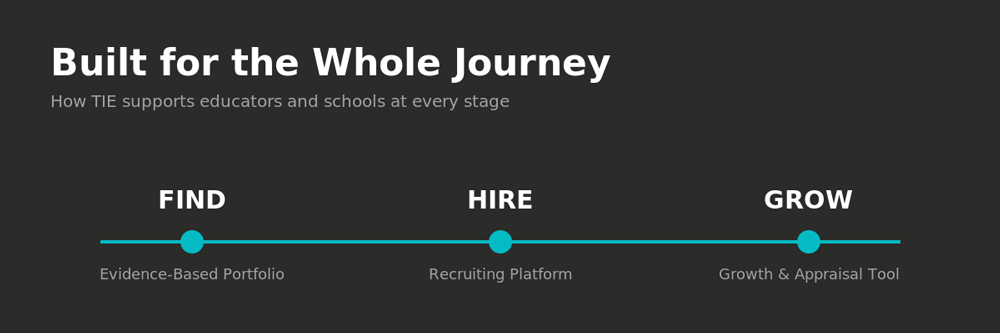
As the field of education advances, TIE changes with it, continuing to meet the needs of the international school community by focusing on three key areas:
Find: Help educators stand out by demonstrating their qualifications to find the right job.
Hire: Help schools identify and hire qualified educators using evidence-based practices.
Grow: Support educators' ongoing professional growth and development.
Each part stands on its own, but they are designed to work together as a single system with the Standards of Practice for International School Educators at the center. Together, they support education from job seeking to hiring, and through years of professional growth.
Helping Educators Stand Out
Our recent Getting the Job Survey highlighted a growing concern for talented educators. Being qualified is no longer enough to get an interview. One respondent put it simply, "I am highly qualified and yet sometimes cannot even get an interview. Getting out of 'the stack' is the biggest hurdle." Another described the same reality from a different angle, "It is a lot harder to get your name out of a slush pile when 250 teachers are applying online for the job you would like." Recruiting has shifted from a qualifications-based model to a positioning-based one, and that shift puts strong candidates at real risk of being overlooked before anyone has actually seen their work.
This is exactly the problem our Evidence-Based Portfolio was built to solve. Instead of asking educators to compress years of practice into a two-page resume, the portfolio lets teachers show their work: videos of instruction, student work samples, reflections, documents, and artifacts, all organized around the Standards of Practice for International School Educators. It is already structured for you, so building it does not mean starting from a blank page. And because it belongs to the educator, not to TIE, it travels wherever you need it, into another portal, onto a personal website, or directly into a hiring team's inbox with TIE’s shareable link.
We also know a portfolio alone will not solve a system-wide problem. That is why we partnered with the Principals' Training Center to build the International School Job Search: Get Hired course, which walks educators through the entire job search: updating a resume and cover letter, building an Evidence-Based Portfolio, preparing for interviews, and following up with schools in a way that keeps you visible rather than lost in the stack. As one respondent told us, "it's become easier to tell my story as virtual portfolios have become more common." We want every candidate to have that advantage, not just the ones who already know how to navigate a changing hiring landscape. To consider if the course might be helpful to you in your recruiting planning and journey, download this reflection guide about the international recruiting process and expectations.
Helping Schools Hire With More Than a Resume
Schools are asking for the same thing teachers are: a fuller picture before a decision gets made. Our recruiting platform was built with that in mind, and priced with our nonprofit mission in mind. Schools can post and hire an unlimited number of positions at one of the lowest price points in the industry, and school groups pay a group rate rather than a per-school rate, which matters enormously for organizations trying to staff several campuses on one budget.
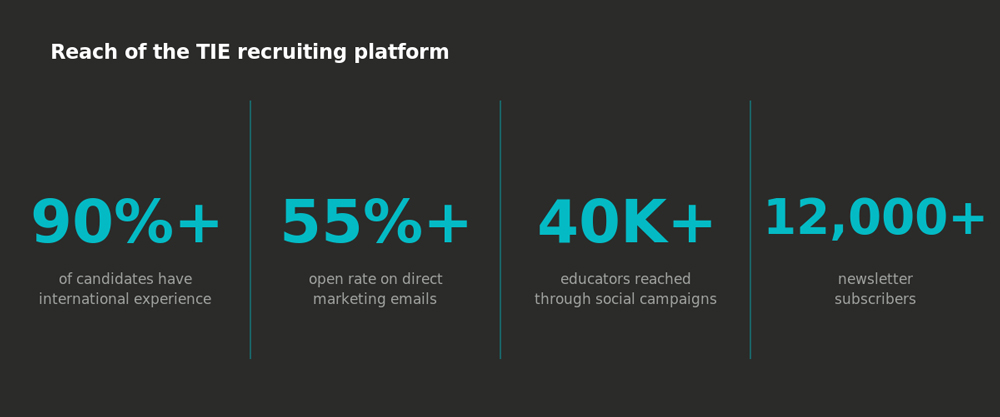
What schools get in return is more than a job board. Every posting reaches a global network of educators, more than 90 percent of whom already have international experience, through direct marketing emails with high open rates, social campaigns reaching more than 40,000 educators, and a newsletter list of over 12,000 subscribers. Candidates now arrive with Evidence-Based Portfolios attached to their applications, giving school leaders a much clearer sense of how someone actually teaches, leads, or counsels before that first interview is ever scheduled.
Building a better recruiting platform is only part of the solution. We also equip school leaders with a recruiting course because effective hiring depends on the systems and practices that support every decision.
Helping Schools Support Teachers in Their Growth
Connecting the right educators with the right schools is critical, but the relationship does not end once a position is filled. Supporting them once they arrive is where meaningful impact happens. Yet, too many growth and appraisal systems still ask teachers to perform for an observation rather than actually develop their practice. Paperwork gets completed. Boxes get checked. And weeks later, very little about classroom practice has changed.
Our Growth and Appraisal Tool (GAT) was built to shift away from that model. It is teacher-driven and evidence-based rather than compliance-driven. Educators set their own goals connected to the Standards of Practice, gather evidence of their impact on student learning over time, reflect on that evidence, and bring it into conversation with peers and school leaders. Feedback moves in more than one direction. A third-grade teacher and a high school physics teacher can be working on the same Standard and learning from each other’s practices. Leaders spend less time chasing one-time observations and more time in real conversations about growth, supported by implementation guides, evidence examples, and technical support so the process feels consistent and fair across a school. Schools do not need to overhaul their entire appraisal system on day one. They can start with one team, or even one Standard, and grow from there. You can learn more about GAT here.
One System, Not Three Products
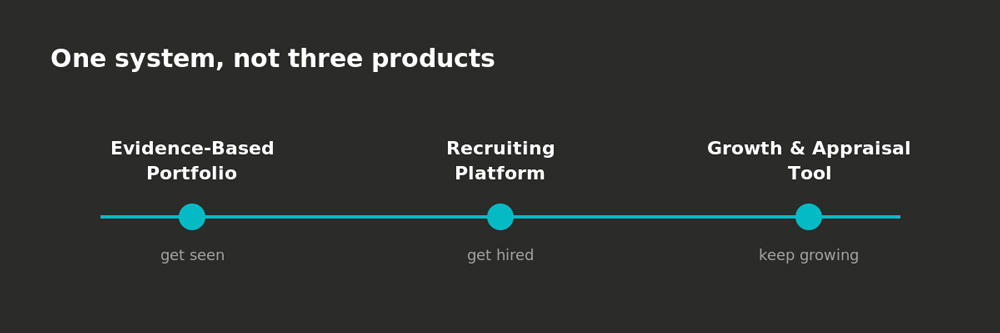
We see these three areas as one continuum, not separate services, because finding, hiring, and growing educators are interconnected parts of the same process. Teachers find the right opportunities when schools can see beyond a resume. Schools build stronger teams when they have better information at the point of hire. And once educators join a community, a commitment to evidence-based growth and appraisal will shape how they are supported over time.
That is the purpose behind everything TIE builds. Every initiative begins with a simple question: How does this ultimately improve the experience of students in the classroom? We would love for you to explore what that looks like for your school or your career at tieonline.com.
Stacy Stephens is the Director of TIE and has more than 25 years in international education as both a teacher and a school leader.