


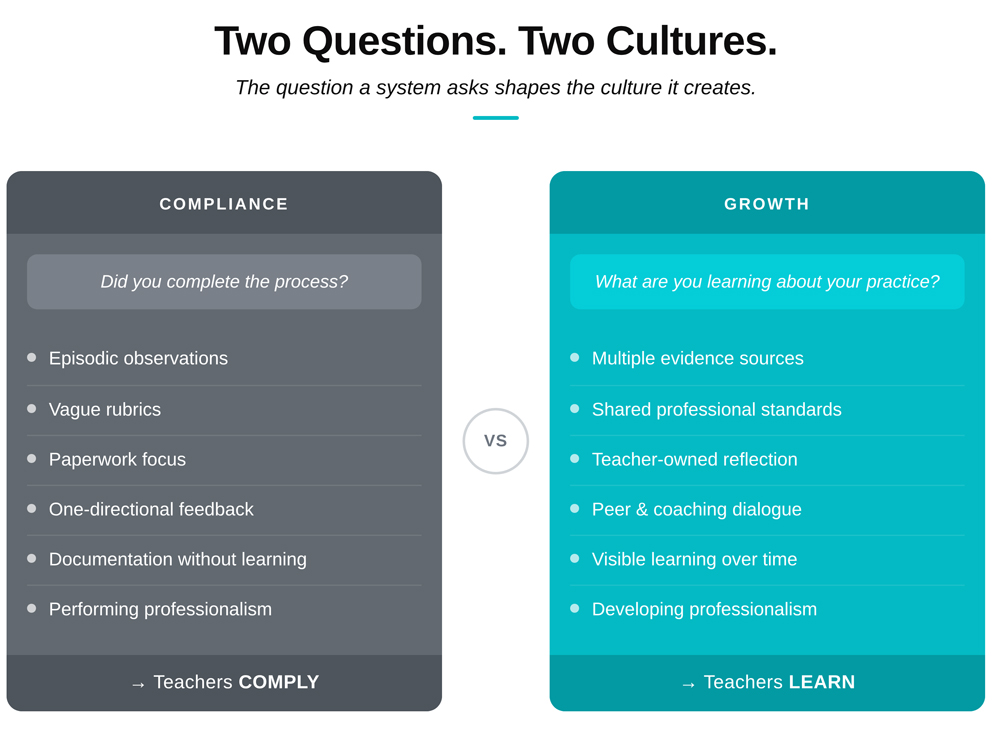
This is where design becomes critical. Too many growth and appraisal systems still ask educators to perform professionalism rather than develop it. They rely heavily on episodic observations, isolated conferences, vague rubrics, and paperwork that gets completed but does not really move practice. They may create documentation, but they do not always create learning and growth. And if the process does not lead to better teaching, then it is not doing the job schools need it to do. We must ask ourselves about our systems; are they about cultivating commitment or expecting compliance?
TIE’s Growth & Appraisal Tool (GAT) was built to address that problem directly. It is an evidence-based, teacher-led system designed around the Standards of Practice for International School Educators. Its purpose is not to digitize old compliance habits. Its purpose is to help schools create a more credible, more developmental, and a more culture-building approach to growth and appraisal.
The power of a system like this starts with shared language.
One of the biggest challenges in growth and appraisal is that schools often say they care about good teaching, but they do not have a clear, shared way to talk about what that means. That creates inconsistency, confusion, and too much dependence on individual interpretation. Standards are essential because they give schools common language for practice. They help educators and leaders talk about teaching with more precision, more coherence, and more fairness.
This shapes both research and culture. When standards are the anchor, the conversation can move beyond personal preference or isolated opinion. It becomes much easier to ask: What does strong practice look like here? How do we know? What evidence supports that? What might growth look like next?
GAT supports this by organizing growth around professional standards rather than disconnected events. Teachers are not just being observed. They are engaging with a clear framework that helps them reflect on practice, identify areas of strength, and set goals with greater focus and purpose.
Standards-based architecture is important, but standards alone are not enough.
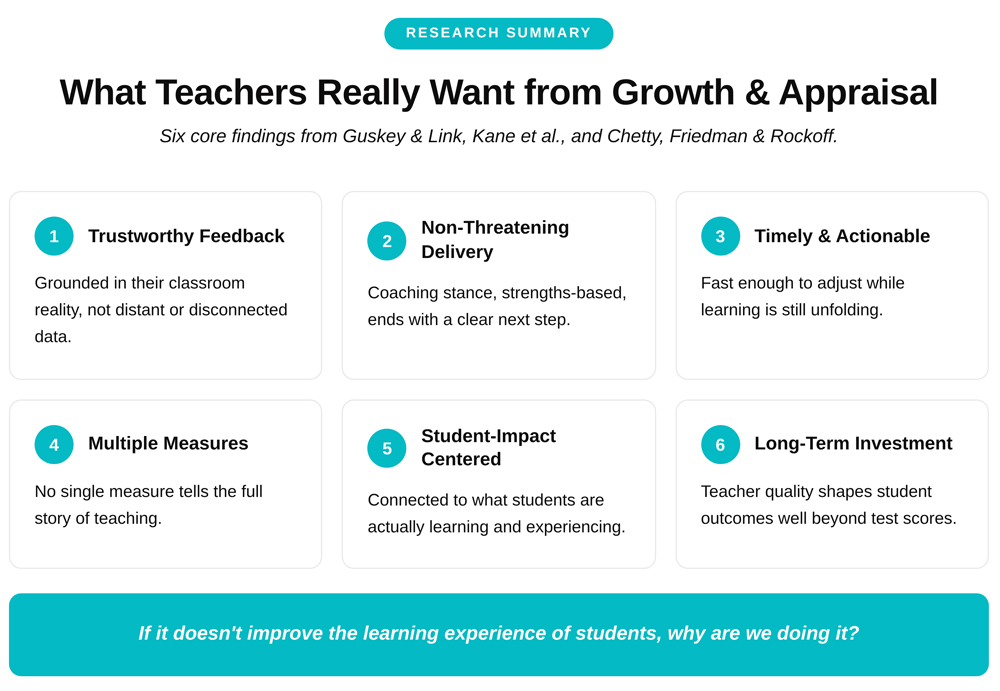
The research from Kane and colleagues reminds us that no single measure tells the full story of teaching. Observation matters, but observation alone is too thin. Student surveys matter, but they are only one slice. Artifacts matter, but only when they are connected to thoughtful analysis. A stronger system uses multiple sources of evidence because teaching is complex and any fair appraisal process needs to respect that complexity.
This is one of the most important design strengths of GAT.
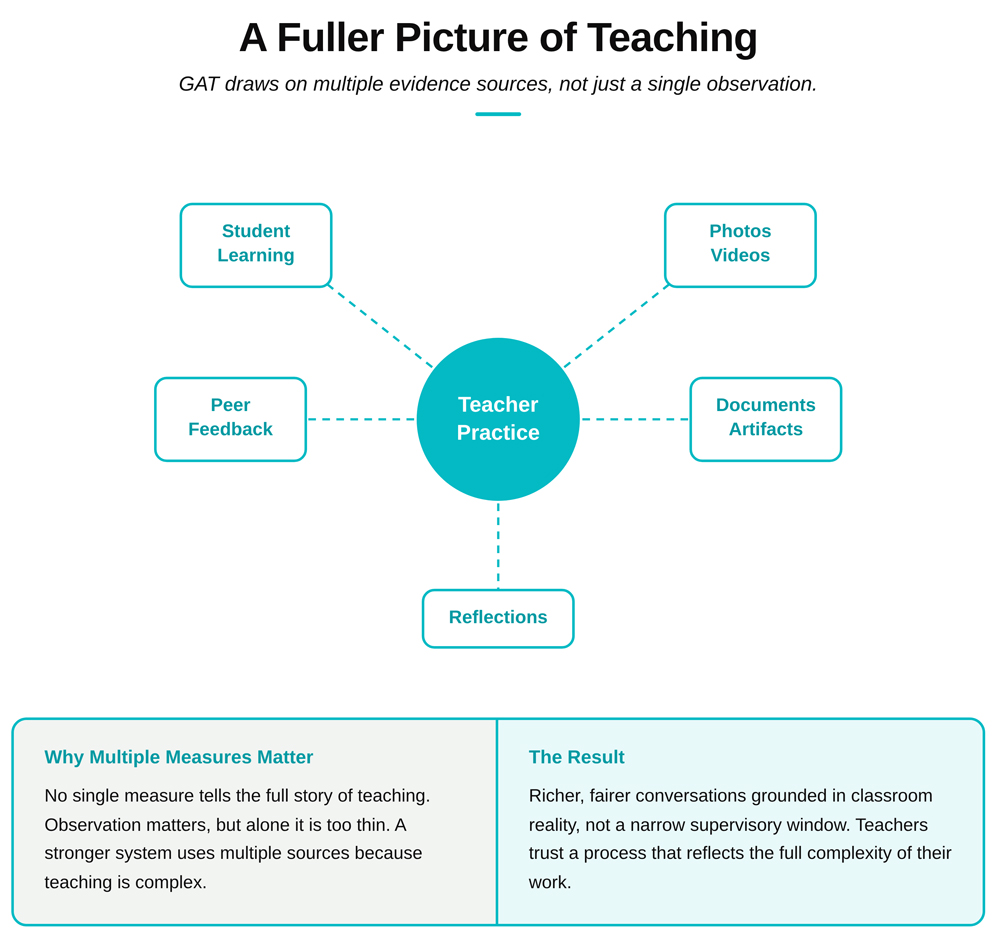
Rather than over-weighting one-time supervisor observations, the tool allows educators to document their professional practice through multiple forms of evidence, including documents, photos, videos, linked assets, reflections, and artifacts of work. This is important because it reduces subjectivity and creates a fuller picture of teaching over time. Instead of asking leaders to make high-stakes judgments from a narrow window, the system allows growth conversations to be grounded in richer and more varied evidence.
And that shift helps build trust.
Teachers are far more likely to invest in a process when they believe it reflects the reality of their work. That is one reason classroom-embedded evidence is so powerful. It feels more credible because it is connected to actual students, actual planning, actual teaching moves, and actual impact. Credibility is the currency of improvement. When teachers do not trust the process, they comply with it. When they do trust it, they learn from it.
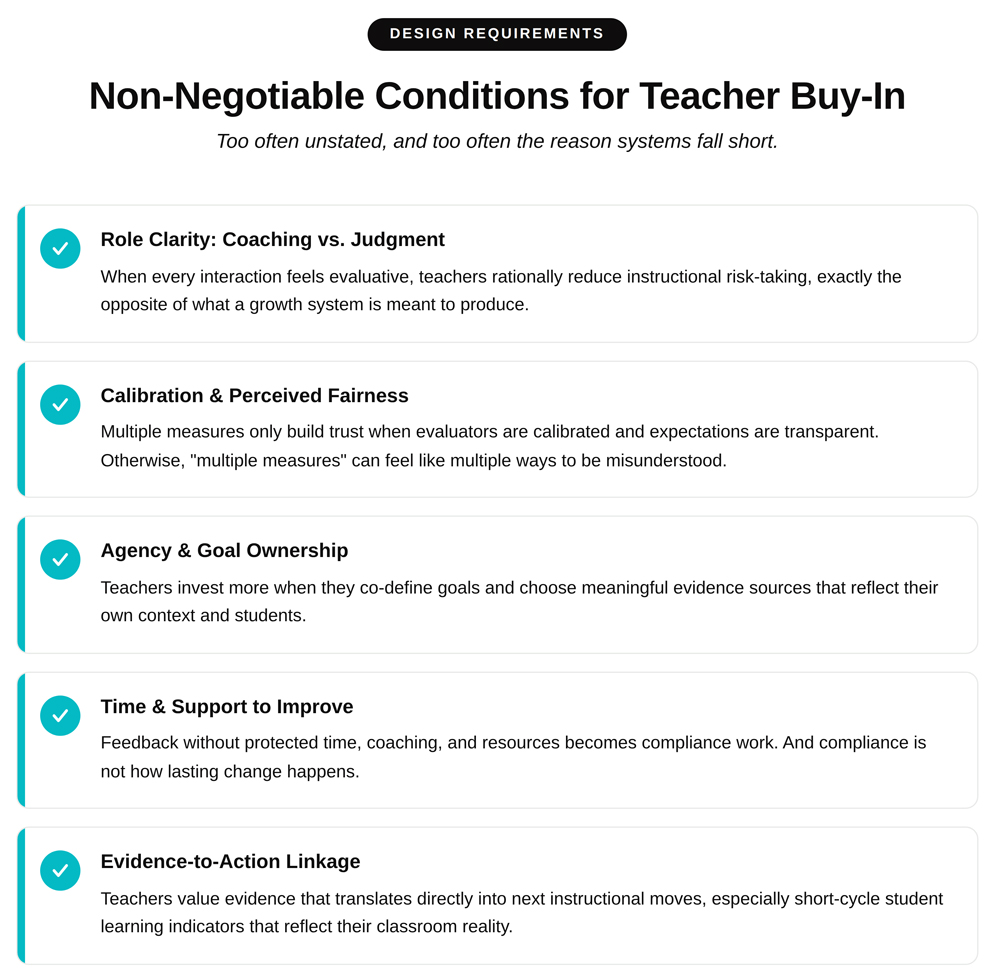
Teachers do not become more skillful because someone tells them what box they are in. They become more skillful when they have opportunities to reflect honestly on their practice, identify meaningful goals, gather evidence related to those goals, and discuss next steps with someone who can support growth. GAT is built to support exactly that kind of ownership. GAT puts educators in control, starting with personal reflection on the standards, goal setting, and collaboration with peers and/or leadership to give feedback on evidence from their practice and of student learning.
This is a significant shift away from compliance. Compliance asks, “Did you complete the process?” Growth asks, “What are you learning about your practice, and what evidence shows that learning?” That difference is not cosmetic. It changes the emotional experience of appraisal. It changes the quality of the conversation. It changes whether teachers see the process as something being done to them or something they can use for their own development.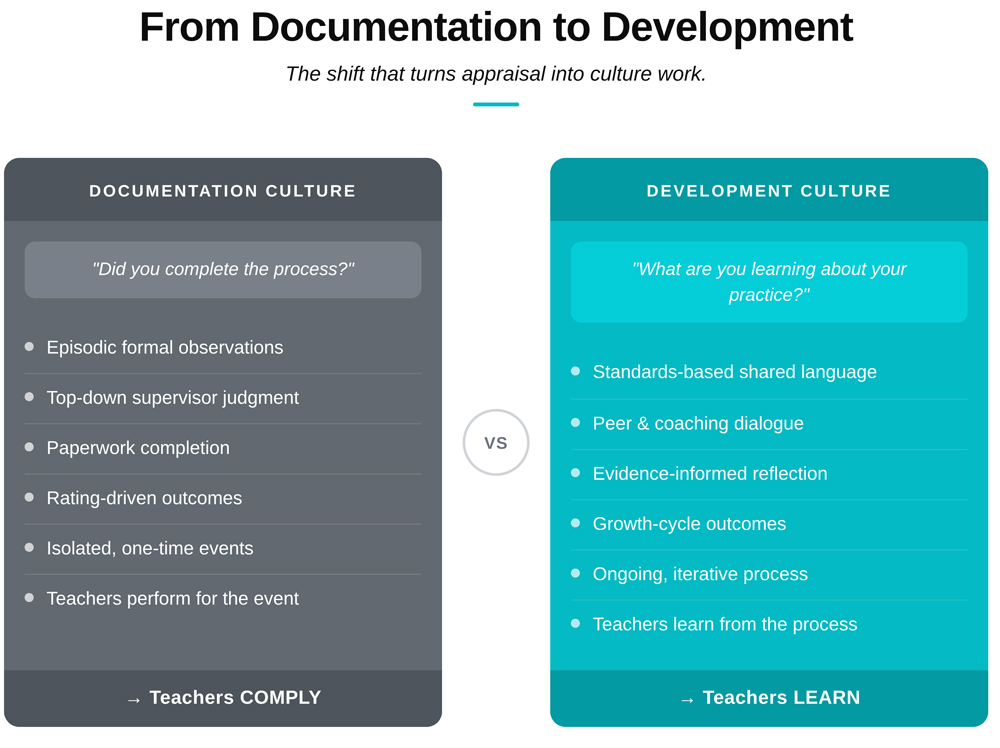
That is also why the tone and structure of feedback are so crucial.
The first article in this series made clear that feedback is only useful when it is timely, actionable, and delivered in ways that do not trigger threats. Teachers need feedback that is specific enough to act on, connected enough to student learning to feel worthwhile, and human enough to preserve dignity. This is not a “soft” feature of a system. It is one of the most important design choices a school can make.
GAT supports that work by treating appraisal as dialogue rather than judgment. GAT has been designed to facilitate meaningful conversations, two-way feedback, mutual understanding, and collaborative improvement. This helps schools move away from appraisal as an isolated event and toward a more continuous coaching model.
And that leads to one of the strongest culture-building features of all: peer connection.
If all professional feedback moves in one direction, from supervisor to teacher, schools reinforce hierarchy more than they reinforce learning. But when peer reflection, peer feedback, and collegial dialogue are built into the system, something important begins to shift. Teachers start to see growth as shared work. They become more willing to talk about practice, share evidence, test ideas, and learn from each other. That is when schools begin to normalize a professional culture where collaboration is expected, not optional.
Imagine a system where teachers reflect on the standards, set their goals, and then peers can be connected to each other through shared goals. A Grade 3 teacher and a high school physics teacher could share the same goal and have collegial discussion around practice and growth in that goal. This allows for connecting across sections of the school, content level, and expertise.
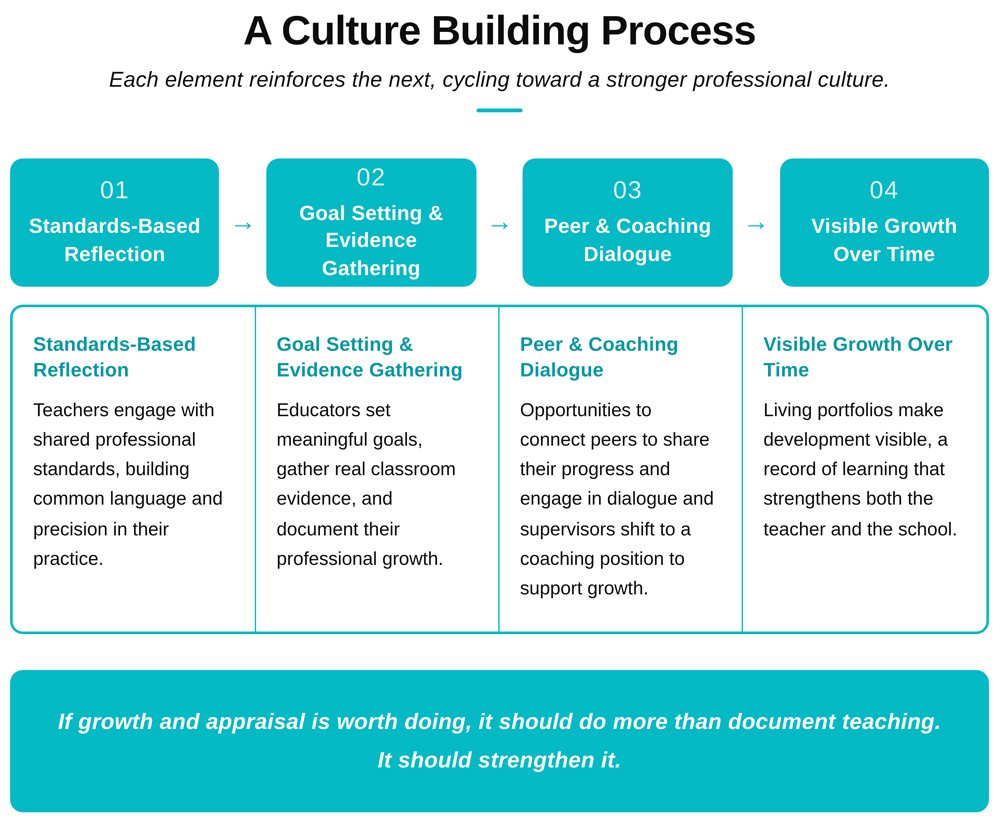
GAT is designed to be a peer-to-peer process that supports collaborative growth, not just supervisory review. A healthy adult culture is built through repeated experiences of shared learning. When peer learning is part of the system design, collaboration becomes more than a value statement. It becomes part of how the school actually works.
The implementation supports are just as critical.
A good idea is not enough. Schools need structure. Leaders need guidance. Teachers need clarity. One reason many appraisal systems fall flat is not because the vision is wrong, but because there is too little support for implementation. Expectations are unclear. Evidence quality is inconsistent. Feedback varies dramatically from one leader to another. The result is a process that feels uneven and difficult to trust.
GAT addresses this by including implementation guides, feedback guides, examples of evidence, guidance for evaluating evidence, and technical support. These kinds of support matter because they help schools build consistency, not just aspiration. They help make the process more fair, more usable, and more sustainable over time.
Just as important, the system creates an archive of professional growth.
This is one of the most overlooked opportunities in appraisal design. Too often, the documentation teachers create disappears into folders no one returns to or sits in files that have no real life after the conference is over. But meaningful evidence of growth should be visible across time. It should help teachers tell the story of their development. It should help leaders identify patterns in strengths and needs. It should help schools see not only who an educator is today, but how that person is growing.
GAT’s living portfolio and archival system make that possible by keeping standards-aligned artifacts, reflections, goals, and feedback in one place over time. This supports individual growth and strengthens school culture. It makes professional learning visible. It gives schools something more meaningful than completed paperwork. It gives them a record of learning.
And that is where the research and the culture argument come together.
If schools want timely, trusted, evidence-based, non-threatening growth processes, they have to build systems that support those conditions.
If schools want cultures where reflection is normal, evidence matters, collaboration is expected, and improvement is visible, they have to build systems that normalize those behaviors.
If schools want growth and appraisal to contribute to better teaching and stronger student learning, they have to stop treating appraisal as a compliance event and start treating it as part of how adults learn together.
That is the real opportunity in TIE’s Growth & Appraisal Tool.
It offers schools a way to align standards, evidence, reflection, coaching, peer learning, and documentation into one coherent system. It helps move growth and appraisal away from one-time judgments and toward an ongoing professional process. It creates the conditions for stronger conversations, more credible evidence, greater teacher ownership, and more visible growth. In other words, it supports exactly the kinds of practices the research calls for and the kinds of professional culture schools say they want to build.
The goal is not to make appraisal feel nicer. The goal is to make it more useful.
It must be useful enough that teachers can learn from it; useful enough that leaders can support growth with more clarity and less subjectivity; useful enough that the school can see patterns, strengthen culture, and keep improving over time; useful enough that the process helps create better teaching for students.
That is the standard we should hold. Because if growth and appraisal is worth doing, it should do more than document teaching. It should strengthen it and have an impact on student learning.
Read more on Growth and Appraisal systems: Are Our Growth and Appraisal Systems Meeting Our Needs? and Growth and Appraisal as Culture Work.
References
Chetty, R., Friedman, J. N., & Rockoff, J. E. (2014). Measuring the impacts of teachers II: Teacher value-added and student outcomes in adulthood. American Economic Review, 104(9), 2633–2679.
Guskey, T. R., & Link, L. J. (2022). What teachers really want when it comes to feedback. Educational Leadership, 79(7), 42–48.
Kane, T. J., McCaffrey, D. F., Miller, T., & Staiger, D. O. (2013). Have we identified effective teachers? Validating measures of effective teaching using random assignment. Bill & Melinda Gates Foundation.
Stacy Stephens is the Director of The International Educator (TIE) and has more than 25 years in international education as both a teacher and a school leader. In her work with TIE, she focuses on strengthening recruitment practices and helping educators show their impact through Evidence-Based Portfolios aligned to the Standards of Practice for International Schools. She also leads the development of TIE’s Growth and Appraisal Tool, which supports schools in building clearer, more supportive systems for feedback, development, and professional growth, always with a focus on better outcomes for students and healthier school cultures.