

As part of our article series on the global shift from Service as Action to Community Engagement in International Baccalaureate (IB) schools, we focus here on explaining the final component of the four new community engagement learning objectives: Students will take principled action (IBO.org).
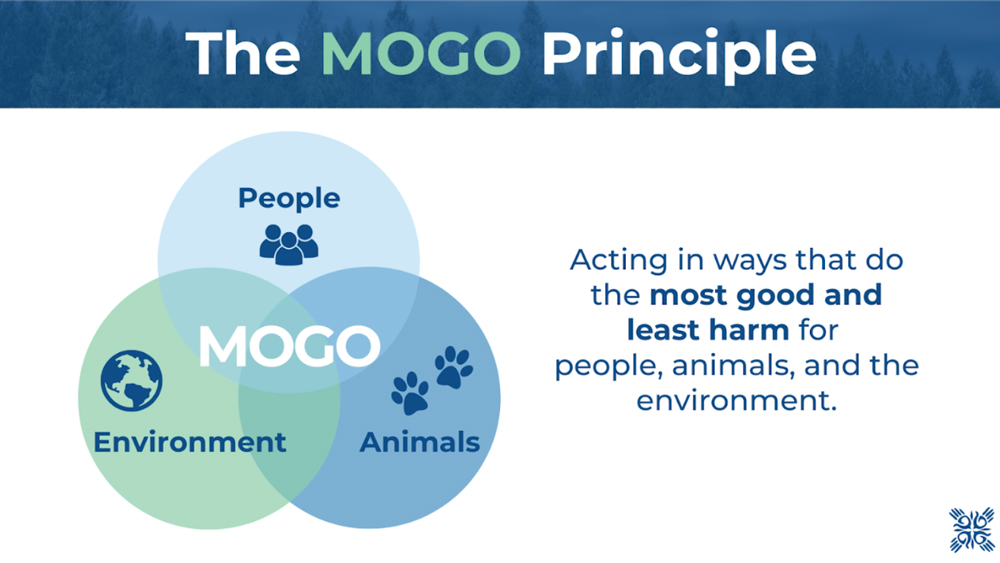
As we wrote in a previous article in this series, "Principled" is one of the terms in the IB Learner Profile. Being principled means “acting with integrity and honesty, a strong sense of fairness and justice, and taking responsibility for one's actions and their consequences” (owis.org). Students who take principled action promote fairness and justice for people, animals, and the environment. They strive to act in ways that do the “Most Good and Least Harm.” They go beyond good intentions and make deliberate commitments to act ethically, responsibly, and with awareness. They engage in deep research, intentional decision-making, and reflection, followed by honest evaluation of an action’s impact.
This higher standard of principled action was set forth and codified by the International Committee of the Red Cross in 1965 in its Seven Fundamental Principles. These principles are rooted in the notion that ethics and morality must guide decision-making when providing aid to communities in need. Those offering assistance should act impartially, without discrimination, and with awareness of their own biases and prejudices. Principled action is, at its core, about respect and connection. It “enables trust and dialogue - with communities, with authorities, and with all sides.” And, if implemented correctly, it becomes not abstract ideals, but “the tools that enable us to deliver help to those who need us most” (ICRC).
Principled action is not about checking a box, completing a one-time act of service, or helping in ways that, even unintentionally, cause harm or reinforce stereotypes. Instead, it embraces asset-based thinking, recognizing and valuing the strengths already present within a community. Principled action values how you do something, not how you feel about doing something. It strives for sustainable, fair solutions for the greater good that endure beyond a single action.
What Does Principled Action Look Like in Practice?
We interviewed Alice Whitehead, a former teacher, service coordinator, alumnus of the United World College (UWC) of South East Asia, and founder of Orenda Learning. This impact-driven social enterprise supports youth in engaging with their communities through active citizenship, helping them dive deeper into what principled action means to them. Alice is committed to the UWC mission of education for peace and a sustainable future and led the development of Be the Change, a program designed to guide students to become agents of change in their local and global communities.
Alice told us:
“What sets [principled action] apart from tokenistic, one-off actions and initiatives is that it is carefully considered, embedded in a thorough inquiry-based cycle of learning, takes place over an extended period of time, includes consultation with community partners and is grounded in critical reflection.”
When asked how educators can help students move from empathy to ethical action, rather than short-term or performative service activities, Alice shared many tips and explained that teachers should support students to:
Principled Action at KIS Bangkok: Beyond Fundraising for the Fun of It
While many of our entrepreneurially-minded students enjoy hosting bake sales, these efforts can sometimes feel disconnected from the very communities they aim to serve. By prioritizing dialogue, systems thinking, and reflection to build relationships, we are shifting away from one-off service activities. Our goal is to move beyond doing things for a community and instead focus on building a future with them.
Students at KIS Bangkok are refocusing their initiatives toward more intentional, principled action. What began for some students as a way to bolster university applications has evolved into something far more meaningful, a journey rooted in research, dialogue, and a return to the heart.
In August 2025, two 9th-grade students were excited to start a new club focused on the protection and conservation of wild animals in Thailand. At first, their focus centered on raising money for a local non-governmental organization. Later, with support and guidance from the Service Learning Stages and their teacher advisor, they broke down the process and took a more strategic approach to action.
The students formed a group called Beyond the Cage and began investigating wild animals in Thailand and the work of various organizations in the country that support and educate citizens, expats, and tourists on how to engage ethically with animals. They took an assets-based approach and asked questions such as:
From there, the students connected with local organizations such as Love Wildlife Foundation and Wildlife Friends Foundation Thailand to discuss how they might support them and to explore the practical strengths the students might bring to the partnership. They spent time researching the existing systems, engaging in dialogue with community members, and brainstorming ideas for principled action.
Prai, one of the group’s founders, shared more about the process they undertook to take action.
“The project began as a small campaign to raise awareness about unethical animal tourism before winter break, so parents would be more informed about the places they were taking their children. Our initial planning focused mainly on posters, but we came to a consensus that many awareness posters were often overlooked because they did not stand out or engage parents enough. I then came to the idea of creating a series of stories related to our issue that young children could pick up and talk to their parents about, because we realised that parents often care about things much more deeply when their children are engaged in them.”
The students ultimately wrote a book series called Where the Wild Things Weep, with each story focusing on different animals in Thailand, teaching readers the actions they can take to make ethical choices about animal tourism. These stories for all ages helped teach readers that being ethical tourists means not engaging in activities such as riding or bathing elephants or attending monkey shows.
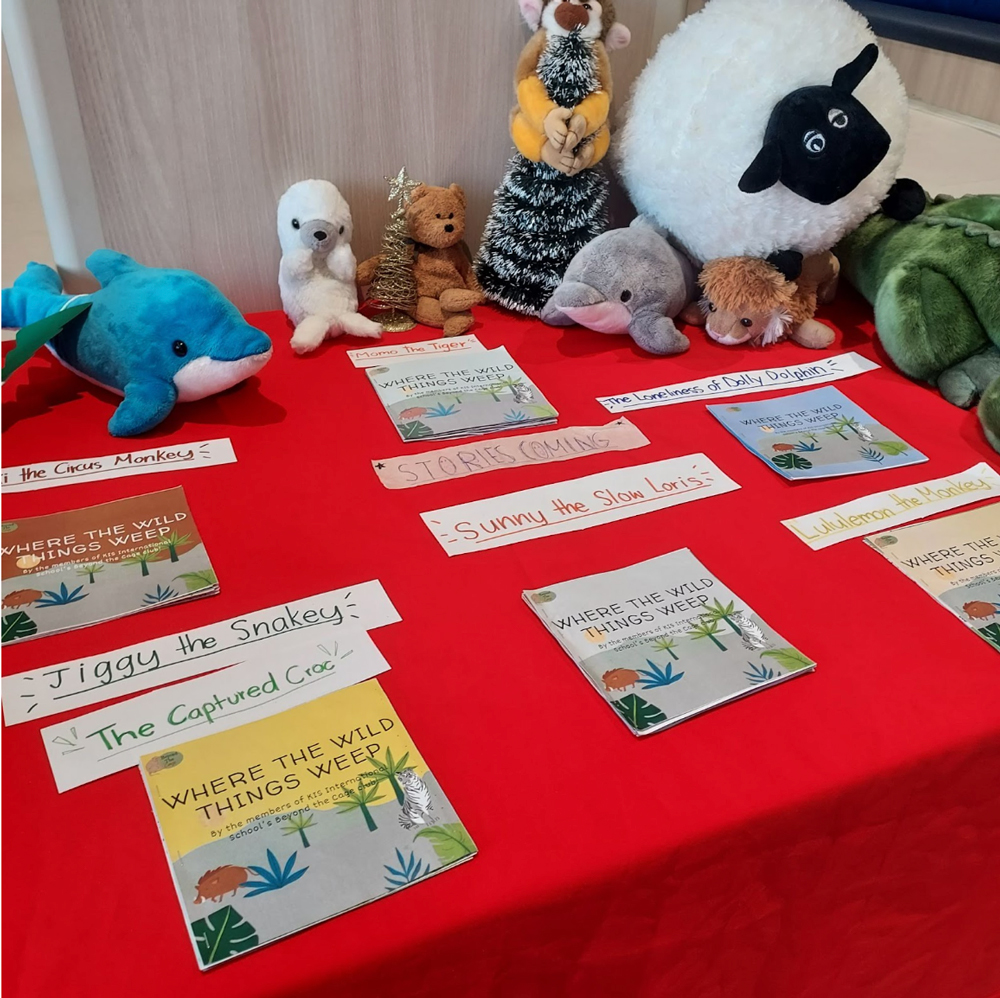
Beyond the Cage’s book display. (Photo source: Dr. Por Inthasasema)
“Everyone was amazing,” Prai continued. “They helped research and then write these stories, put together pre-made illustrations in Canva, and made them child-friendly. These rough first drafts were printed out, glued together, and put on display at a booth stationed in the entrance to the school. After winter break, I received advice from a parent that it would be even better if we could permanently put these stories in the PYP library so they were more accessible to children. That was how the publication process started.”
The students are now publishing the final versions of their books for placement in the primary school library with the hopes that their words will inspire more ethical decision-making by families. They also plan to continue their club into the future and to strengthen their existing partnerships with the local NGOs.
Be the Change
Principled action is how learning turns into meaningful impact. Learning often starts as a solitary, internal process. We read, we listen, we analyze. In contrast, principled action occurs when our knowledge is put into practice in the real world, moving a student from being a consumer of information to an agent of change. “Action” on its own can be impulsive or singular (like the aforementioned bake sales), but the word principled ensures that the impact isn’t just loud, but ethical and sustainable. When students apply their learning through a principled lens, they stop seeing the community as a project and start seeing it as a partner they are working with, not for.
Imagine a world where all of our students grow up thinking about fairness as they make decisions and take action.
Read more about Exploring the Shift From Service Learning to Community Engagement , The Four Components of Community Engagement, Systems Thinking Is Necessary for Positive Change, Building a Generation of Peace Brokers Through Dialogue, and Don’t Skip the Reflection!
Kathryn T. Berkman currently works at Munich International School. She began her journey as a teacher after graduating from the University of San Francisco, focusing on social justice and multiple intelligences in math education. She has had the opportunity to teach middle schoolers across three countries over the last 13 years. Kathryn is keen to engage in opening the Solutionary lens and framework for educators in different contexts.
LinkedIn: Kathryn T Berkman
Meredith Robinson is the Middle Years Programme community engagement coordinator and English Language Acquisition teacher at KIS Bangkok. Her career overseas has taken her to multiple countries where she has worked across primary and secondary school in roles often involving service learning and action, sustainability, and Diversity, Equity, Inclusion, and Belonging (DEIJB).
LinkedIn: Meredith Robinson
Megan Vosk teaches the Middle Years Programme, Individuals and Societies, and English Language Acquisition at Vientiane International School. She is also the community engagement coordinator there. Additionally, Megan is a member of the Association for Middle-Level Education (AMLE) Board of Trustees.
LinkedIn: Megan Vosk