
According to the IBO, the old Service as Action model “focuses solely on service—both direct and indirect—as a mode of contribution to a community.” In the new Community Engagement model, however, “Students can respond to their unique contexts through dialogue, relationship-building and reflection and reflexivity” (IBO.org).
On a practical level, we recognize that, to fulfill the mission of Community Engagement, we must focus on understanding and teaching the four learning objectives of Community Engagement. According to the IBO, these are:
Explore systems and develop awareness of their roles within these.
Foster dialogue and build relationships with others.
Engage in reflective and reflexive practices.
Develop and/or conduct principled action.
In this article, we seek to unpack what each of these learning objectives means, discuss what it might look like in practice to teach into these objectives, set a bar for what we aim to uphold as educators world-wide in teaching students through curricular activities about how to make a positive impact in their community, and to advocate for training in these four areas to support all schools. We also include some quotes from global leaders in the field and ideas to inspire you.
Systems Thinking
The first learning objective is Systems Thinking. Exploring systems and understanding their roles is important for grasping the complexities of social, environmental, and economic interactions. Systems thinking tools help us manage these complexities and have been used by well-known figures like Alan AtKisson, who created the Sustainability Compass and is a leader in sustainability education.
The Sustainability Compass shows how nature, economy, society, and wellbeing are connected and how this connection helps create a healthy and fair society. In the classroom, the Compass helps students realize that if we focus solely on economic growth, we might ignore important areas like nature, community, or personal wellbeing.
For example, students in Megan’s Grade 9 Individuals & Societies class watched a documentary on sand mining in Cambodia called Lost Worlds as part of a unit on “Change and Conservation in Environments”. They then used the Sustainability Compass to analyze the impact of the sand mining on the people of the region. You can see the lesson plan and discussion questions here.
We talked with Nicole Swedlow, the Executive Director of Compass Education, to get her thoughts on systems thinking. She explained its importance in understanding sustainability:
“We understand sustainability to be much more than only “eco” or “green” - going beyond Nature to include the Economy, Society, and individual Wellbeing. This framing places the student (or any of us) directly in relationship with the natural world and highlights how our well-being is interconnected with that of the planet. It also supports an understanding of the … conditions for sustainable outcomes, which contributes to a more holistic understanding of our role and responsibility as citizens.”
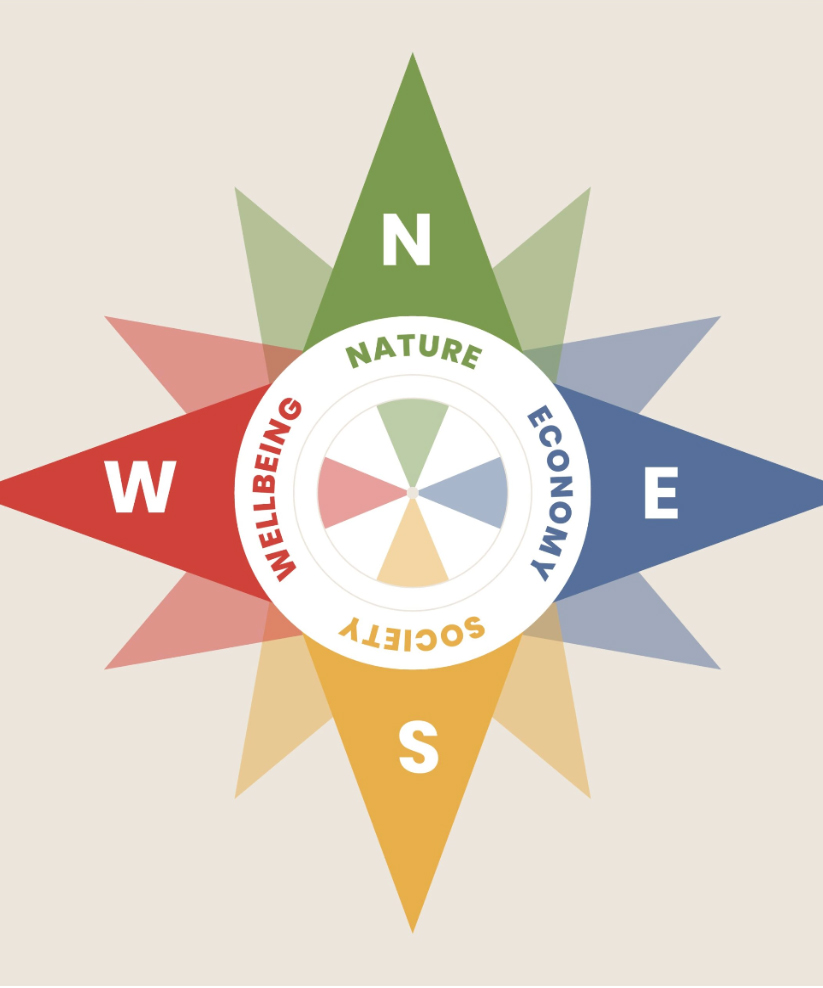
The Sustainability Compass. (Photo course: Compass Education)
Nicole also shared a blog post written by Alan AtKisson about the history of these tools for those interested in learning more about them.
2. Dialogue
The second learning objective is Dialogue. Peace is only possible through dialogue. Our humanity requires students who can reach a shared understanding with individuals from different experiences and viewpoints. These skills can be explicitly taught across all subjects and grade levels.
One effective way to teach students about multiple perspectives is by using Thinking Routines, like those from Harvard’s Project Zero. A particularly powerful routine is the Circle of Viewpoints, which encourages students to consider how people from different groups might interpret the same event. For example, Megan’s Grade 9 Individuals & Societies students used this routine to discuss the current conflict in Israel and Palestine, exploring why a ceasefire and peace negotiations have been so challenging.
At Kathryn’s school, the Grade 7 students also studied the concept of peace. The Yin-Yang symbol was the starting place to discuss why peace isn't always achieved – the safety of the nation vs the safety of all, violence to protect vs peace. Next, each student chose which SDG 16 Indicator was most important to them. They then used a thought-provoking picture (see below) to spark a dialogue about peace in society. Kathryn also taught students to distinguish between dialogue and debate, as the former focused on reaching a common understanding. The students even looked into how the term "dialogue" comes from the Greek "dia," meaning “through,” and "logos," meaning “words or meaning.” (usip.org).

Students used the image, Dialogs?, to spark dialogue about peace in society. (Photo source: Juris Dimiters, 1947; Zuzeum)
In the absence of dialogue, there is conflict. This is the reason for dialogue. Kathryn’s students also did training activities where they had to lead dialogues about pictures in the middle school lobby. They later applied the Solutionary Framework as a road map for taking action. One group identified the inadequate mental-health resources offered to refugees in Germany as a potential problem that leads to more violence. Students researched statistics and used the Sustainability Iceberg to map possible solutions. The students innovated and decided to write a letter to the German chancellor, signed by over 30 students, advocating for more support for victims of violence as people move to Germany.
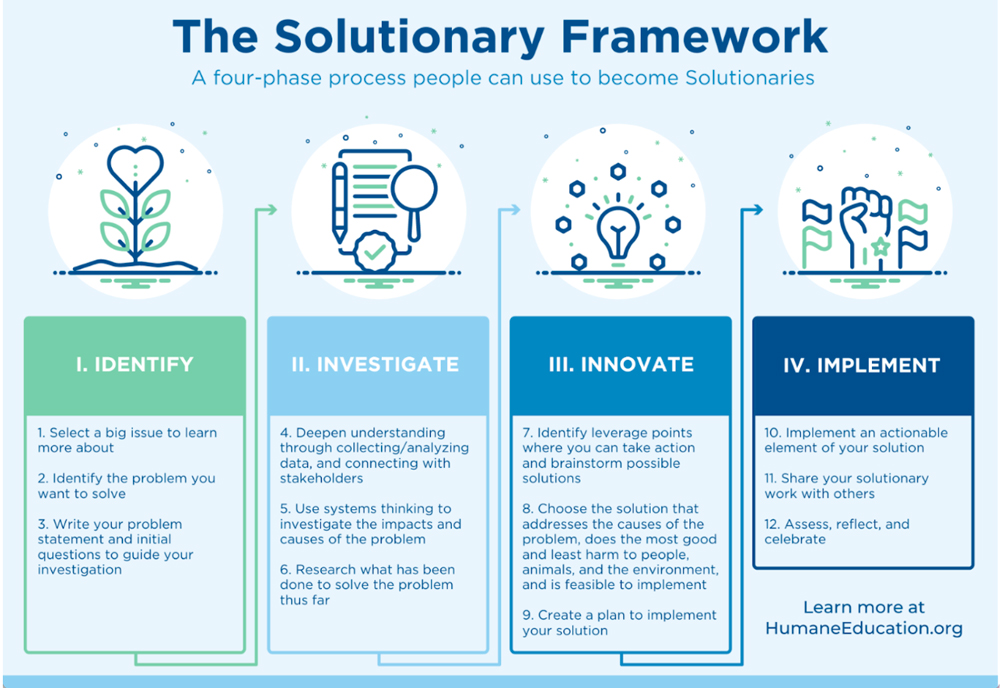
The Solutionary Framework. (Photo source: Institute for Humane Education)
3. Reflective and Reflexive Practices
The third learning objective is Reflective and Reflexive Practices. This means cultivating the ability to analyze past experiences for insight while also being aware of how personal beliefs and contexts influence current actions and decisions. According to Cathy Berger Kaye, the author of the book The Complete Guide to Service Learning, reflection is a step teachers often skip because they are in a rush, but it is very important. She said:
“Pausing for reflection is a celebration of our humanity. We acknowledge our capacity for being aware of self and others, and grow our understanding of reciprocity in the dynamic we call "service learning."
As Cathy highlights in the quote above, students need time, a pause, to recognize how service is reciprocal and to readjust the course if needed to be more mutually beneficial. Cathy also talked about the importance of reflexive practices.
“The idea of a reflexive practice is a concept I have used without the term. Looking within to learn more about our values, perspective, and actions is always a part of reflection.”
We can teach students to engage in reflective and reflexive practices by asking them to look at issues from multiple perspectives. The Compass Points Thinking Routine, also from Harvard’s Project Zero, might be helpful for this.
4. Principled Action
Principled is one of the terms in the IB Learner Profile. Being principled means “acting with integrity and honesty, a strong sense of fairness and justice, and taking responsibility for one's actions and their consequences” (owis.org). Students are encouraged through their actions to promote fairness and justice for people, animals, and the environment.
When reflecting on the impact of Jane Goodall’s work, Zoe Weil, founder of the Institute for Humane Education, wrote about how Jane always acted in a principled manner. She said:
“She [Jane] realized with such profound resolve that she needed to try to protect chimps and other animals, vulnerable human communities, and the ecosystems that sustain us all, and the best way to do this was through education.”
Below are the reflection questions students will use this year at Munich International School to ensure they are taking principled action and meeting the four learning outcomes when it comes to Community Engagement.
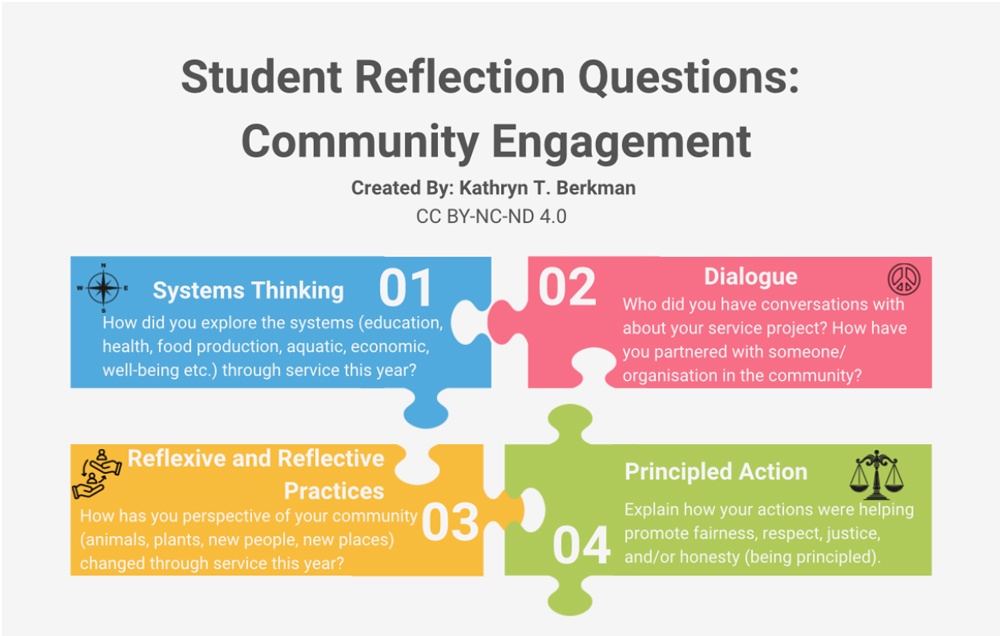
Student Reflection Questions: Community Engagement Outcomes. (Photo source: Kathryn T. Berkman)
Conclusion:
The transition from “Service Learning” to “Community Engagement” is multifaceted and will take time. However, it will ultimately benefit our students, helping them become more innovative thinkers and giving them opportunities to make positive changes that address the root causes of problems in their communities. Fostering resilience in young minds requires a diversity of skills rather than a focus in just one area. In a blog post for Psychology Today, author T. Alexander Puutio, stated, “Lateral thinkers, polymaths, and those comfortable moving across domains fare better in uncertain environments.”
Teachers on the ground must advocate for individualized support during the shift to Community Engagement. Every school has unique strengths and needs, making it essential to start with a community inventory within a 10 km radius to assess current strengths and weaknesses in Community Engagement and to create a plan for moving forward strategically.
Nicole Swedlow remarked:
“I am very glad to see the IB evolving to embrace community engagement as a way of thinking about student participation. The bigger question will be how this shift changes the approaches that many schools currently use. I would love to see a move away from a service/impact/project model toward a co-created learning experience where outcomes are measured in competency development and individual reflection, rather than in photo opportunities and surface-level participation.”
We challenge teachers to implement these ideas in their lesson planning. How will students feel confident to make a positive impact in the world if they only have a few superficial opportunities over the course of their primary and secondary education to put these learning outcomes into practice? Additionally, since the IB does not offer courses on systems thinking, we encourage teachers to look for training opportunities from organizations like Compass Education. We also encourage the IB to form partnerships with training organizations such as Compass Education.
To the International Baccalaureate and other policymakers, we would appreciate your insights on our interpretation of Community Engagement and the four learning objectives.
To all educators, parents, and administrators: we challenge you—yes, you reading this—to increase experiential learning in your schools, aiming to cultivate resilient, creative problem-solvers for the future.
Suggested Resources:
Kathryn created the following graphic to help the teachers at her school plan for community engagement within their curriculum/units of study: https://indd.adobe.com/view/f0284e29-731b-4f0c-8539-17c8d3b253ff
Megan and the Middle Years Programme/Diploma Program coordinator at her school, Elizabeth England, co-presented to teachers about ways to think about community engagement when planning for experiential learning journeys (presentation here and reflection form here).
Here is the link to the IBO article on the shift from Service Learning to Community Engagement.
Kathryn T. Berkman currently works at Munich International School. She began her journey as a teacher after graduating from the University of San Francisco, focusing on social justice and multiple intelligences in math education. She has had the opportunity to teach middle schoolers across three countries over the last 13 years. Kathryn is keen to engage in opening the Solutionary lens and framework for educators in different contexts.
LinkedIn: Kathryn T Berkman
Meredith Robinson is the Middle Years Programme community engagement coordinator and English Language Acquisition teacher at KIS Bangkok. Her career overseas has taken her to multiple countries where she has worked across primary and secondary school in roles often involving service learning and action, sustainability, and Diversity, Equity, Inclusion, and Belonging (DEIJB).
LinkedIn: Meredith Robinson
Megan Vosk teaches the Middle Years Programme, Individuals and Societies, and English Language Acquisition at Vientiane International School. She is also the community engagement coordinator there. Additionally, Megan is a member of the Association for Middle-Level Education (AMLE) Board of Trustees.
LinkedIn: Megan Vosk