

At Windhoek International School (WIS), our experience suggests a different path, a middle way. We have learned that inquiry is most powerful when it is deliberately fuelled by explicit instruction in foundational knowledge, language, and skills. This article describes how WIS recalibrated its shared understanding of high quality learning to strike a sustainable balance—strengthening rather than diluting our inquiry-driven mission.
A Strong Tradition of Inquiry-Based Learning
As one of the original pilot schools for what eventually became the International Baccalaureate (IB) Primary Years Programme (PYP), WIS has long championed student voice, choice, and conceptual inquiry. For over 30 years, the Grade 5 PYP Exhibition has served as a defining capstone experience at WIS. Yet by 2020, evidence from MAP Growth assessments and the quality of student Unit of Inquiry projects revealed a troubling pattern: while students were engaged, confident, and creative, many lacked the literacy and numeracy foundations needed to clearly articulate, extend, and defend their thinking. Achievement levels on standardized tests were significantly below global norms (NWEA, 2023).
We looked closely at student work, and realized something; we had not failed at inquiry. Rather, we had underestimated the degree to which inquiry depends on structure. Beginning in 2021, WIS undertook a strategic instructional recalibration. Our aim was not to retreat from progressive education, but to design learning that intentionally combines student-led inquiry with knowledge-rich, explicit teaching. The results have been transformative for both achievement and learning quality.
Inquiry Needs Fuel for the Fire: Evidence for Balance
The IB continuum promises curiosity sustained through inquiry, action, and reflection (IBO, 2023). Our experience at WIS suggests that curiosity, while innate, is not self-sustaining. Without secure foundations in language, number, and disciplinary thinking, inquiry risks becoming superficial and inequitable. We were inspiring all students to think big but failing to equip many of them with the tools to articulate those thoughts, a deficit confirmed by MAP Growth scores ranking significantly below global averages (NWEA, 2023). It became clear that while our inquiry-driven approach fostered engagement, our students were falling behind in foundational skills.
At WIS, we have learned that the flame of inquiry requires the fuel of essential knowledge and skills. By prioritizing core skills and scaffolding inquiry more deliberately, we are now ensuring that all students are equipped to question, investigate, and think critically. This rebalance in our pedagogy fulfills the core promise of the IB continuum: to sustain curiosity through inquiry, action, and reflection (IBO, 2023).
The results are striking. Since focusing on explicit literacy and numeracy instruction in September 2021, WIS students have achieved dramatic MAP Growth gains. Our scores, once significantly below average, now surpass the medians of both global and IB schools, and also the median results of schools offering the IB.
Importantly, we have found that these standardized test gains are mirrored in the quality of student work. Across the IB continuum—PYP Exhibition, MYP Personal Project, and DP Extended Essay—students now demonstrate clearer argumentation, stronger use of evidence, and more confident academic voice. Inquiry has not narrowed; it has deepened.
A Both/And Pedagogical Framework
In rethinking our approach, Claxton’s The Future of Teaching and the Myths That Hold It Back provided a crucial conceptual lens. Claxton challenges the notion that direct instruction and inquiry-based learning are oppositional. Instead, he argues that powerful learning environments deliberately integrate structured skill development with opportunities for exploration, divergence, and reflection.
This framing allowed WIS to move beyond ideological debates and toward intentional learning design. Inquiry sets purpose, relevance, and motivation; direct instruction ensures students possess the tools required to inquire well.
A Comparison of Open Inquiry and Direct Instruction
Rather than asking which pedagogy should dominate, we began asking:
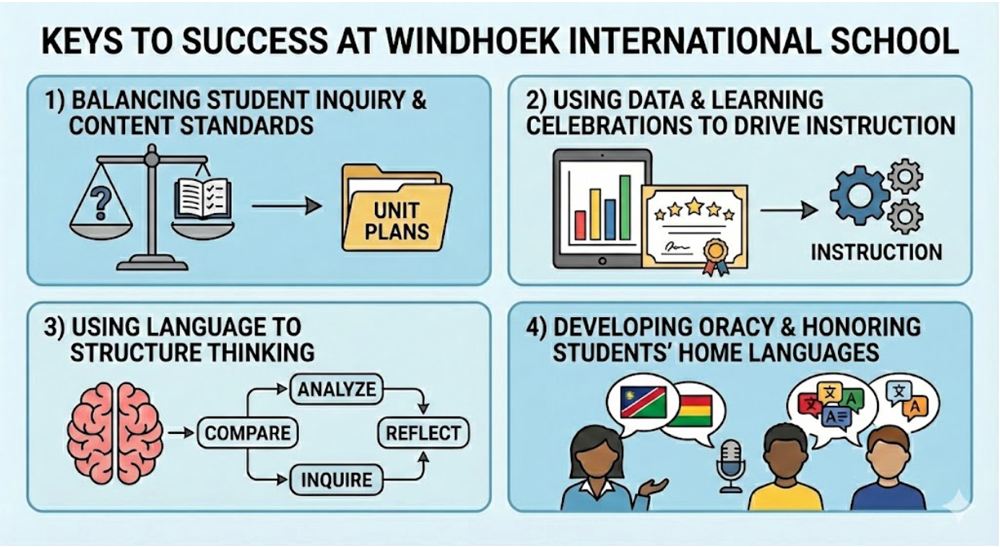
These questions informed four key academic shifts that reshaped teaching and learning across the school.
Four Academic Shifts to Balance Inquiry and Instruction
1. Designing Units That Integrate Inquiry and Standards
Unit planning was redesigned so that learning goals, success criteria, and assessments are clearly articulated from the outset. This clarity allowed teachers to focus less on daily lesson scripting and more on feedback, formative assessment, and tracking student progression.
Inquiry remained central, but it was now intentionally aligned with content standards and skill progressions. Teachers reported that students were more motivated and purposeful when they understood both why they were learning and what high-quality work looked like.
Key insight: When students feel genuine pride in their final products, they are better able to articulate the knowledge and skills they developed along the way.
2. Using Data to Personalize Instruction and Celebrate Learning
Engaging honestly with achievement data required a cultural shift. MAP Growth results became tools for instructional decision-making rather than evaluation. Teachers used data to identify misconceptions, form flexible learning groups, and target direct instruction precisely where it was needed. For example, online platforms such as IXL, Khan Academy, and Twinkle were used alongside a “daily review” to assess individual student progress towards mathematics standards.
This data-informed approach also reshaped End-of-Unit Learning Celebrations. These events now function as rigorous performance assessments, where students present polished work to authentic audiences, reflect on feedback, and articulate their learning processes. Multiple feedback cycles are embedded into the academic calendar, and additional time is provided where necessary to ensure quality.
Key insight: When data guides instruction, differentiation becomes intentional, transparent, and equitable.
3. Explicitly Teaching Language by Text Type and Disciplinarity
Analysis of student performance revealed a familiar challenge in international schools: conceptual understanding often outpaced students’ ability to communicate it. In response, WIS adopted a functional linguistics approach informed by Stephen Graham’s research on explicit writing instruction (Graham et al., 2019).
Across the school, students are now explicitly taught to write for imaginative, informative, and persuasive purposes using nine clearly defined text types. These structures function as cognitive scaffolds. Teachers use a functional linguistics approach to explicitly teach writing structures which help students to organise ideas, develop arguments, and demonstrate higher-order thinking.
As students developed this metalinguistic awareness, teachers observed clearer reasoning, stronger transfer across subjects, an ability to develop language disciplinarity, and a more confident academic voice—particularly among multilingual learners. This framework aligns with the broader evidence base on writing instruction that emphasizes explicit modeling, genre awareness, and structured feedback (Graham et al., 2019).
In Grades 5 and below, it has been possible to explicitly teach these nine different text types one at a time, unit by unit, and then have students utilize the assigned text type whenever they were explaining or reflecting upon their End of Unit Celebration. In Grades 6 and above, a typical end of unit assignment will use a variety of text types. We are still learning how to explicitly teach functional literacy for our inquiry-driven projects. When teachers share how language works in their subject area and view language disciplinarity as their responsibility to explicitly teach, then all students benefit, especially multilingual learners.
Key insight: Explicitly teaching how to communicate inquiry strengthens, rather than constrains, critical thinking.
4. Developing Oracy and Honoring Linguistic Diversity
Building on this foundation, WIS strengthened its oracy framework, addressing both learning through talk and learning how to talk. Structured academic discussion provides students with opportunities to rehearse ideas, experiment with vocabulary, and receive immediate feedback before writing.
In our multilingual context, translanguaging practices have further supported equity and access, particularly for early-stage English learners. Students are encouraged to develop ideas across languages, deepening conceptual understanding while gradually strengthening academic English. Emerging technologies, including artificial intelligence supported feedback tools, have expanded these possibilities.
Key insight: When students are supported to think aloud and learn new concepts using both their home language and target language, gains in reading comprehension, writing quality, and mathematical reasoning follow.
Conclusion: Striking the Balance for Content-Rich Curiosity
WIS’s experience affirms Claxton’s central argument: the opposition between traditional and progressive education is a false one. Inquiry without structure limits access and precision; structure without inquiry limits meaning and transfer.
By deliberately integrating explicit instruction with student-led exploration, WIS has strengthened its inquiry-driven mission while significantly improving student outcomes. Achievement has risen, the quality of student work has improved, and curiosity has become more durable across the IB continuum.
There is no universal formula for finding this balance. However, our experience suggests that when schools move beyond pedagogy wars and commit to evidence-informed, reflective practice, they can design learning environments where inquiry truly thrives.
References
Bartlett, K. 1993. “Internationalism: Getting beneath the Surface, Part 1: Internationalism? It’s About Thinking!” International Schools Journal. Vol 26. Pp 35–38.
Claxton, G. (2021). The future of teaching and the myths that hold it back. Independent Thinking Press.
Graham, S., MacArthur, C. A., & Hebert, M. (Eds.). (2019). Best practices in writing instruction (3rd ed.). The Guilford Press.
Graham, S. (2019). Explicitly teaching writing: Professional development guide. Nelson Primary (Cengage Learning Australia).
International Baccalaureate Organization. (2025). Primary Years Programme: Curriculum Framework. Geneva, Switzerland: International Baccalaureate Organization.
NWEA. (2023). MAP Growth normative data overview. Portland, OR: Northwest Evaluation Association.
Ethan Van Drunen has two decades of experience in day and residential international schools. He is committed to fostering inclusive and student-centered schools. As the Director of Windhoek International School since 2021, his emphasis has been on strengthening inquiry-based learning, staff and student wellness, strategic planning, outdoor education, teaching literacy, and mission-focused governance.
Marcelle van Leenen is the Primary Principal of Windhoek International School and an international school leader committed to creating inquiry-driven and language-rich learning communities. With over 25 years of experience in international education, she has led teams to strengthen teaching and learning through collaboration, reflection, and a shared commitment to student growth. Marcelle also contributes to the wider International Baccalaureate community as a trainer, consultant, and school evaluation leader.
LinkedIn: https://cn.linkedin.com/in/marcellevanleenen