
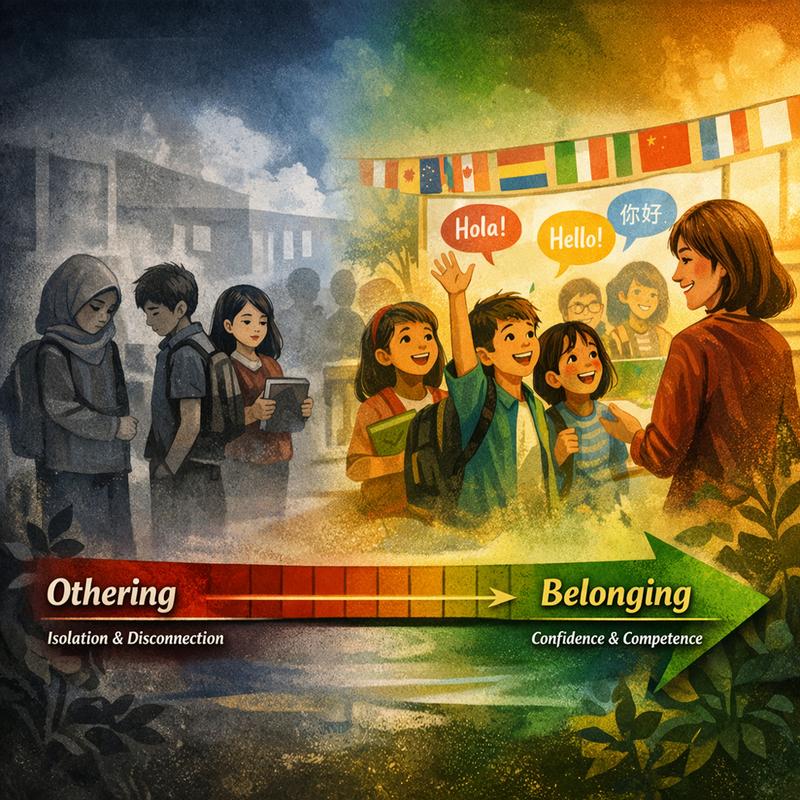
Across many schools around the world, multilingual learners enter classrooms carrying linguistic richness, cultural knowledge, and diverse lived experiences. Yet despite these assets, many multilingual learners (MLLs) experience a subtle but persistent phenomenon: othering. Othering occurs when students are positioned, intentionally or unintentionally, as outsiders within the academic and social fabric of school life.
In many cases, this othering does not come from harmful intentions. Schools often strive to be inclusive, and teachers frequently act with care and dedication. However, good intentions do not always translate into equitable outcomes. I often remind educators that intention does not equal impact, and when impact excludes, we have work to do. Even when schools aim to support multilingual learners, small gaps in mindset, systems, and instructional practices can unintentionally create environments where students feel like perpetual outsiders.
Othering may appear in subtle classroom moments: when multilingual learners are praised for academic success “despite” learning English, when their curriculum is simplified instead of scaffolded, when classroom participation norms privilege dominant linguistic cultures, or when school policies unintentionally isolate them from full participation. These experiences accumulate and shape how students perceive their place within the learning community.
Research consistently demonstrates that belonging is not merely a social or emotional luxury; it is a fundamental human need. Baumeister and Leary’s work on the Need to Belong establishes that human beings are driven to form meaningful interpersonal relationships and social connections (Baumeister & Leary, 1995)¹. Similarly, Maslow’s hierarchy of needs positions belonging as a foundational requirement that must be satisfied before individuals can reach higher levels of development such as confidence, achievement, and self-actualization (Maslow, 1943)². In educational contexts, this suggests that students cannot fully engage in complex learning if they feel disconnected from the social environment of the classroom.
For multilingual learners, belonging is especially critical because linguistic difference can easily become a basis for exclusion. Too often, schooling systems center assimilation, expecting students to leave their linguistic identities at the classroom door. Yet multilingualism is not a limitation; it is an intellectual asset. Multilingual learners represent diverse linguistic backgrounds and experiences that share the common asset of multilingualism (Huynh & Skelton, 2023)10. Scholars such as Ofelia García further argue that multilingual learners possess dynamic linguistic repertoires that support complex thinking, communication, and knowledge construction (García, 2009; García & Wei, 2014)3. When schools fail to leverage these linguistic resources, they are not only marginalizing students, they are also missing opportunities for deeper learning.
It was within this context that, in a session at the English Language Specialists in Asia (ELLSA) 2026 Conference, I introduced a conceptual model designed to help schools navigate the journey from othering to belonging. The model centers on two interconnected ideas: the R.I.S.E Framework, which I developed to help schools intentionally engineer belonging within multilingual learning environments, and the Belonging-to-Competence Continuum, which illustrates how belonging, when intentionally cultivated, transforms multilingual learner identity into confidence and academic competence (Conde, 2026)4.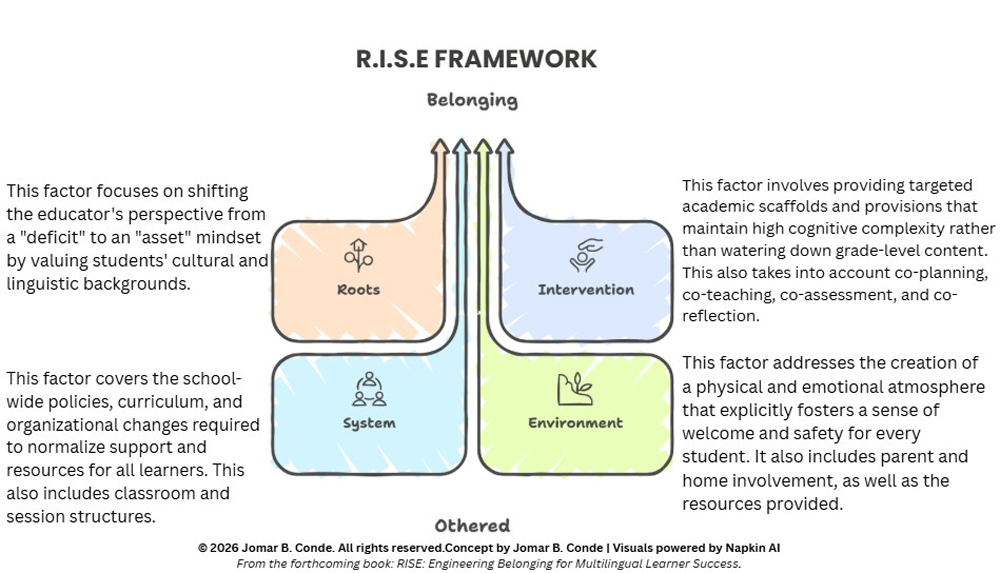
.jpg)
At the heart of this work is a reframing of a common educational assumption. In many schools, learning and belonging are often treated as two separate or competing priorities. Academic learning is frequently positioned as the primary goal, while belonging is viewed as something secondary, something that will naturally occur once learning is already underway. However, this separation creates a false dichotomy. The relationship between belonging and learning is not sequential, nor are they independent goals. They are deeply interconnected processes that shape and reinforce one another.
It is not learning and belonging. It is learning through belonging.
To understand this relationship, we must consider the broader environment in which multilingual learners operate. I describe this environment as a multilingual ecosystem—an intentionally engineered educational system that recognizes a learner’s linguistic starting point, aligns mindset, instruction, structures, and environment, and continuously recalibrates to ensure that belonging strengthens identity and identity translates into competence (Conde, 2026)4.
Within this ecosystem, belonging does not happen by chance. It is intentionally designed through the interaction of four interconnected elements that form the engine of the R.I.S.E. framework: Roots, Intervention, Systems, and Environment.
The first element, Roots, focuses on mindset. For decades, multilingual learners have often been viewed through a deficit lens, defined primarily by what they lack rather than by what they bring. Asset-based perspectives challenge this narrative by recognizing students’ languages, cultural backgrounds, and lived experiences as intellectual resources for learning (López, 2017; Alexandrowicz & Hansen, 2023)5. When educators shift their perspective in this way, multilingual learners are not valued despite their linguistic identities, they are valued because of them. This shift establishes the foundation for belonging.
The second element, Intervention, addresses instructional practice. Too often, support for multilingual learners takes the form of simplifying curriculum and lowering academic expectations. While these approaches may appear supportive, they often limit intellectual engagement. Research grounded in Vygotsky’s Zone of Proximal Development demonstrates that students learn most effectively when they engage with challenging tasks supported by appropriate scaffolds (Vygotsky, 1978)6. Walqui (2006) describes this approach as scaffolding up, where instruction maintains rigorous academic expectations while providing linguistic tools that allow learners to access complex ideas7.
Instruction within this framework also embraces translanguaging, allowing students to draw upon their full linguistic repertoire to process ideas and express understanding. Rather than separating languages, translanguaging recognizes multilingualism as a cognitive resource that supports deeper thinking and knowledge construction (García & Wei, 2014)³.
The third element, Systems, recognizes that belonging cannot rely solely on individual teacher practices. School structures—including curriculum, scheduling, policies, assessment practices, and collaboration models—shape the experiences of multilingual learners. Research on collaborative instructional models highlights the importance of co-planning and co-teaching between language specialists and content teachers (Honigsfeld & Dove, 2019)8. When language development becomes a shared responsibility across the school, multilingual learners are integrated into the academic ecosystem rather than isolated within support structures.
The final element, Environment, focuses on the physical and emotional climate of schools. Environment asks a simple but powerful question: does the school visibly and emotionally communicate that multilingual learners belong here? When students see their languages represented at school and in classrooms, hear them acknowledged in conversations, and experience spaces where their voices are expected and valued, they internalize a sense of belonging. Jim Cummins describes this process as identity affirmation, where recognition of linguistic and cultural identity strengthens engagement and learning (Cummins, 2001)9.
When these four elements—Roots, Intervention, Systems, and Environment—operate together, they create the conditions necessary for belonging to flourish. This interaction forms the foundation of what I describe as the Belonging-to-Competence Continuum (Conde, 2026)4.
The continuum illustrates how belonging evolves over time. When the R.I.S.E framework functions as an integrated engine within a multilingual ecosystem, students begin to experience a stable foundation of belonging. Within this foundation, a healthy and functional multilingual ecosystem emerges, one where multilingual learners can fully embrace their multilingual identity with confidence.
As students develop confidence in their multilingual identity, they begin to take intellectual risks, participate more actively, and engage with complex academic language. Over time, that confidence translates into competence. Language proficiency develops alongside content mastery, and students move toward becoming thriving multilingual learners.
Within the continuum, the arrow surrounding the framework represents an important idea: belonging is constant. It is not an initiative implemented on a specific day or through isolated programs. Belonging must be continuously cultivated and sustained through intentional design and practice.
This perspective also challenges a common misconception in education, that multilingual learners struggle primarily because of language limitations. In reality, many challenges arise not because learners are deficient but because educational systems were not designed with them in mind.
Multilingual learners are not broken. They are simply a different shape. If they appear to struggle, it may not be because of the wheel, but because the road was not built for them. Our work as educators is not to fix the wheel. It is to redesign the road. When schools intentionally align mindset, instruction, systems, and environment, they create ecosystems where multilingual learners can thrive academically without abandoning their identities.
And when belonging becomes the foundation of schooling, learning does not merely follow, it flourishes. As I often say:
Belonging is not a byproduct of learning.
It is a condition for learning.
References
1. Baumeister, R. F., & Leary, M. R. (1995). The need to belong: Desire for interpersonal attachments as a fundamental human motivation. Psychological Bulletin.
2. Maslow, A. H. (1943). A theory of human motivation. Psychological Review.
3. García, O. (2009). Bilingual Education in the 21st Century: A Global Perspective.
García, O., & Wei, L. (2014). Translanguaging: Language, Bilingualism and Education.
4. Conde, J. B. (2026). Engineering a Multilingual Ecosystem: Strategic Scaffolds for Learning Through Belonging. Conceptual framework presented at the English Language Specialists in Asia (ELLSA) Conference.
Engineering_an_Ecology_ELLSA_20…
5. López, F. (2017). Asset-based pedagogies for multilingual learners.
Alexandrowicz, R., & Hansen, K. (2023). Asset-based perspectives in multilingual education.
6. Vygotsky, L. S. (1978). Mind in Society: The Development of Higher Psychological Processes.
7. Walqui, A. (2006). Scaffolding instruction for English language learners.
8. Honigsfeld, A., & Dove, M. (2019). Co-Teaching for English Learners.
9. Cummins, J. (2001). Negotiating Identities: Education for Empowerment in a Diverse Society.
10. Huynh, T., & Skelton, B. (2023). Long-Term Success for Experienced Multilinguals
Jomar Bronola Conde is currently an MLL specialist at CIA FIRST International School and a board member of SENIA Cambodia. For the next academic school year, he will be moving into a managerial leadership role at another international school, focusing on English as an Additional Language (EAL) provisions. A passionate advocate for equitable education, Jomar has presented at regional and international conferences on collaboration, leadership, language learning, and curriculum design, and has facilitated numerous professional learning sessions for teachers. In addition, he is an active member of the English Language Specialist Network in Asia and the International Business Chamber of Cambodia (education sub-committee), and has completed visiting committee training with the Western Association of Schools and Colleges (WASC).