


A practical response is for teachers to embrace a functional approach to language development. First developed by Michael Halliday, Systemic Functional Linguistics (SFL) is a theory of language teachers can use to integrate content with the subject-specific language and literacy skills mathematicians need to access it. Through SFL, grammar is viewed as a system of choices based on audience, context, and purpose. This understanding allows learners to notice patterns and make sense of grammar in authentic situations, rather than memorizing sets of isolated rules practiced in artificial contexts (de Oliveira, 2023).
SFL provides the underpinning for the Knowledge About Language (KAL) text analysis framework and WIDA’s Annotated Language Analysis. Both are powerful tools teachers can use to make the mathematical language demands visible. When a mathematical text, such as worked examples, written/oral explanations, and diagrams are analysed through a functional lens, two key features stand out:
These features make mathematical language challenging, especially for students learning the content through English as a second or additional language. It is therefore essential for teachers to explicitly teach subject-specific vocabulary, sentence patterns, and mathematical genres in a clear and intentional way. At the word level, this means teaching specific mathematical vocabulary in context, including the everyday language that carries additional meanings, e.g., nouns such as “operation,” “table,” “face,” and “mean,” etc., and verbs such as “model” and “represent,” etc. At the sentence level, it means using open narration and model sentences to explicitly examine the sentence structures present, providing opportunities for translanguaging to discuss, compare, and contrast how grammar builds meaning. For example, understanding the ways conditional language (e.g., If…then…) is used to justify, reason, and explain mathematical theories and understandings. At the text level, it means exploring the text’s cohesive devices (e.g. because, as a result, after, since) to show how mathematicians express, organize, and connect their ideas. 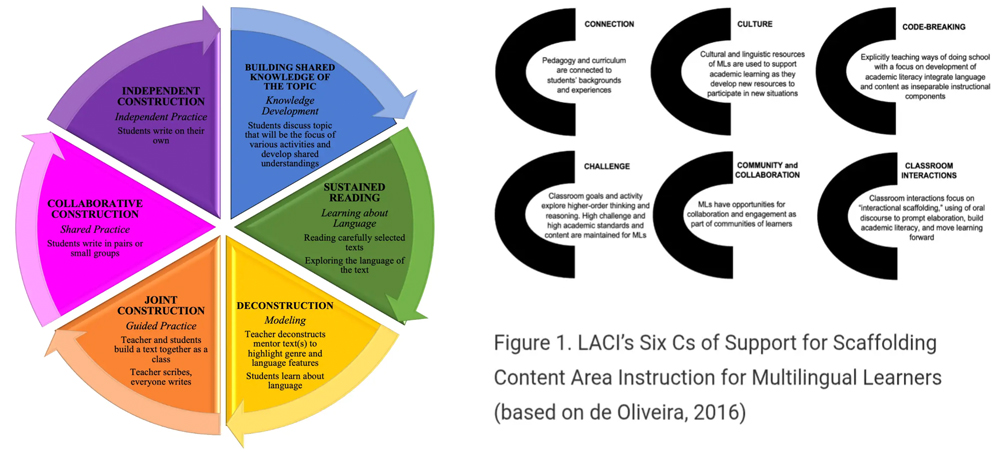 (From left to right) The Teaching and Learning Cycle and the Langauge-Based Approach to Language Instruction. (Photo source: L.C. de Oliveira)
Additionally, SFL aligns well with genre-based pedagogical models and culturally responsive instructional strategies that boost engagement and support MLLs (de Oliveira, 2020; 2023). Frameworks such as the Teaching and Learning Cycle (TLC) or the Language-Based Approach to Language Instruction (LACI), give teachers a clear sequence for supporting students as they move from highly scaffolded to independent work. They also create space for students to develop ideas in their home languages before writing/speaking in English. Rather than expecting students to infer linguistic expectations, these approaches make requirements explicit and normalize translanguaging as a way for students to make sense of the content. Rose (2018) explains that genre-based pedagogy promotes educational equity by making the often hidden language demands of schooling visible to all learners.
Before teaching a complex skill or concept, Hendrick (2025) highlights that educators must examine what students already need to understand, know, and do, including assessing their prior knowledge. For MLLs this means tapping into their home languages and facilitating “interactive activities [where MLLs] use, hear, and see the language associated with the topic” (de Oliveira, 2023, p. 7). Although simplifying texts may seem supportive, even with the best of intentions, it signals a deficit mindset by tying MLLs mathematical ability to their English proficiency and limiting access to high quality material. In contrast, when teachers believe that MLLs can meet both the conceptual and linguistic challenges of a rigorous mathematics curriculum and provide appropriate scaffolds, they adopt an asset-based mindset that benefits all learners.
With all this in mind, a good first step for teachers is to use the KAL text analysis framework to analyse mentor texts before starting a new unit. This helps to clarify the linguistic demands and identify the learning goals students will need to be successful. The TLC or LACI models can then be implemented effectively ensuring the scaffolds are purposeful and strategic in helping MLLs communicate with greater academic accuracy. As Adoniou (2014) notes, when teachers do not attend to the language demands, it is difficult to determine whether less-than-expected progress and achievement stems from conceptual or linguistic challenges.
English as an Additional Language (EAL) specialists play a salient role in helping mathematics teachers plan deliberate, language rich instruction that includes MLLs. Such collaboration may include:
References
Adoniou, M. (2014). Language, mathematics and English language learners. Australian Mathematics Teacher, 70(3), 3–13.
https://www.researchgate.net/publication/268280059_Language_Mathematics_and_English_La nguage_Learners
de Oliveira, L. C. (2020). Planning and application using a language-based approach to content instruction (LACI) in multilingual classrooms. MinneTESOL Journal, 36(2), 1–8. https://minnetesoljournal.org/planning-and-application-using-a-language-based-approach-to-con tent-instruction-laci-in-multilingual-classrooms/
de Oliveira, L. (2023). A functional approach to language development in second language writing in K–12: Genre-based pedagogy through the Teaching and Learning Cycle with multilingual learners. New York State TESOL Journal, 10(1).
https://journal.nystesol.org/index.php/NYSTJ/article/view/17/7
Hendrick, C. (2025, September 19). 10 rules for designing effective learning: Or how to plan teaching that works for all students, not just the strongest [Blog post]. Carl Hendrick’s Substack. https://carlhendrick.substack.com/p/10-rules-for-designing-effective
Moschkovich, J. N. (2023). Language and learning mathematics: A sociocultural approach to academic literacy in mathematics, 30, 6–15.
https://www.researchgate.net/publication/373990813_Language_and_learning_mathematics_A _sociocultural_approach_to_academic_literacy_in_mathematics#fullTextFileContent
Rose, D. (2018). Languages of schooling: Embedding literacy learning with genre-based pedagogy. European Journal of Applied Linguistics, 6(1), 59–89.
https://doi.org/10.1515/eujal-2017-0008
Sharma, S., & Sharma, S. (2023). Successful teaching practices for English language learners in multilingual mathematics classrooms: A meta-analysis. Mathematics Education Research Journal, 35(3), 821–848. https://doi.org/10.1007/s13394-022-00414-0
Jessica McArdle works at Munich International School. She is a Primary Years Programme educator with nearly 20 years of experience working in International Baccalaureate schools in Australia, Germany, and the United States of America. She is passionate about multilingual education, and creating asset-based and data informed systems where language serves as a bridge to belonging, confidence, and empowerment.