


“We do not learn from experience. We learn from reflecting on experience.” – John Dewey
The Reflective Shift
As part of our article series on the transition from Service as Action to Community Engagement in International Baccalaureate (IB) schools, we focus here on explaining the third of the four new community engagement learning objectives: Engage in reflective and reflexive practices (IBO.org).
Reflection means looking back at what happened, and reflexivity means looking inward at one's own biases, positionality, and how they affect the community. In community engagement, understanding who we are in relation to the community we serve is a huge part of the reflexive shift.
Cathy Berger Kaye, the author of the book The Complete Guide to Service Learning, says that when teachers recognize the essential value of reflection, providing the space for it becomes a priority rather than an afterthought.
“All too frequently, reflection is relegated to a last-minute activity… When reflection is viewed as having minimal value, the minimal time allotment makes sense. When teachers understand the essential value of reflection to maximize learning… ensuring that students spend time reflecting on their learning becomes time well spent” (cbkassociates).
As the title of this article suggests, many teachers usually skip the reflection part at the end of a unit or community engagement experience. At least, to be honest, we usually skipped the reflection part at the end of our units and community engagement experiences. It wasn’t that we didn’t want to reflect or didn’t think it was important. We did. But we always seemed to run out of time, forget, or rush through it. There was some cognitive dissonance between our thoughts, words, and actions. We believed and said reflection was valuable to us, but our actions showed that we didn’t really value it.
Without reflection, school becomes a series of activities, one after the other, to cover content and curriculum. When teachers move from checkpoint to checkpoint without pausing, students don’t have time to integrate the essence of what they are supposed to be learning. Reflection is a powerful tool for slowing down and taking stock. Imagine a world in which adults are not reflective of their actions. Education prepares the next generation. If we do not teach students how to reflect, they may act thoughtlessly and unintentionally harm others.
From Transactional to Transformative
Reflection is what turns an activity into a transformative experience for a student. Otherwise, community engagement risks becoming "performative" or "transactional," and we raise a generation to move through life without ever taking into account the impact of their actions on the animals, environment, and people around them.
A couple of questions that help Kathryn when preparing to reflect on an experience are: Have you ever climbed a mountain or a big hill? Did you take the time to look back halfway and see the progress you have made? So often, we keep hiking up and forget to acknowledge or celebrate how far we have come. This is reflecting.
Reflecting and Acting is an essential component of The Cycle of Inquiry as outlined by Kath Murdoch, author of The Power of Inquiry. In the diagram below, reflection is given equal weight when compared to other parts of an inquiry unit.
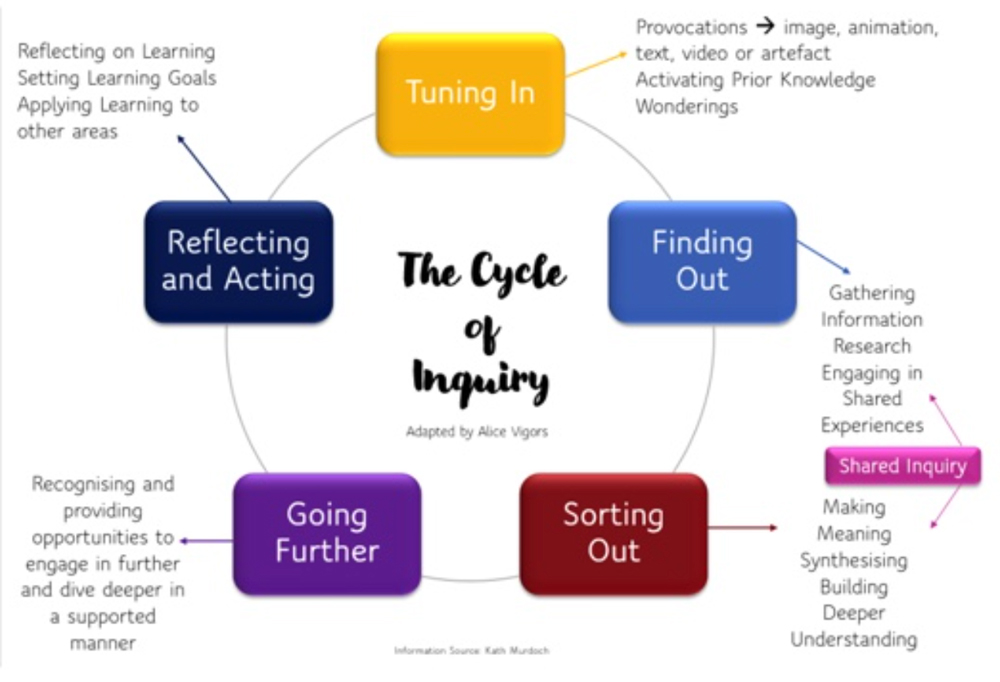
Kath Murdoch says that when we build in time for reflection, we evaluate the process, make connections to big ideas, and determine the “now what” of our learning journey (Exploring the Cycle of Inquiry). In process-driven learning, reflection is critical because the entire learning journey is important, not just the product.
Modeling the Process - Reflection in Practice
In the past, Megan's reflections were often limited to quick, one-period tasks like basic mind maps or filling in a box in ManageBac. Sometimes, she had the students reflect on their learning using a Google form. The reflections she received were okay, but not great.
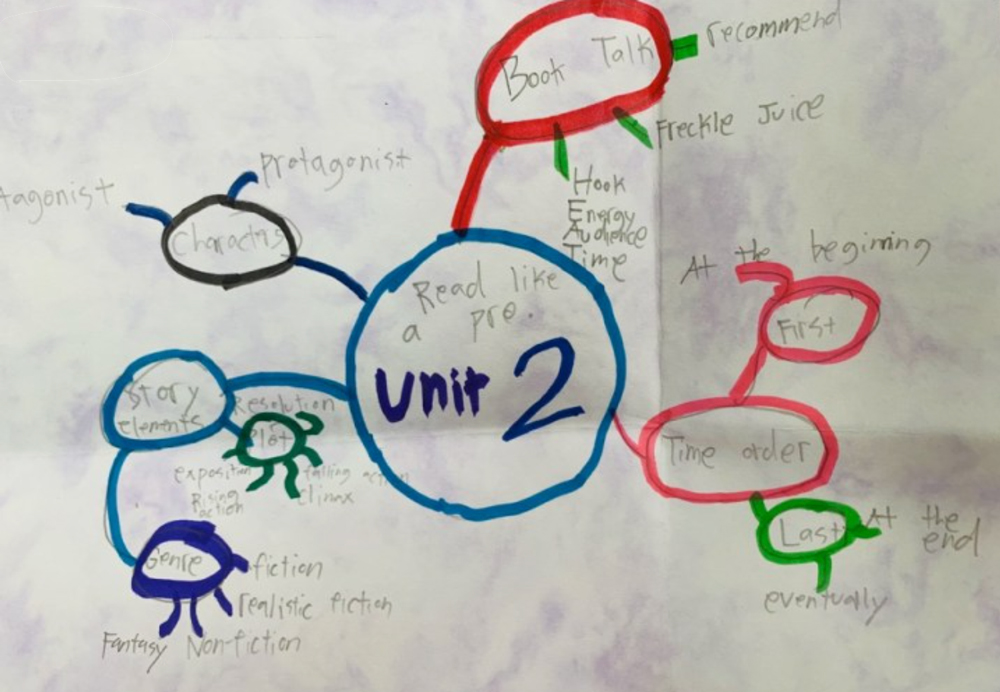
Once Megan changed her mindset and realized the value of reflection, she began to integrate more opportunities for reflection tasks into her classroom routines. She made a conscious effort to try to prioritize reflection and approaches to learning as much as she did content.
A few years ago, Megan and her Grade 7 teaching team at the American Embassy School (AES), New Delhi, created a set of posters to help teach the what, why, and how of reflection in their middle school classrooms.
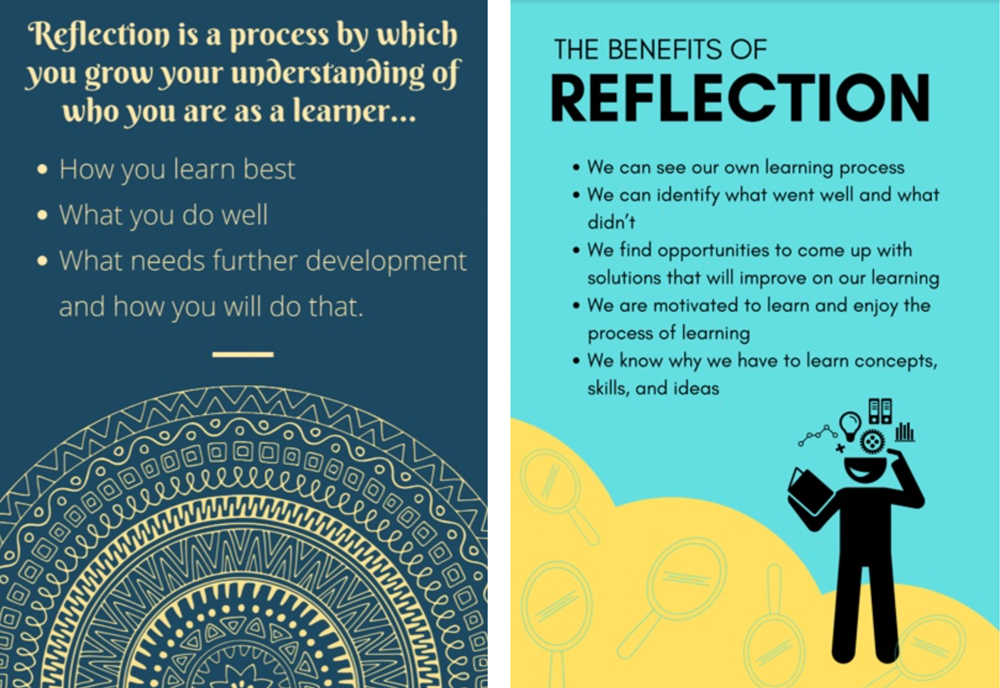
(From left to right) What is Reflection? and Benefits of Reflection posters created by members of Team 7 at AES New Delhi. (Photo source: Megan Vosk)
After teaching students about the importance of reflection (and reflecting on the importance of reflection herself), Megan and a Grade 5 English as Additional Language (EAL) teacher at AES New Delhi, Shafali, decided to collaborate and co-teach a digital storytelling unit with an emphasis on process-based learning and reflection.
Here are just a few of the things that the students did in their Grade 5 and Grade 7 EAL classrooms to reflect on their learning during the digital storytelling unit:
Posted their work on a Padlet, along with their thoughts about their work, and answered metacognitive questions such as: How did my own identity influence the way I told this story?
Looked through each other’s work and gave each other glow/grow feedback.
Completed a 3-2-1 protocol to give Megan and Shafali feedback on how the unit went and how it could be better next time.
Shared their thoughts about the unit in a video reflection.
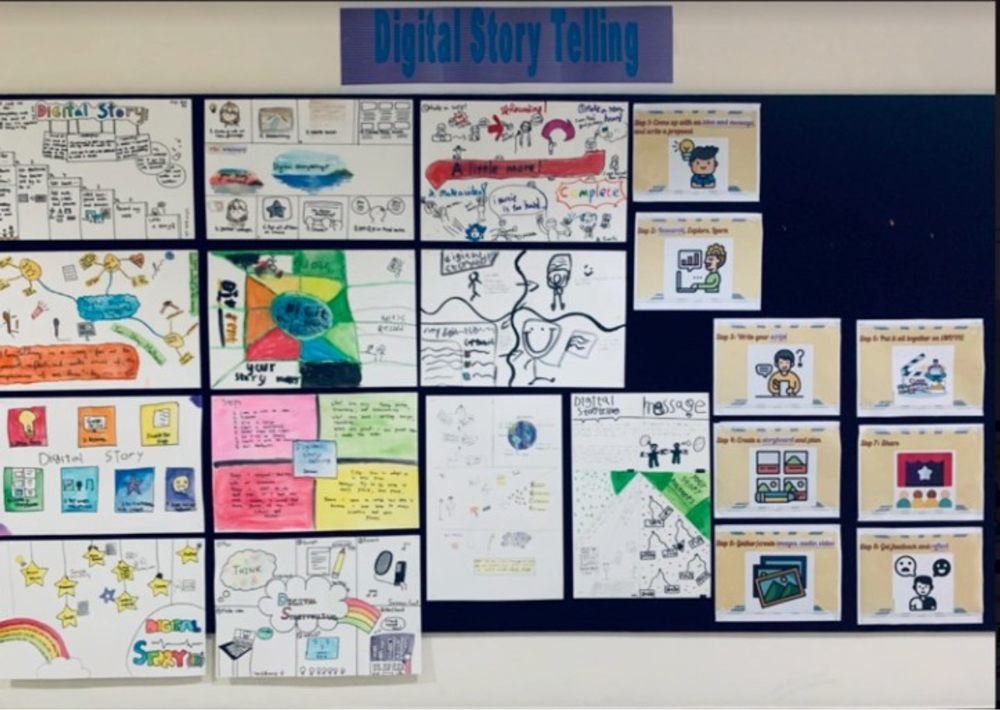
Created a “one-pager“/mind map to reflect on their learning process.
Engaged in a mid-unit checkpoint and peer feedback lesson using the task success criteria and the TAG feedback protocol to help them reflect on their progress and plan their next steps when creating their digital stories.
Here are some examples of the one-pagers the students created to reflect on their digital storytelling project. You can see that the quality of these reflections was much higher than the quality of the mind map shared above. This is because a lot of time and effort was spent on the reflection task.
Upon reflecting on their collaboration, Shafali said, “True learning can't take place without some unlearning, and reflection paves the way for both as students and teachers continue to evolve.” By reflecting on their own biases and areas for improvement during the unit, Megan and Shafali were able to practice the very reflexivity they were asking of their students.
Tools for Community Engagement Reflections
If you are unsure how to teach reflection, here are some tools to get you started.
Sample Reflection Prompts for Service Learning Experiences: Consultant LeeAnne Lavender has a lovely reflection guide that teachers can access for free on her website. It includes information on how to structure reflections around writing/journaling, movement, and talking. It also includes a section with questions for reflecting on community engagement experiences.
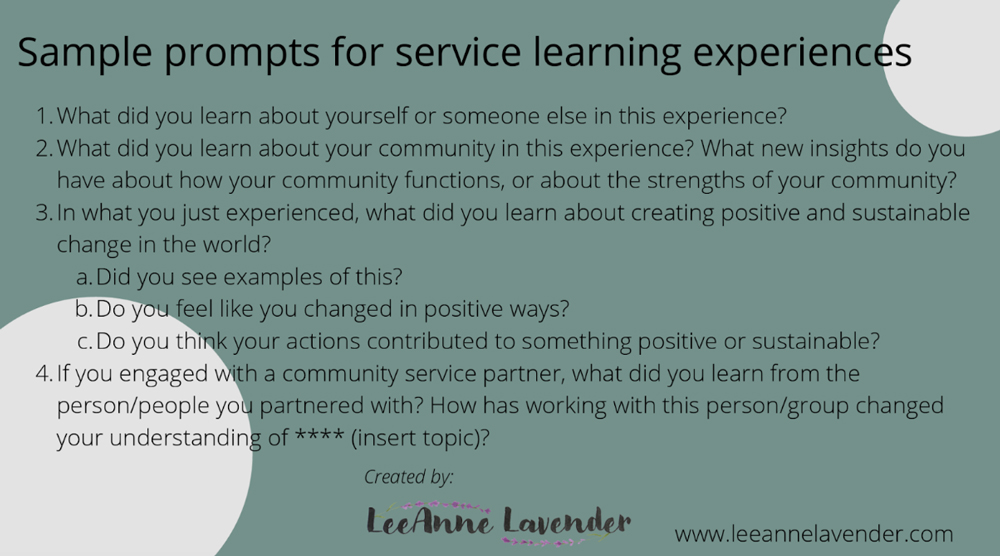
Sample prompts for reflecting on service learning experiences. (Photo source: Leeannelavender.com)
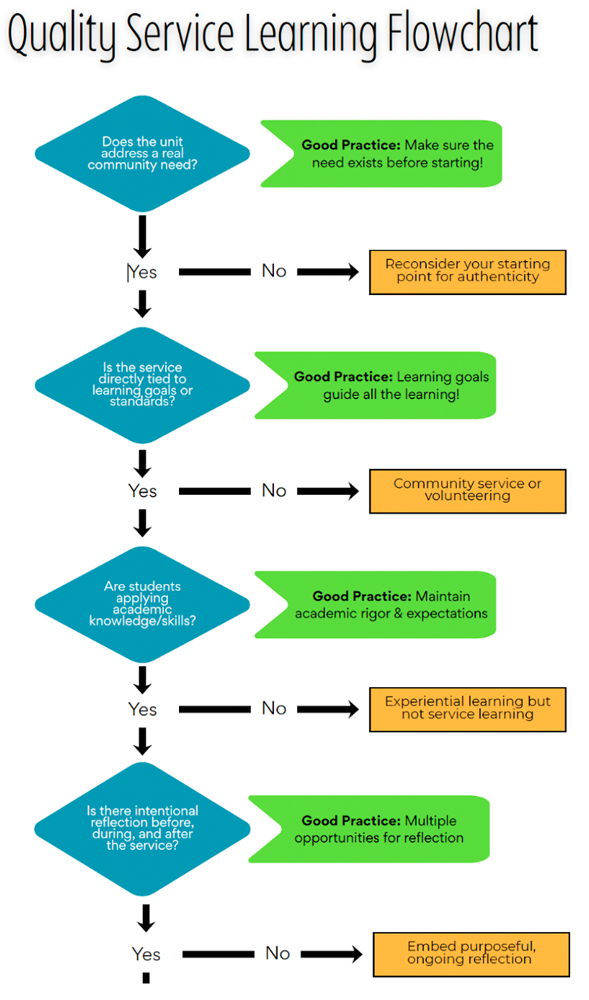
Quality Service Learning Flowchart: Laurence Myers, from Edvolution Services, created a diagram to help students and educators reflect on different aspects of their community engagement experiences. Laurence said, “All too often, educators with limited experience in community engagement feel that the move to more authentic and student-driven learning will be overwhelming. Reflection on the decisions, the outcomes, and the learning itself is a critical piece to recognizing your own capacity to make change for a larger scope than yourself.” You can see a portion of the diagram below.
Conclusion - Making the Time
Many teachers and students internalize the belief that halfway through the unit, a check-in quiz will measure progress, and that when the final product is done, so is the learning. But the practice of reflecting is something that needs to become inherently part of learning, not a teacher-delivered moment. We used to think that once the arc of the unit has passed its climax, the denouement doesn’t really matter. But now we know this is wrong. There is so much to be gained from deep reflection.
Find a few ways for students to reflect and start integrating these into your practice as a teacher. The requirements of any school can be enhanced by personal reflection, which can be explicitly taught using some of the techniques and tools shared in this article.
Learning doesn't only happen in the doing; it also happens in the thinking about the doing. While teaching the art of reflection may feel new, and finding the time may feel difficult, it is the only way to ensure community engagement remains transformative rather than transactional. Reflections should be celebrated. Mention them in report cards, hang them on the walls, and read them out loud.
And so, our advice to educators everywhere is, “Don’t skip the reflection!”
Kathryn T. Berkman currently works at Munich International School. She began her journey as a teacher after graduating from the University of San Francisco, focusing on social justice and multiple intelligences in math education. She has had the opportunity to teach middle schoolers across three countries over the last 13 years. Kathryn is keen to engage in opening the Solutionary lens and framework for educators in different contexts.
LinkedIn: Kathryn T Berkman
Meredith Robinson is the Middle Years Programme community engagement coordinator and English Language Acquisition teacher at KIS Bangkok. Her career overseas has taken her to multiple countries where she has worked across primary and secondary school in roles often involving service learning and action, sustainability, and Diversity, Equity, Inclusion, and Belonging (DEIJB).
LinkedIn: Meredith Robinson
Megan Vosk teaches the Middle Years Programme, Individuals and Societies, and English Language Acquisition at Vientiane International School. She is also the community engagement coordinator there. Additionally, Megan is a member of the Association for Middle-Level Education (AMLE) Board of Trustees.
LinkedIn: Megan Vosk