
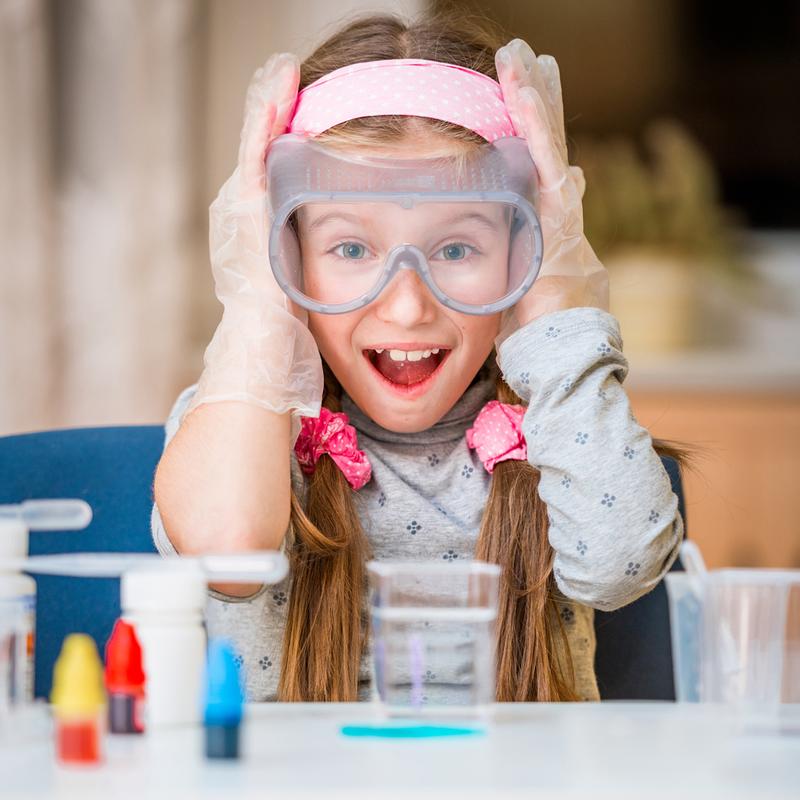
I watched a group of five-year-olds look through a microscope for the first time last year. They had been studying a lesson on plants—what a stem does, what roots are for—standard early years content. Then I put a leaf under a lens. Before I had even stepped back, one of them asked whether there were cells inside her too. Then asked whether we could look at something else, then whether skin would work. The lesson had moved somewhere none of us had planned.
That session cost nothing except a microscope and the decision to do it. Most schools at that age group wouldn't try it. Not because it isn't appropriate, it clearly was, but because nobody had decided it was allowed yet.
Two Kinds of Gatekeeping
There is a quiet assumption running through education, particularly in STEM subjects: children must earn access to the real materials and tools before they get near them. The Bunsen burner comes after the worksheet. The scalpel comes after the diagram. This sequential logic sounds reasonable until you look at what it actually produces.
The first kind of gatekeeping is about knowledge. Certain concepts are assumed too complex for younger children: Cells are secondary content; circuits belong in Grade 5. The sequencing has some logic, but researchers who study how children actually develop consistently find they engage with sophisticated ideas far earlier than curriculum documents allow for. The limiting factor is rarely the child's mind. It is the adult's imagination about what the child's mind can hold.
The second kind of gatekeeping gets less attention and does more damage. It is about access to practice, to authentic scientific experience rather than representations of it. What gets withheld is not a concept but a physical reality: the equipment, the unpredictability, the moment when the experiment does not go as planned. The justification is almost always the risk. But a ten-year-old with a scalpel, properly briefed and given something real to do, is more careful and more focused than the same child with a pencil. The risk calculation is often wrong.
How Children Actually Think
Parents will recognize something in this that school sometimes loses track of. Watch a three-year-old with anything unfamiliar and you are watching someone work. They drop the same object repeatedly, not out of boredom, but to check whether it falls the same way each time. Breaking things is how they find out what is inside. When they ask why, it is not conversation, it is a genuine question. That disposition does not disappear when they start school. It just stops being the main thing we ask them to do.
What we call scientific thinking in secondary school is something children are already doing informally before they are five. Giving them real equipment and real materials to investigate does not ask them to do something different. It gives that natural way of thinking a more interesting object to work with and allows them more opportunity to experience and explore.
What We Actually Remember
Ask any adult what they remember from school science, and you get roughly the same answer. Not a formula, not a worked example, but something that actually happened. The experiment that went wrong. The moment someone handed them something real.
I see the same pattern with students in Grade 5. When they reflect on what they have learned in class, the cow eye dissection comes up every time, unprompted. Not because it was the most academically rigorous thing they did, but because it was a real experience. They held something that had been part of a living creature. They cut into it. When they got to the lens and held it up, they could see through it. That is simply not something a diagram gives you.
The value of that kind of hands-on, embodied learning does not show up on any assessment rubric, and I am not sure it needs to. A student who has worked with real materials, made a cut, and found out what is actually inside, carries something forward that is different from content knowledge. Science stops being a subject they are taught and starts being something they have done. Getting that exposure early matters in a way that is hard to reverse engineer later.
A Structural Choice
Making these experiences happen consistently, not as occasional enrichment but as a genuine feature of how students move through a school, requires more than goodwill and individual initiative.
A classroom teacher's deep skill is understanding their students: how they learn, how they relate to each other, how to manage a room productively. That is not the same expertise as knowing what a child encountering cell biology for the first time could look like, or how to run a calorimetry experiment with ten-year-olds. Both kinds of knowledge matter. The problem is that most schools only house one of them in the same room as younger children.
Some schools have made a deliberate choice: to embed STEM specialists in an EdTech or STEM department with a remit that spans the whole school, from early years through senior year, a single role that holds both kinds of knowledge at once.
The microscopy session worked because the classroom teacher had already built the foundation, the plant unit, the relationships, the room culture, that made the experience land. The STEM specialist brought the microscope and the cell biology. The teacher brought everything else. Neither was supplementary. Both were necessary. And because whole-school STEM specialists work across every age group, the same logic applies from the youngest students in the building to those preparing for their final examinations.
Opening the Door Earlier
The argument here is not that children should learn more content at a younger age. It is more specific than that, and in some ways more urgent: authentic scientific and technological practice can begin far earlier than most schools allow, and younger students are entirely capable of participating in it safely and meaningfully.
Schools that make this work have one thing in common, something structural. A specialist who was in an early years classroom with a microscope in the morning can be supporting a high school physics investigation the same afternoon. That continuity, one person holding the whole span, means the youngest children in a school are never waiting for the real thing to begin.
A five-year-old who looks through a microscope and cannot quite believe what they are seeing will remember that moment for years. Not because of the biology, but because the world turned out to have more in it than they had previously been shown. Giving children that experience early, rather than making them wait for the curriculum to catch up, is one of the more straightforward choices a school can make.
The relationship children form with science in their early years is not something you can rebuild later by adding better content. We have to stop making them wait for the real thing.
Stephen Kaye an EdTech coach at Dulwich College Beijing working alongside teachers to integrate technology into everyday classroom practice, enhance feedback and assessment using digital tools, design authentic STEM and inquiry-based learning experiences, and support curriculum innovation across subjects. Stephen is particularly interested in the intersection of pedagogy and technology, using EdTech to improve learning, not just digitize existing practice. He enjoys connecting with educators, instructional coaches, and school leaders, exploring effective technology integration, STEM education, and data-informed teaching. He has a background in physics and astronomy, and a master’s in educational leadership and management. He spent 14 years teaching high school physics before moving into IB Diploma Programme examining and workshop leadership, supporting teachers internationally.
LinkedIn: https://www.linkedin.com/in/stephen-kaye-a59891176/