

This collaborative series has explored how well-intentioned systems can inadvertently limit multilingual learners: from over-reliance on English as Additional Language staffing (When More Is Never Enough), to challenging the “every teacher is a language teacher” narrative (A Promising Mythconception), to scaffolding access to rigorous curriculum (Build It and They Will Learn), and finally to examining how deficit-based labeling and exclusionary structures can diminish multilingual learners’ identities (From Identity Theft to Asset Framing), before shifting toward asset framing, assigning competence, and system-level change. In this final article of our five-part series, Gini explores the “probletunities” that many international schools encounter when confronting the deep-seated contradictions of a monolingual identity. It is an honest call to dismantle monolithic monolingualism of the past and replace it with a plurilingual habitus that recognizes the linguistic superpowers of our students. - Jon Nordmeyer
Despite the surge in linguistically diverse student demographics and articulated commitments to multilingualism and intercultural understanding, international schools embody a monolingual habitus, defined as deeply ingrained attitudes that prioritize normative monolingual language beliefs and lead to contextually inappropriate institutional policies, programs, and practices. (Asher, H.R. & Pichery, K., 2023; Bunnell, T. & Gardner-McTaggart, A., 2022; Gogolin, I., 2013; Huckle, J., 2022, 2021; Tay, I., 2025). Diversity,Equity, Inclusion, and Justice (DEIJ) initiatives have begun to nudge schools toward inclusive classrooms; curriculum leaders toward recognizing the necessity of culturally responsive teaching; and teachers toward allowing translanguaging, a contemporary alternative to the exclusionary access, Anglo-centric curricula, and English-only policing of the past. Still, these efforts remain limited by schools’ seeming inability to bridge the core contradictions between promoting a deeper ethos of multi- and plurilingualism and remaining rooted in the historical and ideological origins of the one-language catechism of imported expatriate schools. The persistent enigmas of monolingual organizational identities, problem-solving program structures, curriculum and pedagogical pitfalls, and fragmented approaches to language education seemingly remain an inevitable, natural way of doing things.
Organizational identity in schools refers to the shared beliefs and values that define a school's unique character—what its members believe the school stands for. It shapes the school’s culture, reputation, and educational approach through visible traditions and assumptions. What international schools represent, and do, is to provide access to Englishness, with an idealized native speaker as the ultimate goal (Gardner-McTaggert, A., 2018, p. 113). This bias positions monolingualism as the desirable norm, while multilingualism is perceived as a problem to be fixed through intervention, leading to a deficit lens on multilingual speakers, regardless of research on the academic benefits of bilingualism and its recognition as a “superpower” (Ardell, L., 2025; Nordmeyer, J. & Heidt, B., 2025; Rojas, 2022). Conversations unveil deficit-thinking language, despite avowed shifts to an asset-based paradigm: low English, language needs, weak academically, poor vocabulary, remedial, at-risk, they can’t. Even some English as Additional Language (EAL) specialists use these stigmatizing descriptors, inadvertently pathologizing a lack of competence in the dominant language. Although international schools experience high turnover among leadership and teaching staff, the winning template for substitute players is simple: English speakers socialized in a monolingual habitus (Gardner-McTaggert, A., 2018).
The collective mindset of the monolingual habitus and a language-as-a-problem orientation has led schools to adopt problem-solving structures, portrayed as “fix them” medical models for multilingual learners (Hult & Hornberger, 2016; Rojas, V.P., 2023; Spina, C., 2025). The trajectory of support programs–whether in or out of classrooms, coupled with the 4-Step Problem-Solving process of MTSS–shares two monolingual-habitus commonalities: they target learners who come to school using a language other than English due to an alleged language barrier, and they do so within a problem identification, analysis, implementation, and evaluation design. Strategy meetings focus on what is immediately lacking in English rather than on developing a comprehensive multilingual language profile of what students can do academically and linguistically across their multiple languages (Barker, 2023). Because EAL programming is structurally positioned under the purview of the Student Support Division, the services provided are more akin to learning support than to those informed by language immersion or dual-language education research. Some schools even hire a single “support” specialist for their caseload, regardless of whether students are neurodivergent or multilingual. Using these medical-model response frameworks perpetuates the view of multilingual learners as a uniformly needy population.
Given that teachers’ classroom practices are shaped by their underlying language-in-education ideologies, what students are expected to learn, how it will be taught, and how it will be assessed are significantly shaped by a monolingual bias (Barros, S. et al., 2021; Genesee, F., 2022; Gorter, D. & Arocena, E., 2020; Soto, I. et al., 2023). Instructional practices tend to simplify materials, modify tasks, and use well-intentioned but insufficient language-development scaffolds, relying on visuals, vocabulary banks, and sentence starters (Nordmeyer, J., & Rojas, V.P., 2025; Rojas, V.P., 2023). Most teachers allow the use of translanguaging tools until students attain some English proficiency, though they express concern about using them for assessment, believing that overreliance on home-language use may delay English acquisition. Universal Design for Learning (UDL) has found its way into instructional planning for inclusive classrooms, requiring educators to provide multiple means of engagement, representation, and expression. While the effort shifts from fixing students to removing environmental barriers, the fundamental issue remains that these barriers stem from how deeply steeped classroom pedagogy is in the monolingual habitus and a sink-or-swim approach to language education.
One of the most evident contradictions of the monolingual habitus is the lack of comprehensive, integrated approaches that connect EAL, world languages, and community languages, resulting in a fragmented approach to second language education with compartmentalized linguistic communities, separate curricula, monitoring processes, and specialized staff (Conteh, J., & Meier, G., 2014; Forbes & Morea, 2024; Piccardo, 2017). Schools harvest a hierarchy of languages: English language arts as the language of learning and prestige; EAL through the lens of support and intervention; world languages as academic subjects; and heritage or host languages related to diversity and inclusion. Minimal attention is paid to intersect multilingual learners’ holistic linguistic repertoires; in fact, the dogma of the monolingual bias resides in the explicit practice of disallowing multilingual learners from host or world language learning in favor of additional English support, despite research on the benefits of home language maintenance and cross-linguistic transfer (Billings. E. & Walquí, A., 2018; Rojas, V.P., August, 2022). Even multilingual parents adhere to a monolingual speaking habitus, viewing home language maintenance as secondary to the acquisition of English (Schwab, S., & Günesli, H., 2025). What emerges is a tension between a desire to value multilingualism and a proclivity to enforce an exclusive emphasis on English acquisition, enshrined in day-to-day life (Soto, I. et al., 2023; Rojas, V.P., October 2022).
The Opportunity for a “Multilingual/Plurilingual Habitus” in a Multilingual Context
ISC Research (2025) confirms that local- and nationally based families account for the majority of enrollments in most international schools. A question arises about what schools might do in light of this linguistic landscape, with at least three continuum options from which to choose:
English monolingualism remains the default orientation with little effort made to address the dogmas of the “one-language-only” configurations of the past (Vallejo & Dooly, 2020);
Multilingual initiatives are evident in nominal and cosmetic changes, but multilingual learners continue to experience the contradictions of the historical monolingual habitus, confirming that “the more things change, the more they stay the same” (J. Huckle, personal communication, May 10, 2026).
The more visibly the language-as-resource and right-orientation are articulated, the more deliberate the disruption of the monolingual habitus and the more intentional the design principle of placing the multilingual/ plurilingual habitus at the center of a multilingual ecology in name and deed (Ardell, L. 2025; Huckle, J. 2025; Rojas, V.P. 2023).
The opportunity to structurally reposition languages, distribute leadership, and promote research-based curriculum, instruction, and assessment practices lies with schools that choose to bring to life the transformational call for a multi- and plurilingual habitus in multilingual contexts (Slaughter, Y., & Cross, R., 2021; Vallejo, C., & Dooly, M., 2020).
Restructuring language-in-education programs offers an opportunity to position a connected ecosystem that clearly articulates schools’ commitment to multi- and plurilingualism as core elements of their purpose and to align policies, programs, and practices (Forbes, K., & Morea, N., 2024). This ecological model proposes a “Languages” learning environment with a primary goal of mapping language teaching and learning to include all multilingual learners, whether they are “English monolinguals” acquiring a world or community (host) language, “English learners” simultaneously developing their home or a third language, and both populations studying in English as the medium of instruction (Forbes, K., & Morea, N., 2024; Heugh, K., 2023).
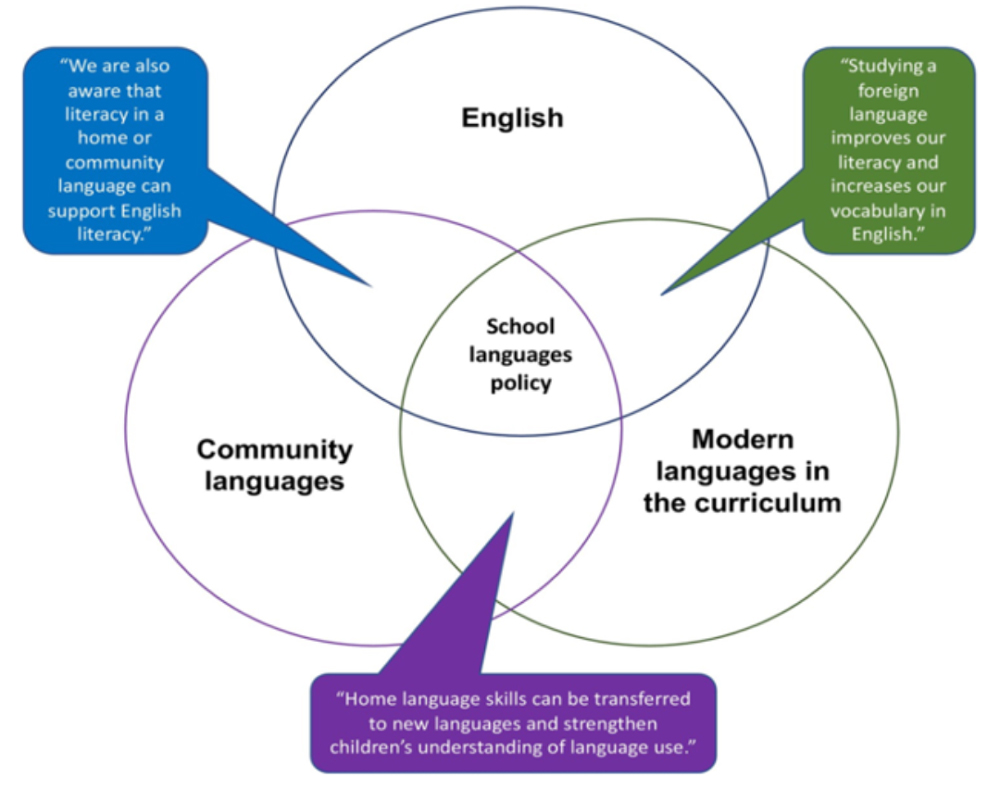
As these concentric circles of interaction widen, so too do students’ linguistic repertoires expand, shifting the focus from English proficiency to developing proficiency in multiple languages, and in so doing, emphasizing the importance of maintaining the mother tongue and in acquiring an additional language without asking students to choose between linguistic identities in countries where multilingualism is the norm (Klapwijk, N. & van der Walt, C., 2016; Tay, I., 2025). Plurilingual proficiency translates into the new linguistic and cultural capital, fulfilling the overall aim of the International Baccalaureate (IB) language curriculum to create “internationally minded” individuals to navigate an increasingly interconnected world while also exercising that proficiency to advantage in a global workforce (Ascher, H.R. & Pichery, K., 2023; Huckle, J. 2022; Ortega, L. 2019; IBO, 2023 as cited in Tay, I. 2025; Vallejo, C., & Dooly, M., 2020).
This plurilingual ecological model has the potential to offer a more expansive approach to languages, language learners, and language learning, as proposed by the multilingual turn paradigm shift and articulated in the fifteen IB Language Tenets, designed to guide language development as a schoolwide commitment (Conteh, J., & Meier, G., 2014; IBO, 2023). Huckle (2025) calls for school leaders to navigate the challenges and opportunities of linguistic diversity and to lead the transformation towards a multilingual habitus. However, research indicates that school leaders are hired expressly for their Englishness, a feature that dominates schools’ organizational cultures and systems, and that the teachers most informed about a shift to a multi- and plurilingual habitus seldom have their voices heard (Huckle, 2025; Gardner-McTaggert, A., 2018). Moving from what is usually done to the creative design of what should be done requires a distributed leadership model in which, alongside positional leadership, teacher leaders assume responsibilities for ensuring multiple perspectives, interactions, and collaborative problem-solving opportunities (Gardiner-Hyland, F. 2025). This doesn’t mean that schools abandon the centrality of English, but that they embrace the rich multilingual realities of the ‘languages’ professionals to infuse multilingual dispositions, knowledge, and skills into every classroom and in every corner of the educational setting (Amin, S., & Mohamed, N., 2025).
In their efforts to assume responsibility for ensuring a multi- and plurilingual design, teacher leaders embed coaching and professional learning opportunities into curriculum, pedagogy, and assessment practices (Gonzalez-Ajeda, A. et al., 2024; Nordmeyer, J. & Rojas; V.P., 2025). Five leadership moves immediately impact the opportunities multilingual learners have for learning:
Co-construct a content and language integrated learning curriculum—an approach used to promote multilingualism—whereby subject area assessment tasks inform the development of language goals to be taught by content teachers (Forbes, K. & Morea, N., 2024; Rojas, V.P, 2025; Tai, K.W.H. et al., 2025);
Embed the multiple dimensions of scaffolding for designing asset-based instruction and assessment in rigorous, dual language contexts (LaChance, J., & Honigsfeld, A., 2022; Van Viegen, S. et al., 2026)
Unlock translanguaging and culturally responsive teaching as sustainable resources to tap into multilingual learners’ assets by embracing their plurilingual and intercultural repertoires (Asher, H.R. & Pichery, K., 2023; Barros, S. et al., 2021; Duarte, J., 2020; Heugh, K., 2023; Huckle, J. November, 2022; Rojas, V.P. November, 2022; Wei, L., 2024; Will, M. & Najarro; I., 2022);
Model how to utilize a genre-based pedagogy to apprentice students of varying proficiency levels as writers, readers, and speakers in their multiple languages (Troyan, F.J. et al. 2019; WIDA, 2025);
Cultivate a multiliteracies pedagogy and artificial intelligence strategically to impact language teaching and learning in general, and multilingual learners’ academic success and development of language and disciplinary literacies specifically (Utrecht, J. & Warner, B., 2025; Zapata, G.C. et al., 2023).
International schools may face a veridical paradox when presented with the three continuum options above: the seemingly least likely choice may nevertheless be the most informed. The monolingual paradox of multilingual international schools is simple: the historical hegemonic dominance of English minoritizes the linguistic repertoires of diverse students, treating them as hurdles to be overcome, much as happens in English-language national schools bounded by the monolingual habitus. Despite the shift towards a majority linguistically diverse population, international schools may continue to pursue a "monolingual monolith" approach, in which the raison d'être is to produce standardized, globalized, and competitive students rather than truly plurilingual ones. Many international schools attest to serving as a market for international cultural capital, emphasizing an international-mindedness that represents the multilingual lifeways of students, families, and communities as a normal, integral part of their lives. This concept views plurilingualism as a dynamic, "lived reality" that shapes how people communicate, work, relate to others, and understand themselves. As with the Monty Hall lesson, schools might re-evaluate their initial decision, since, when given the opportunity to incorporate new informed perspectives, switching is the winning strategy.
References
Amin, S. & Mohamed, N. (June 25, 2025). Building a Whole-School Approach to Multilingualism: A Leader’s Perspective. TESOL International Association. https://www.tesol.org/blog/posts/building-a-whole-school-approach-to-multilingualism-a-leader-s-perspective/
Ardell, L. (2025). Disrupting the monolingual bias: A framework for teacher advocacy. Corwin Pess.
Ascher, H. R. & Pichery, K. M. (2024). Language policy in English as a medium of instruction schools: A multilingual approach. In M. Barker, R. Hansen, & L. Hammer (Eds.), Handbook of research on critical issues and global trends in international education. 260-283. IGI Global Scientific Publishing. https://doi.org/10.4018/978-1-6684-8795-2.ch011
Barker, B. (2023). EAL/D or an additional need? A cycle of learning, teaching and assessment to discern if an EAL/D student has additional needs to learning English, Studies in Language Assessment, 12(2), 272-285, SiLA_12_2_Barker1.pdf.
Barros, S., Domke, L. M., Symons, C., & Ponzio, C. (2021). Challenging monolingual ways of looking at multilingualism: Insights for curriculum development, Journal of Language, Identity & Education, 20(4), 239–254. https://doi.org/10.1080/15348458.2020.1753196
Billings. E. & Walqui, A. (2018). Dispelling the myth of “English Only”: Understanding the importance of the first language in second language learning, 1-8. NYSED https://www.nysed.gov/sites/default/files/dispelling_myth_rev-2.pdf
Bunnell, T, & Gardner-McTaggart, A. (2022, July 8-9). Leadership in international schools: The enduring paradox of discrimination [Paper presentation]. British Educational Leadership Management Administration Society (BELMAS) Annual Conference, Liverpool, England. https://researchportal.bath.ac.uk/en/publications/leadership-in-international-schools-the-enduring-paradox-of-discr/
Conteh, J. & Meier, G. (Ed.) (2014). The Multilingual turn in languages education: Opportunities and challenges. Multilingual Matters.
Duarte, J. (2020). Translanguaging in the context of mainstream multilingual education. International Journal of Multilingualism. 17(2), 232–247. https://doi.org/10.1080/14790718.2018.1512607
Forbes, K. & Morea, N. (2024). Mapping school-level language policies across multilingual secondary schools in England: An ecology of English, modern languages, and community languages policies. British Educational Research Journal. 50, 1189–1207. https://doi.org/10.1002/berj.3959
Gardiner-Hyland, F. (2025). EAL teacher leaders’ knowledge, voice, and leadership identity in Irish schools. Second Language Teacher Education. 3(2), 148-171. DOI: 10.3138/slte-29978-Gardiner
Gardner-McTaggert, A. (2018). The promise of advantage: Englishness in IB international schools, Perspectives: Policy and Practice in Higher Education. 22(4), 109–114. https://doi.org/10.1080/13603108.2018.1456491.
Genesee, F. (2022). The monolingual bias: A critical analysis. Journal of Immersion and Content-Based Language Education. 10(2), 153-181. DOI: 10.1075/jicb.21016.gen
Gogolin, I. (2013). The "monolingual habitus" as the common feature in teaching in the language of the majority in different countries. Per Linguam. 12(2) 38-49. DOI: 10.5785/13-2-187.
Gonzalez Ojeda, A., Fisher, D., & Frey, N. (2024). Leading the Multilingual School. In Multilingualism in Its Multiple Dimensions. IntechOpen. https://doi.org/10.5772/intechopen.1005496
Gorter, D. & Arocena, E. (2020). Teachers’ beliefs about multilingualism in a course on translanguaging. System. https://doi.org/10.1016/J.SYSTEM.2020.102272
Heugh, K. (2023). Multilingualism, plurilingualism, translanguaging and transknowledging: recharting languages education futures. [Keith Horwood Memorial Lecture, Australian Federation of Modern Language Teachers Associations (AFMLTA).] Babel, 57, (1-2), 7-10. DOI: 10.13140/RG.2.2.13996.07047
Huckle, J. (2025). The leadership for multilingualism framework: What do we need to understand, believe, and do to lead in multilingual international schools? In M. Barker & L. Hammer (Eds.), Diversity and Inclusion Challenges for Leaders of International Schools (pp. 225 – 254). IGI Global. DOI: 10.4018/979-8-3373-0867-8.ch001
Huckle, J. (November, 2022). Routines for Translanguaging & Multilingual Thinking, jacobhuckle.com www.jacobhuckle.com/routines.
Huckle, J. (July 25, 2022). Rethinking and reconfiguring English(es): Challenging the dominance of English in international schools. Medium. https://medium.com/@jacobhuckle/rethinking-reconfiguring-english-es-challenging-the-dominance-of-english-in-international-112f8ac1d82b
Huckle, J. (2021). Multilingualism and the International Baccalaureate Diploma Programme (IBDP): An analysis of language learning in the IBDP in light of the ‘Multilingual Turn’. Journal of Research in International Education. 20(3) 263–280. DOI: 10.1177/14752409211059267
Hult, F.M. & Hornberger, N.H. (2016). View of revisiting orientations in language planning: problem, right, and resource as an analytical heuristic (pp. 30-49). Bilingual Review, 33(3), 30-49. http://bilingualreview.utsa.edu/index.php/br/article/view/118
International Baccalaureate Organization. (2023). The IB language tenets. Cardiff, Wales: International Baccalaureate Organization.
ISC Research (2025). Meeting the challenges of shifting student demographics: EAL provision in international schools - ISC Research. https://iscresearch.com/reports/eal-white-paper-2025/
Kim, S., Park, J.Y. & Zhao, M. (2024). Content teachers’ beliefs and attitudes toward working with multilingual learners through integrative approaches. Frontiers 9. 1-14. https://doi.org/10.3389/feduc.2024.1282936
Klapwijk, N. & Van der Walt, C. (2016) English-Plus multilingualism as the new linguistic capital? Implications of university students' attitudes towards languages of instruction in a multilingual environment, Journal of Language, Identity & Education, 15(2), 67-82. DOI: 10.1080/15348458.2015.1137475
LaChance, J. & Honigsfeld, A. (2022). Collaboration and co-teaching for dual language learners: Transforming programs for multilingualism and equity, Corwin Press.
Nordmeyer, J. & Heidt, B. (2025). Using research to transform multilingual international school communities. The International Educator (TIE Online). https://www.tieonline.com/article/5713/using-research-to-transform-multilingual-international-school-communities
Nordmeyer, J. & Rojas, V.P. (2025). When more is never enough, it’s time to think differently. The International Educator (TIE Online). https://www.tieonline.com/article/7801/when-more-is-never-enough-its-time-to-think-differently
Ortega, L. (2019), SLA and the study of equitable multilingualism. The Modern Language Journal, 103. 23-38. https://doi.org/10.1111/modl.12525
Piccardo, E. (2017). Plurilingualism as a catalyst for creativity in superdiverse societies: A systemic analysis. Frontiers in Psychology, 8:2169, 1-13. Doi: 10.3389/fpsyg.2017.02169
Rojas, V.P. (2025). A promising mythconception. The International Educator (TIE Online). A Promising Mythconception | The International Educator (TIE Online).
Rojas, V. P. (2023). Out with the old medical models, In with a new ecological response. The International Educator (TIE Online). https://www.tieonline.com/article/3399/out-with-the-old-medical-models-in-with-a-new-ecological-response
Rojas, V.P. (November, 2022). In response to English only: A translanguaging call to action, The International Educator (TIE Online). In Response to English-Only: A Translanguaging Call to Action | The International Educator (TIE Online)
Rojas, V.P. (October, 2022). From deficit thinking to an asset-based paradigm. The International Educator (TIE Online). https://www.tieonline.com/article/3338/from-deficit-thinking-to-an-asset-based-paradigm
Rojas, V.P. (August, 2022). From monolingual mindsets to the multilingual turn. The International Educator (TIE Online). https://www.tieonline.com/article/3296/from-monolingual-mindsets-to-the-multilingual-turn
Schwab, S., & Günesli, H. (2026). Monolingual habitus through the lens of multilingual parents. Journal of Multilingual and Multicultural Development, 47(4). 2101–2117. https://doi.org/10.1080/01434632.2025.2455985
Slaughter, Y. & Cross, R. (2021). Challenging the monolingual mindset: Understanding plurilingual pedagogies in English-as-an-additional-language (EAL) classrooms. Language Teaching Research 25(1):39-60. DOI: 10.1177/1362168820938819
Soto, I. et al. (2023). Breaking down the monolingual wall: Essential shifts for multilingual learners' success. Corwin Press.
Spina, C. (2025). Igniting real change for multilingual learners: Equity and advocacy in action. Routledge Publishers.
Szeto, A. (May 13, 2026). From Translation to Transcreation: Using AI to Connect with Multilingual Families. ISTE+ASCD Blog. https://ascd.org/blogs/from-translation-to-transcreation-using-ai-to-connect-with-multilingual-families.
Tai, K.W.H., Wei, L. & Loh, E.K.Y. (2025). Enhancing students’ content and language development: Implications for researching multilingualism in CLIL classroom context. Learning and Instruction, 96. 1-7. https://doi.org/10.1016/j.learninstruc.2025.102083
Tay, I. (2025). View of reconceptualizing the IBDP and IAL as English-medium instruction: A critical review of policy and pedagogical implications for international schools, Journal of International and Comparative Education. 14(2), 47–61. https://doi.org/10.14425/jice.2025.14.2.1205
Troyan, F.J., Sembiante, S.F. & King, N. (2019). A case for a functional linguistic knowledge base in world language teacher education. Foreign Language Annals. 52. 644–669. https://doi.org/10.1111/flan.12410
Utecht, J. & Warner, B. (January 15, 2025). The potential of AI for multilingual learners. Shifting Schools. https://www.tieonline.com/article/5695/the-potential-of-ai-for-multilingual-learners
Vallejo, C., & Dooly, M. (2020). Plurilingualism and translanguaging: emergent approaches and shared concerns. Introduction to the special issue. International Journal of Bilingual Education and Bilingualism, 23(1), 1–16. https://doi.org/10.1080/13670050.2019.1600469
Van Viegen, S., Bell, N. & Khan, N. (2026). Creating a multilingual assessment ecology in the classroom. TESOL QUARTERLY. https://doi.org/10.1002/tesq.70071
WIDA (2025). Taking a genre-based approach to curricular development using the curriculum amplification guide, WIDA Focus Bulletin, 1-15.
Will, M. & Najarro, I. (April 18, 2022). What Is Culturally Responsive Teaching? EducationWeek
Wei L. (2024). Transformative pedagogy for inclusion and social justice through translanguaging, co-learning, and transpositioning. Language Teaching, 57(2), 203-214. doi:10.1017/S0261444823000186
Zapata, G.C., Kalantzis. M., & Cope, B. (2023). (Eds.). Multiliteracies in international educational contexts: Towards education justice, Routledge.
Dr. Virginia Rojas coordinates the EAL certification program in partnership with the Principals’ Training Center. Before semi-retiring to Mexico, she was a faculty member for the Association of Supervision and Curriculum Development (ASCD) and a language education consultant for over 350 international schools. She is an inductee into the Association for the Advancement of International Education (AAIE) Hall of Fame.