


In a design class, a student can produce a detailed project plan for a design assignment and still leave examination revision until the last minute. Another can test a prototype against carefully written criteria but rarely stop to ask whether a semester goal submitted at the beginning of the semester is on course.
As a design teacher, I have seen versions of these contradictions in all the schools I have taught. Students can demonstrate thoughtful planning, testing, and reflection when a task requires it, yet those same habits do not always appear elsewhere in their lives inside and outside of school. This raises a question that matters beyond the design subject: How do we help students carry useful ways of thinking from one learning context into another?
Middle Years Programme (MYP) design offers a useful starting point. The International Baccalaureate describes design as a process in which students investigate and analyze problems, develop feasible solutions, create them, and test and evaluate their success (International Baccalaureate Organization [IBO], 2026). The visible outcome may be a website, prototype, or digital product. But underneath the design products sit a way of thinking. This thinking includes the need to understand before acting, consider alternatives, plan deliberately, respond to change, and evaluate honestly.
The challenge is that transferring this thinking is not automatic. Perkins and Saloon (1992) argue that learners may fail to recognize when knowledge from one setting is relevant in another. It is therefore imperative for teachers to be deliberate in connecting relatable contexts. Lobato (2008) similarly shows that possessing knowledge does not guarantee that students will use it when a problem looks different. There is a need for deeper learning where students can apply their knowledge and skills in new situations (National Research Council, 2012). For teachers, the implication is simple: if we want students to use classroom learning beyond the classroom, we need to help them see the connection.
Four Design Habits for Life
The four MYP design criteria make these connections surprisingly visible.
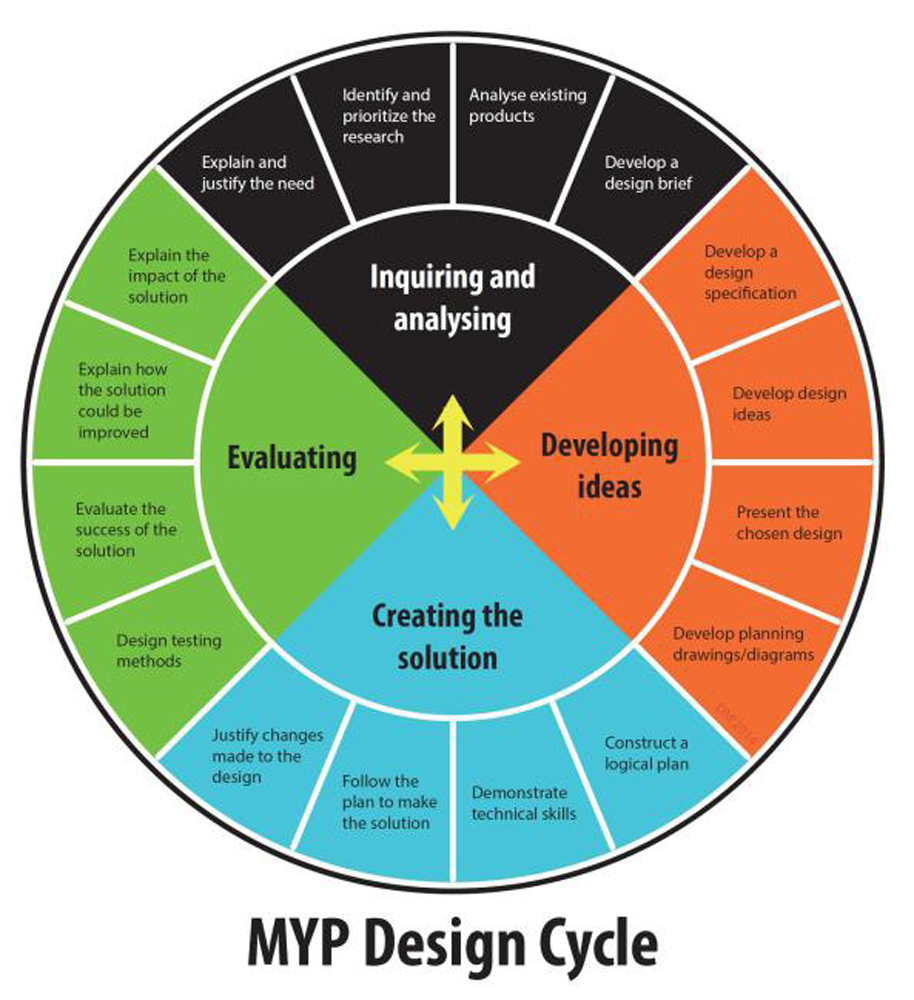
The MYP Design Cycle. (Photo source: IBO)
Criterion A: Learn before you act.
Students begin their design journey by identifying a problem, determining what they need to know, examining existing solutions, and using evidence before deciding what to do to solve the design problem. The underlying life lesson is inquiry before any meaningful action. Whether a student is choosing subjects, managing screen time, or deciding how to approach a difficult situation, useful action often begins with better questions. The questions are: What is really happening? What do I need to know? Whose perspective should I consider?
Criterion B: Do not fall in love with your first idea.
Students develop criteria for success, generate alternatives, and justify a chosen idea. The deeper lesson is that the first solution may not necessarily be the best one. Students can learn to ask: What are my options? What matters most? What evidence supports this choice? These are design questions, but they are also decision-making questions which can be applied in various areas of our lives.
Criterion C: Plans matter, but plans can change.
Students plan, manage resources, create, monitor progress, and explain changes. In my classroom, students may carefully sequence the steps needed to build a website or prototype. Yet some students may approach revision or another long-term task without a clear plan. This creates an opportunity to ask: Could the planning process you used here help you somewhere else? For example, planning your service project.
Criterion C can also teach students that adapting a plan is not necessarily evidence that the original plan failed. Sometimes changing direction shows that we are responding intelligently to new information.
Criterion D: Finishing is not the same as learning.
Students test solutions, evaluate them against criteria, identify improvements, and consider their impact. These habits closely resemble processes associated with self-regulated learning: planning, monitoring progress and evaluating performance (Zimmerman, 2002).
The life questions become: Did it work? How do I know? What evidence do I have? What would I change next time? These questions confirm John Dewey's idea that we do not learn from experience alone, but by reflecting on experience.
In one digital citizenship unit, for example, my students researched online safety issues, developed website ideas, created their website to educate others on digital safety, gathered user feedback, and evaluated their websites. The assessed work was about design, but the habits underneath it were wider. They included listening before deciding, defining what success looks like, responding to feedback and improving a solution. Those connections become more useful when we name them explicitly rather than assume students will make them for themselves.
A DESIGN for Life Framework
To make these underlying habits easier for students to recognize, I propose a simple practitioner framework called DESIGN for Life.
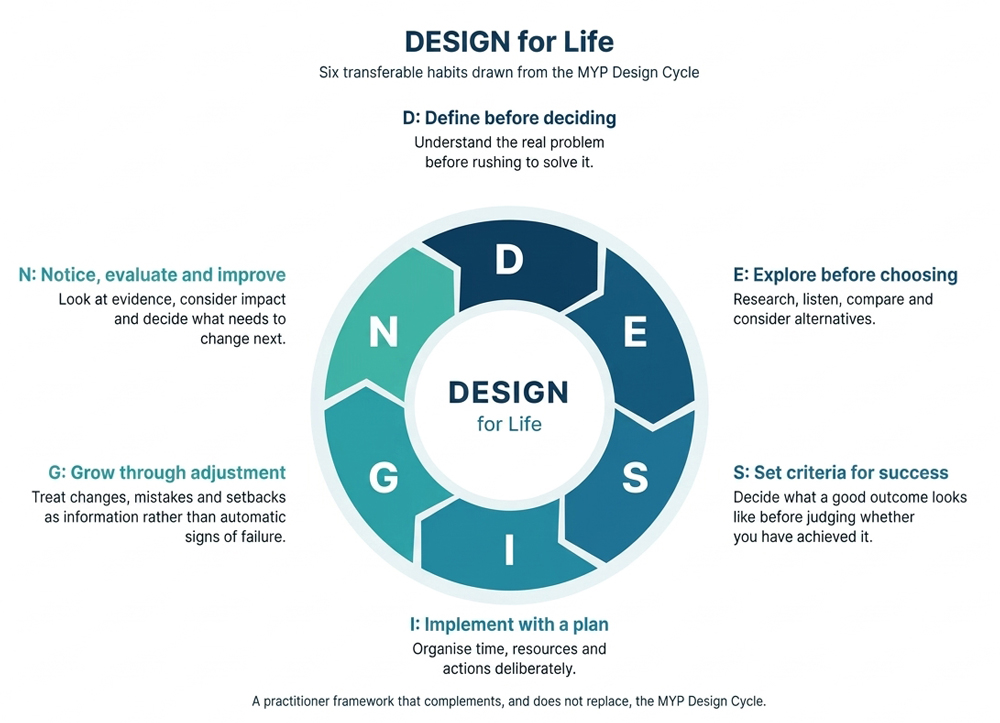
D: Define before deciding.
Understand the real problem before rushing to solve it.
E: Explore before choosing.
Research, listen, compare and consider alternatives.
S: Set criteria for success.
Decide what a good outcome should look like before judging whether you have achieved it.
I: Implement with a plan.
Organize time, resources, and actions deliberately.
G: Grow through adjustment.
Treat changes, mistakes, and setbacks as information rather than automatic signs of failure.
N: Notice, evaluate, and improve.
Look at evidence, consider impact, and decide what needs to change next.
The framework does not replace the MYP Design Cycle. It makes some of its transferable habits easier to name. And although it grows from design, its questions are not limited to design teachers.
A language teacher can ask students to define what success will look like before preparing an oral presentation. A science teacher can ask how new evidence should change an initial explanation. A career counselor can help a student compare post-secondary options against personally meaningful criteria. A sports coach can ask athletes to evaluate a training plan and adjust it using evidence.
Making Transfer Visible
Helping students transfer learning does not necessarily require another unit or another assessment. Sometimes one question is enough. After students create a plan, ask: Where else could this planning process help you? After they compare possible solutions, ask: What decision outside this class could benefit from comparing options against clear criteria? When they change a plan, ask: When is changing your mind evidence of good judgment? After an evaluation, ask: What personal goal could you review using the same process?
Teachers can also design short transfer tasks. Students might use success criteria to compare university options, apply a project schedule to examination preparation, or use an evaluation framework to review their study routine. These small acts of bridging help students move from “I can do this in this class” toward “I recognize when this way of thinking might help me.” That is the larger promise of design education. Its value is not only in what students make. It is also in the habits they practice while making it. If we teach only the project, students may remember the product. If we make the thinking beneath the project visible, they have a better chance of carrying it into new situations. By doing so, we are helping our students turn their knowledge into action. As Herbert Spencer suggested, the great aim of education is not knowledge but action, which is in line with my school’s motto: knowledge in the service of Africa. Design is not simply about making things. It is practice in making decisions, solving problems, and shaping what comes next.
References
International Baccalaureate Organization. (2026). Design in the MYP. International Baccalaureate.
Lobato, J. (2008). When students don’t apply the knowledge you think they have, rethink your assumptions about transfer. In M. P. Carlson & C. Rasmussen (Eds.), Making the connection: Research and teaching in undergraduate mathematics education (pp. 289–304). Mathematical Association of America.
National Research Council. (2012). Education for life and work: Developing transferable knowledge and skills in the 21st century. The National Academies Press.
Perkins, D. N., & Salomon, G. (1992). Transfer of learning. In T. Husén & T. N. Postlethwaite (Eds.), International encyclopedia of education (2nd ed.). Pergamon Press.
Zimmerman, B. J. (2002). Becoming a self-regulated learner: An overview. Theory Into Practice, 41(2), 64–70.
Dr. Jonathan Amengor is an educator, researcher, and International Baccalaureate Middle Years Programme coordinator at SOS International College in Tema, Ghana. With more than 15 years of experience in education, he has worked across the Ghanaian secondary school curriculum, Cambridge International General Certificate of Secondary Education, and International Baccalaureate programs. His expertise spans curriculum development, educational assessment, teacher professional development, and instructional leadership. His teaching experience includes information and communications technology, MYP Design, Diploma Programme Theory of Knowledge, and Digital Society. In his leadership role, he supports curriculum planning, assessment practices, and teacher professional learning. He recently led his school's successful implementation of its first MYP eAssessment cycle, coordinating teacher preparation, student readiness, and assessment processes. He holds a doctorate in education from the University of South Africa. His professional and research interests include digital responsibility, curriculum decolonization, educational assessment, and teacher professional learning. As a scholar-practitioner, he is committed to bridging educational research and classroom practice, supporting teachers and school leaders in developing approaches to teaching, learning, and assessment that respond to changing educational needs.
LinkedIn: https://www.linkedin.com/in/dr-jonathan-amengor-891391b1/