These experiences are part of a biomedical science program at EF Academy New York, an international school, designed to give students interested in medicine meaningful opportunities to explore those interests through hands-on experiences. The program has made me think more broadly about something international schools are particularly well positioned to offer: strong co-curricular programs that go beyond occasional activities or traditional clubs.
International schools often provide rigorous academics, diverse communities, and preparation for universities around the world. But some of the most valuable opportunities we can give students happen beyond the formal curriculum, where they have space to explore an interest deeply, develop practical skills, take risks, and discover possible future pathways.
When an Interest Becomes an Experience
Many students arrive at international schools with strong ambitions. They want to become doctors, engineers, entrepreneurs, scientists, designers, or researchers. But wanting to enter a profession and understanding what that profession involves are very different things.
Medicine is a good example. A student can say for years that they want to become a doctor without ever having the opportunity to explore the practical side of medicine. They may understand that the profession requires strong academics, but they may know much less about the patience, precision, communication, coordination, problem-solving, and persistence that clinical work demands.
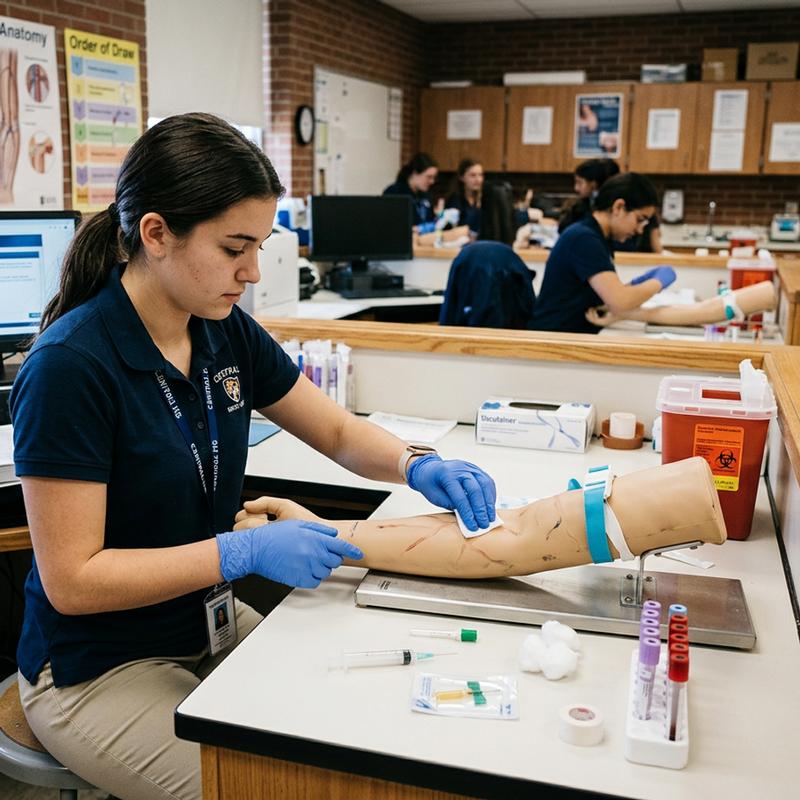
That gap is what I wanted the biomedical science program to address. Students do not simply discuss medical careers; they explore them. The program includes simulated phlebotomy, suturing, basic laparoscopic skills, anatomy exploration, and forensic investigation. These experiences combine practical skills with teamwork, problem-solving, and career exploration.
More Than a Club
There is nothing wrong with a club built around a shared interest. Clubs create community and give students opportunities to pursue something they enjoy. But a strong co-curricular program can go further by offering continuity, increasingly sophisticated experiences, specialized equipment, clear goals, and opportunities to develop knowledge and skills over time.
That distinction became important as the biomedical science program developed. Students do not simply meet occasionally to talk about medicine. They participate in medical and biomedical simulations and hands-on experiences. A student may initially join because medicine sounds interesting, but once they have to identify structures in the arm before exploring phlebotomy, manipulate instruments during a laparoscopic simulation, or repeatedly adjust a suture that did not work the first time, that interest becomes something they can actively investigate.
The difference is depth. Students are no longer only imagining a future profession; they are beginning to experience some of what it demands.
Let Students Encounter the Difficulty
One of the most useful things a strong co-curricular program can provide is difficulty without the pressure of grades. Students can struggle with a skill because the skill itself is difficult, not because an assessment has been designed to challenge them. That creates a different kind of persistence.
When a suture does not look right, the student can adjust and try again. When a laparoscopic instrument does not move as expected, the student has to rethink the relationship between what their hands are doing and what they see on the screen. When simulated phlebotomy requires more precision than expected, the student begins to understand why professionals train for years.
Success is not always completing the task perfectly. Sometimes success is discovering how much practice the task requires. A co-curricular program can create a space where improvement, patience, curiosity, and repeated attempts matter more than a grade.
Why International Schools Are Ideal Places
International schools are especially well positioned to build programs like this because students bring different cultures, educational backgrounds, experiences, and levels of access to professional opportunities. One student may have family members working in medicine, while another may know the profession only through school, media, or personal experiences as a patient. Some may have attended specialized camps or shadowing opportunities, while others may never have had access to anything similar.
A school-based program creates a shared starting point. Around a training arm or laparoscopic simulator, students encounter the same challenge together. That does not erase differences in opportunity, but it can make exploration more accessible. Students should not need a family connection to a hospital or an expensive outside program before they can begin investigating whether medicine interests them.
International schools can bring some of those opportunities inside and make them part of the student experience.
Co-Curricular Programs Can Become Pathways
The biomedical program has reinforced for me that strong co-curricular experiences should not exist simply to occupy students after class. They can become pathways. A student who enters because they want to become a doctor may discover an interest in biomedical research, anatomy, biotechnology, forensic science, nursing, genetics, biomedical engineering, or laboratory work.
A student may also decide that clinical medicine is not what they expected, and that is valuable too. Career exploration should not only confirm existing plans; it should give students enough experience to question them intelligently. If a student discovers at 16 that they love medical science but dislike clinical procedures, or that they are more interested in the problem-solving of forensic investigation than patient care, that insight can open a pathway they had not previously considered.
A strong program gives students permission to find out.
What Do We Want Students to Carry With Them?
International schools often emphasize university preparation, global citizenship, and readiness for an increasingly complex world. Strong academics are essential to that mission, but preparation also means giving students meaningful opportunities to discover what they care about and what kinds of work they may want to pursue.
A student holding a laparoscopic instrument for the first time may discover that surgery fascinates them, while another may decide they prefer research. A student practicing simulated phlebotomy may become more interested in anatomy and patient care, while someone working through a forensic investigation may discover that what really excites them is evidence, laboratory analysis, or scientific problem-solving.
None of those discoveries can be guaranteed, and that is exactly the point. Co-curricular education should create room for discovery rather than predetermined outcomes. The biomedical science program has convinced me that some of the most valuable opportunities international schools can offer are not necessarily the ones that produce another certificate or another line on a university application. They are the experiences that allow students to encounter something they had previously only imagined.
So perhaps the question for international schools is not simply, “How many clubs do we offer?” A better question is, “Which of our programs give students the time, tools, expertise, and space to turn an interest into something real?”
That is where co-curricular education can become one of the most powerful parts of the international-school experience.
Osman Tuncel is an international science educator who teaches International Baccalaureate and Advanced Placement biology at EF Academy New York, where he also leads a hands-on biomedical science program. He has taught science in the United States and internationally and previously served as a head of science and biomedical curriculum developer. His teaching focuses on inquiry, authentic laboratory experiences, biotechnology, and connecting science learning with real-world applications. He holds a Master of Education in the International Baccalaureate from the University of Melbourne and is currently pursuing a Doctor of Education in Curriculum and Instruction.