

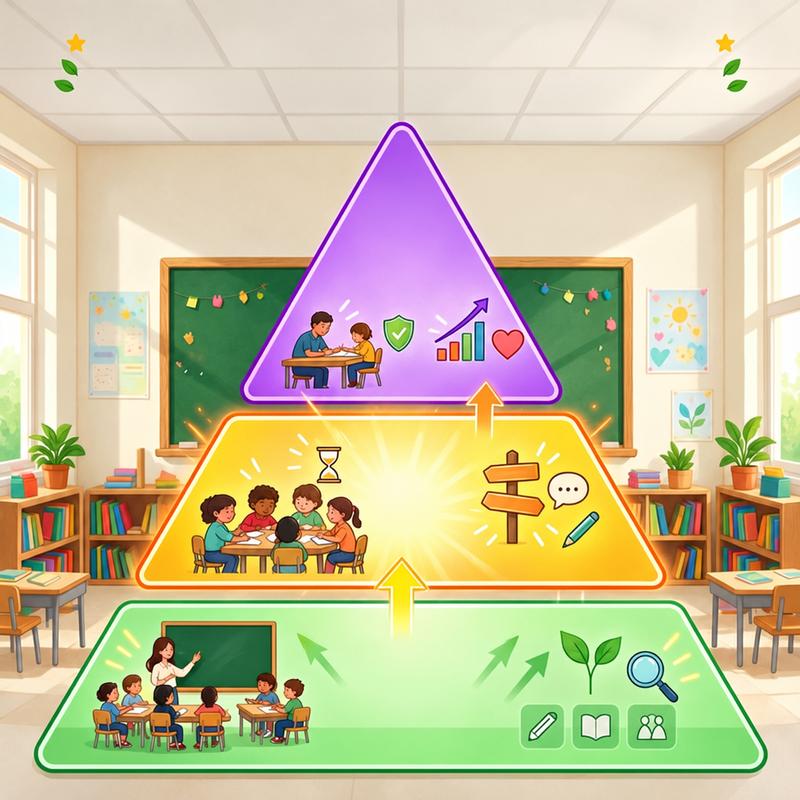
Tier 2 has an identity problem.
Schools generally know what Tier 1 and Tier 3 should look like within a Multi-Tiered System of Supports (MTSS), a framework for organizing different levels of support according to students’ needs. Tier 1 is universal provision: inclusive, well-differentiated teaching built into every classroom, delivered by every teacher, for every student. Tier 3 is intensive, individualized support: targeted intervention for students with more significant or persistent needs, often delivered by English as an Additional Language (EAL) teacher, learning support, or other specialist teams, sometimes through withdrawal from the classroom.
Tier 1 belongs in the classroom. Tier 3 is often associated with specialist teams. Tier 2 is often much harder to pin down.
Intended to provide targeted, additional support for students who need more than universal classroom provision, but not the intensive, individualized support of Tier 3, it can become a thin layer in the middle: interventions, catch-up groups, and extra support that happen in an ad hoc way, rather than as anything planned or intentional.
In some schools, it barely exists. In others, students enter Tier 2 without anyone being particularly clear about what they need, other than maybe to catch up. And when that middle layer is weak, the pressure has to go somewhere.
I have seen this pattern across different schools and systems I have worked in: strong Tier 1 practice, carefully built up over years, sitting alongside genuinely outstanding Tier 3 specialist provision. And yet, because Tier 2 is missing, things still come undone. Students who need short-term, targeted support instead drift, slipping further behind before anyone catches it. Tier 3 keeps growing to absorb them, filling with students who never needed that level of support in the first place.
The answer isn’t to repeat existing approaches, make another referral, or bolt on another catch-up group. It’s giving Tier 2 a clearer logic of its own. Tier 2 should be targeted, timetabled, and shared.
Targeted: analysis, not placement.
Take several students across different science classes struggling to explain cause and effect. If it’s a whole-class pattern, that’s a Tier 1 issue, taught more explicitly within normal lessons. If it’s a handful of students, they need a short, specific block of work, not a lengthy program.
Too often, we start from the fact that a student is “behind” and look for a program to put them into, rather than analyzing what they actually need. A student struggling with comparative language doesn’t necessarily need a term of generic literacy intervention. A student who hasn’t grasped a prerequisite math concept doesn’t need a broad catch-up group; they need explicit teaching of that concept. The gap is specific, so the response should be too.
Because the target is specific, the intervention can be short, often just a few weeks, rather than becoming another long-term provision pathway.
Timetabled: if it depends on goodwill, it will remain fragile.
Identifying the right intervention is only half the problem. Someone still has to deliver it, and this is where Tier 2 often becomes unsustainable. It happens at lunchtime, during somebody’s planning period, when a teaching assistant happens to be free, or because a specialist has agreed to squeeze in one more group. If schools believe Tier 2 matters, it needs to appear on the timetable.
Short, targeted intervention should form part of a department, phase, or grade-level team’s normal provision, with identifiable staff responsible for delivering it. The same is true of the collaboration required to make it work: teachers and specialists need protected time to analyze need, plan intervention, and review impact.
This is often where conversations about “buy-in” begin, but buy-in isn’t always the real problem, at least not on its own. When collaboration is something staff are expected to do on top of everything else, it will inevitably be inconsistent. When it has a place in the timetable, meeting structures and workload, it simply becomes part of how the school works.
The same principle applies when teaching assistants deliver Tier 2. We cannot hand someone an intervention and assume effective delivery will follow. If teaching assistants are expected to provide targeted academic support, they also need training, planning time, and access to the expertise behind it.
The cost that schools sometimes overlook is the analysis itself. Working out precisely what a student needs takes time. So does deciding what to teach, how to teach it, and what progress should look like at the end of a short intervention block. But that time does not disappear if we refuse to spend it. We simply spend it later, often when the student is in greater difficulty, the specialist caseload is larger and the stakes are higher.
Shared: specialists build capacity rather than absorbing delivery.
Perhaps the biggest shift is ownership. Tier 2 should not automatically belong to EAL or learning support. If a student needs targeted support to access science, history, or mathematics, there is a strong argument that the department, phase, or classroom team should remain closely involved in that support. Otherwise, responsibility for the student’s progress can quietly move away from the classroom and towards the specialist team.
That has consequences beyond Tier 2. When subject and classroom teachers are involved in designing and delivering intervention, they become more aware of the barriers students encounter in their own areas of the curriculum. A science teacher begins to notice the language demands involved in explaining a process. A history teacher becomes more conscious of the linguistic complexity of evaluating evidence. A math teacher sees that understanding the mathematics and understanding the language used to express it are not always the same thing. Primary teachers may begin to notice patterns too, such as which aspects of reading are breaking down or where students struggle to organize written ideas.
In other words, good Tier 2 work can strengthen Tier 1. This does not make specialist expertise less important. It makes better use of it.
An EAL specialist might help colleagues understand how academic language develops, identify the language demands within a topic, or design a short intervention around a particular linguistic structure. A learning support specialist might help teachers understand how a specific need presents, identify barriers to access, or adapt the way a skill is taught. The classroom or subject teacher brings something equally important: deep knowledge of the curriculum, the context in which the skill is being used and what successful performance actually looks like. Tier 2 becomes collaborative rather than outsourced.
That does not mean specialist teachers should never deliver Tier 2. There will be students, interventions, and school contexts where specialist delivery is entirely appropriate. The problem comes when additional need automatically becomes specialist ownership, regardless of what the student actually needs or where that support could most effectively sit.
Specialists also have a wider role at Tier 2, which is building capacity. As teachers’ confidence grows, specialist involvement can become lighter touch because expertise is being spread through the school rather than contained within one team. But this only works if coaching and collaboration are recognized as part of specialist work. If every minute of an EAL or learning support teacher’s timetable is filled with direct intervention, there is no space to build anyone else’s capacity. We cannot ask specialists to work systemically while timetabling them entirely for individual delivery.
A clear beginning and a clear end.
There is one final feature that separates Tier 2 from open-ended additional support: it should have an endpoint. At the end of a defined intervention block, perhaps four or five weeks for some targets and longer or shorter for others, the question is not whether the student has “graduated” from Tier 2 and returned to Tier 1. They never left Tier 1. Tier 2 sits on top of strong classroom teaching. It does not replace it.
The question is much more specific: has the gap we identified changed? If it has, the intervention changes or stops. If another specific need becomes apparent, there may be another short, targeted block. If Tier 2 support has been delivered well and is not shifting the difficulty, that tells us something too. It may be time to look more closely and consider whether the student requires Tier 3 support. That is a far more useful pathway than leaving students in intervention indefinitely simply because nobody is quite sure what should happen next.
What a stronger Tier 2 makes possible.
Tier 2 does not need to become another large layer of provision. In fact, that risks recreating the very problem it is supposed to solve. It needs to be precise: target the gap, put the response on the timetable, keep responsibility close to the classroom, use specialists to build expertise as well as provide it, and review after a defined period to decide what the evidence tells you to do next.
Built this way, Tier 2 stops being the vague space between classroom teaching and specialist intervention. It becomes the part of the system that notices a student starting to struggle and responds early, so that for many students, Tier 3 never needs to be the next step.
Brenna Weston Bell is an Anglo-American educator with 25 years of experience in inclusive education. Currently head of EAL at Regents International School Pattaya, Thailand, and a Senior Fellow of the International Forum of Inclusion Practitioners (IFIP), she specializes in multilingual learners, neuroinclusion, and whole-school approaches to inclusion.
LinkedIn: https://www.linkedin.com/in/brenna-weston-bell-fifip-1b2b49279/