

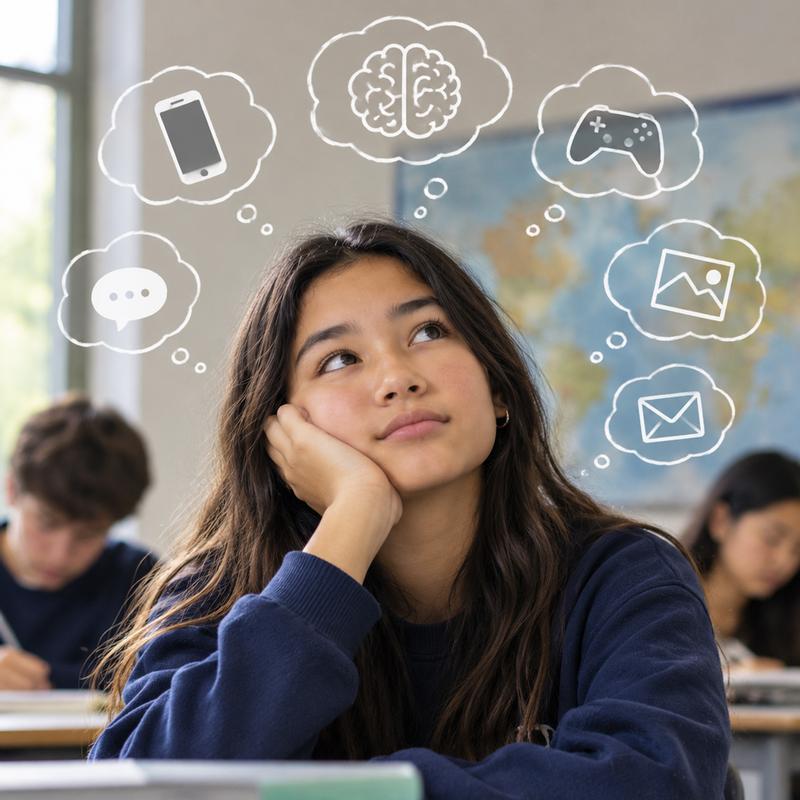
It is 8:00 in the morning. A teacher asks a question. Some students respond. Others have that ambiguous expression every teacher knows: present, but not quite there. Someone asks for the instructions again. Another student starts the task and, a few seconds later, is already looking somewhere else.
The teacher thinks: They can’t concentrate. Maybe. But before accepting that explanation, another question is worth asking: What exactly do we mean when we say a student can’t concentrate?
For years, attention has often been treated as an individual quality, almost a matter of character. There are focused students and distracted students, engaged students and disengaged students. It is a convenient way to describe what we see. And precisely because it is convenient, it may be incomplete.
Before concluding that a student lacks attention, perhaps we should ask what kind of attention we are asking for, and what kinds of attention the student has been practicing elsewhere. Because the issue may not be only how much attention a student has. It may also be how they have learned to use it.
Attention Is a Selection System
Attention is not a camera pointed at the world. It is a dynamic process of selecting and prioritizing information in relation to goals, expectations, and what becomes salient in the moment (Nobre & van Ede, 2023). That distinction matters in school. A surprising image can capture attention. A joke can capture attention. A story can capture attention. A notification can capture attention too.
But capture is only the beginning. Learning requires attention to be directed toward something, sustained long enough to work on it, and connected to meaning. It also requires students to retrieve and reconstruct what they have learned rather than merely recognize it. Research on retrieval practice in school settings shows consistent benefits for learning across a range of classroom contexts (Agarwal et al., 2021).
So perhaps the educational question is not simply: How do we get students to pay attention?
Perhaps it is: What kind of attention are we asking students to develop?
From Information Scarcity to Attention Scarcity
More than 50 years ago, Herbert A. Simon argued that in an information-rich world, attention becomes a scarce resource (Simon, 1971). Today, information is abundant, immediate, and continuously refreshed. Digital platforms do more than deliver information: many use features that encourage users to return, continue scrolling, watch another item, or respond to a notification. The National Academies of Sciences, Engineering, and Medicine identifies recommendations, autoplay, infinite scroll, and push notifications among persuasive design features that can be used to capture users’ attention and time (National Academies of Sciences, Engineering, and Medicine [NASEM], 2024).
This does not mean that technology simply “destroys attention.” That claim is too broad for the evidence. Social media experiences vary according to platform features, content, patterns of use, and individual differences among young people (Maheux et al., 2025).
The more useful question is: What kinds of attention are we repeatedly practicing inside the environments we have built?
Each Era, a Different Attentional Demand
What follows is not an exhaustive history of attention. It is an interpretive exercise: a way of asking what kinds of attentional demands particular environments have tended to privilege. The point is not that people in one era possessed one fixed kind of attention, but that different social environments made some forms of attending especially necessary.
Prehistory and Antiquity: REACT
For much of human history, attention was closely tied to immediate relevance: detecting movement, recognizing danger, locating food, and reading changes in the environment. React.
The Middle Ages: REMAIN
In parts of medieval Europe, especially in monastic settings, prayer, chanting, reading, and contemplation required prolonged engagement with the same text, idea, or practice. Not better attention, just different demands. Remain.
The Early Modern Period and Enlightenment: DISCOVER
The spread of movable-type printing from the mid-fifteenth century, followed by developments in modern science and Enlightenment thought, expanded opportunities for reading, comparison, observation, argument, and inquiry. Follow an argument. Compare ideas. Test a claim. Discover.
Industrialization: PRODUCE
Industrialization intensified social pressures around clock time, sequence, punctuality, repetition, and productivity (Thompson, 1967). The factory also became a powerful metaphor through which modern schooling was sometimes understood, although historians caution against treating that metaphor as a complete explanation of how schools developed (Davis et al., 2020). Attend in order to do. Produce.
Modernity and the Metropolis: FILTER
In 1903, Georg Simmel described metropolitan life as an environment of intensified and rapidly changing stimuli. His discussion of the blasé attitude refers not simply to boredom, but to a psychological adaptation in which a person becomes less responsive to the distinctions among stimuli when responding fully to everything becomes unsustainable (Simmel, 1903/1971). Do not respond to everything. Filter.
The Information Age: PROCESS
As computing, electronic media, and the Internet expanded, the challenge shifted toward selecting and processing information: evaluating sources, comparing claims, and deciding what mattered. Process.
The Attention Economy: COMPETE
Now we live in environments where content can be personalized, ranked, recommended, refreshed, and delivered in response to user behavior. The National Academies notes that recommendation systems, notifications, autoplay, and infinite scrolling can function as persuasive design features intended to extend time on platforms (NASEM, 2024).
This differs in an important way from the metropolis Simmel described. The city confronted people with an excess of stimuli. Digital platforms can also use information about our interactions to shape what appears next.
The issue is no longer simply that there is too much to notice. Some environments are designed to compete for what we notice.
The Educational Problem May Be Different Attention, Not Simply Less Attention
Once we recognize this shift, it is tempting to conclude that students now have shorter attention spans. But that conclusion is too simple. Young people can sustain attention when an activity is meaningful, socially engaging, emotionally relevant, or connected to a clear goal. At the same time, many digital environments repeatedly reward rapid orientation toward what is new, salient, social, or immediately rewarding.
The classroom may ask for something different: Stay with the problem. Read beyond the headline. Listen to the whole explanation. Revise the first answer. Work through confusion. Tolerate a period in which the reward is not immediate.
Perhaps some students are arriving at school with attention practiced for a different economy. If so, asking for more attention is not enough. We have to teach another way of using it.
School Cannot Outcompete an Algorithm
There is an obvious temptation. If students are accustomed to rapid stimulation, make lessons faster. If they watch short videos, use more videos. If they need novelty, increase novelty. If they are bored, eliminate boredom.
But this carries a hidden risk: we may teach students that whatever does not capture attention immediately is not worth staying with.
School has a different job. It does not need to become a slower entertainment platform. It needs to help students develop forms of attention that learning requires.
The Hook Is Not the Learning
Initial attention matters. A question can open a lesson. A paradox can create curiosity. A story can make an abstract idea human. A real problem can make a concept relevant. But the hook is not the learning. It is the doorway. Once attention has been captured, the teacher still has to help students direct it, sustain it, deepen it, and eventually retrieve what they have learned.
One useful way of thinking about that process is: Capture. Direct. Sustain. Deepen. Retrieve.
Capture attention by making something relevant. Direct it by making the destination of the thinking clear. Sustain it by organizing the task so students can remain with the work. Deepen it through discussion, analysis, interpretation, connection, and meaning-making. Retrieve it by asking students to reconstruct what they know rather than simply recognize it.
The point is not to turn every lesson into a spectacle. It is to help students experience the difference between being stimulated and being engaged.
Perhaps We Need an Attention Literacy
We have spent years talking about digital literacy. Students need to search for information, evaluate sources, recognize bias, and understand how digital environments shape what they see.
But perhaps there is another literacy beneath all of these: Attention literacy. I use the term here not as a formal diagnostic category, but as a way of naming capacities that schools may need to make more explicit. Can students decide what deserves their attention? Can they distinguish what is urgent from what is important? Can they resist interruption long enough to finish a thought? Can they remain with an idea that offers no immediate reward? Can they return to a task after their attention has wandered? Can they choose, deliberately, where to remain? These are not skills against technology. They are human capacities that matter regardless of technology.
The Question We Should Bring Into the Classroom
The discussion about technology in schools often becomes a debate about devices: Should students have phones? Should they use laptops? How much screen time is too much? Those are legitimate questions. But beneath them is a deeper educational question: What kind of attention are we teaching?
Are we helping students react quickly, or remain with a question? Select information, or simply consume it? Seek stimulation, or seek meaning? Use novelty as a bridge to learning, or come to believe that learning itself requires constant novelty?
And perhaps the most important question: When students leave our schools, will they know not only what to think about, but how to decide what deserves their attention?
Digital environments will continue competing for it. Schools do not need to win that competition. They need to teach something different: that attention can be directed, protected, practiced, and ultimately chosen. Education is not only about filling a mind with knowledge. It is also about helping a person decide what deserves space in that mind, and for how long. Perhaps one of the most important things a school can teach is not simply how to concentrate. It is how to choose where to remain.
AI Use Disclosure: During the preparation of this article, ChatGPT (OpenAI, 2026) was used as a support tool to curate and summarize relevant literature, check bibliographic details, test the organization of the argument, and refine language and style. The author reviewed the cited sources and retains responsibility for the article’s ideas, interpretations, factual claims, and final wording.
References
Agarwal, P. K., Nunes, L. D., & Blunt, J. R. (2021). Retrieval practice consistently benefits student learning: A systematic review of applied research in schools and classrooms. Educational Psychology Review, 33, 1409–1453. https://doi.org/10.1007/s10648-021-09595-9
Davis, R. A., Conroy, J. C., & Clague, J. (2020). Schools as factories: The limits of a metaphor. Journal of Philosophy of Education, 54(5), 1471–1488. https://doi.org/10.1111/1467-9752.12525
Maheux, A. J., Burnell, K., Maza, M. T., Fox, K. A., Telzer, E. H., & Prinstein, M. J. (2025). Annual research review: Adolescent social media use is not a monolith: Toward the study of specific social media components and individual differences. Journal of Child Psychology and Psychiatry, 66(4), 440–459. https://doi.org/10.1111/jcpp.14085
National Academies of Sciences, Engineering, and Medicine. (2024). Social media and adolescent health. The National Academies Press. https://doi.org/10.17226/27396
Nobre, A. C., & van Ede, F. (2023). Attention in flux. Neuron, 111(7), 971–986. https://doi.org/10.1016/j.neuron.2023.02.032
OpenAI. (2026). ChatGPT [Large language model]. https://chatgpt.com/
Simon, H. A. (1971). Designing organizations for an information-rich world. In M. Greenberger (Ed.), Computers, communications, and the public interest (pp. 37–52). Johns Hopkins Press.
Simmel, G. (1971). The metropolis and mental life. In D. N. Levine (Ed.), On individuality and social forms: Selected writings (pp. 324–339). University of Chicago Press. (Original work published 1903)
Thompson, E. P. (1967). Time, work-discipline, and industrial capitalism. Past & Present, 38(1), 56–97. https://doi.org/10.1093/past/38.1.56
Carlos Osorio is a psychologist and educator at The Columbus School in Medellin, Colombia, where he has taught Life Skills for 28 years. His professional work sits at the intersection of psychology, education, student well-being, and learning. Over nearly three decades in education, he has developed a particular interest in how changing social and technological environments are reshaping the ways students attend, engage, learn, and relate to themselves and others.