

Maya is a sixth grader who speaks three languages and has attended schools in four countries. In class, she listens carefully, contributes selectively, and completes her work well enough to avoid attention. Teachers describe her as adaptable. Her assessment scores fall between the 70th and 80th percentiles.
No one appears to have noticed the cognitive “translation” Maya performs before she raises her hand. She has not been referred for gifted services, perhaps because none exist, because her data do not suggest need, or because educators lack training in how giftedness appears across languages and cultures. The problem may not be Maya’s ability. It may be the framework through which the school is looking.
A Framework Problem
Students like Maya are hidden high achievers in international schools. They are academically successful but overlooked for gifted support. Many gifted education models were developed for stable, domestic contexts, creating a mismatch between the learner and the framework used to understand the learner.
International schools offer opportunities to develop deep thinkers, compassionate learners, and changemakers. Their environments act as a lever for Cross-Cultural Kid (CCK) and Third Culture Kid (TCK) identities. Many CCKs and TCKs live the dispositions associated with the 21st-century workplace: adaptive thinking, empathy, collaboration, and cultural awareness (OECD, 2019).
Although there is no globally agreed-upon definition of giftedness, several traits are well supported in the literature, including advanced cognitive ability, rapid learning, creativity, task commitment, intellectual curiosity, and asynchronous development (Gagné, 2004; Renzulli, 2012). Sheard (2008) identified overlaps between gifted learners and TCKs, including adaptability, feelings of difference or alienation, asynchronous development, and a tendency to mask identities or abilities to fit in socially.
My follow-up phenomenological study explored how gifted Cross-Cultural Kids understood this intersection. Participants described the combination as advantageous and complicated. They spoke about belonging and alienation, the social costs of ability, masking aspects of their identities, and the importance of family as a source of stability (Jaeger, 2020). These findings suggest an opportunity to foster intellectual gifts alongside the dispositions needed to thrive in multicultural environments.
International schools should consider a contextualized model of giftedness: a Transcultural Giftedness framework. This framework would account for students whose abilities are shaped, expressed, and obscured through multilingualism, high mobility, and cross-cultural experience. Research on multilingualism and multicultural experience suggests connections with lateral thinking, cognitive flexibility, creativity, and critical thinking (Leung et al., 2010; Liverani, 2024).
Transcultural Giftedness Theory (TGT) is an emerging conceptual framework that builds on existing research rather than a fully developed or validated theory. It focuses on three interconnected areas: cognitive flexibility, socio-emotional complexity, and resilience. Together, these areas offer a way to understand how giftedness may be expressed, shaped, and supported among students navigating multiple languages and cultures. 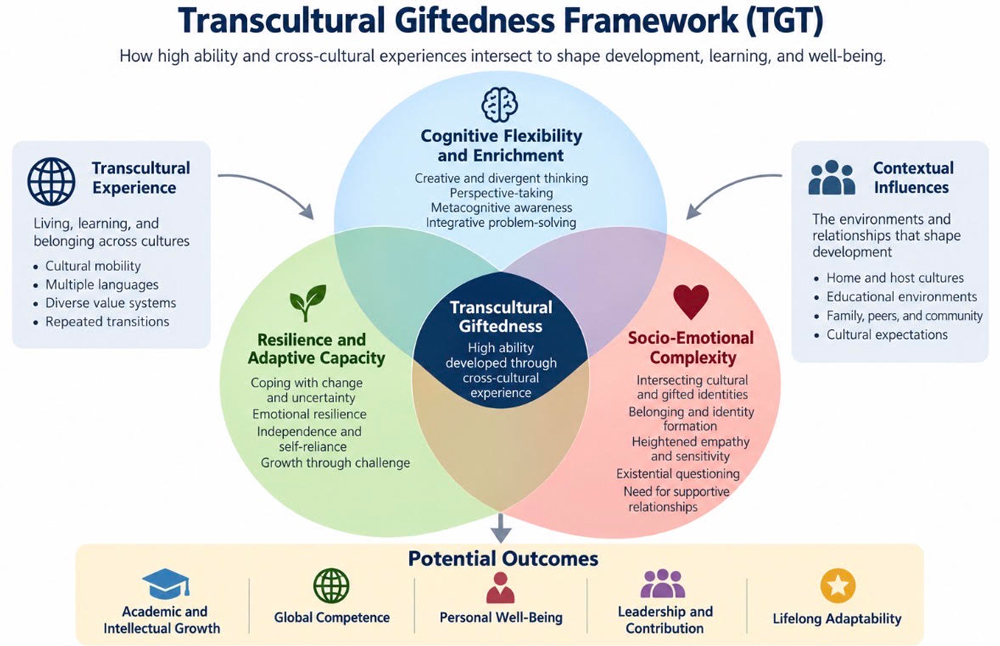
Seeing More Than a Percentile
This framework requires schools to reconsider identification. A score at the 99th percentile in mathematics or reading may identify some gifted learners, but it is not an equitable net for identifying all of them. Traditional measures can underestimate students whose knowledge is distributed across languages or whose performance has been affected by curriculum changes and repeated transitions. Culturally responsive gifted education calls for multiple measures, less reliance on language-heavy assessments, and attention to deficit thinking in referral practices (Ford & Grantham, 2003; Worrell & Erwin, 2011).
Nontraditional expressions of giftedness should also be part of the international school model. These might include leadership and adaptability, sensitivity and inclusivity, unconventional problem solving, artistic talent, perspective-taking, or concern for justice. Schools can use task-based activities to observe how quickly students learn, respond to feedback, and solve unfamiliar problems. Teachers can also ask deeper questions to determine whether a student synthesizes information across cultures or subjects.
From Identification to Development
Learning within this framework should provide student-driven opportunities to pursue questions, use their linguistic resources, and solve problems through the lens of global citizenship. Cluster grouping can help students find intellectual peers, but this should not simply mean placement in the highest mathematics class. Similarity may be found through creative, linguistic, leadership, artistic, or justice-oriented profiles.
Belonging must remain central. Gifted and cross-cultural students may appear resilient while still carrying the effects of transition, social dislocation, or pressure to adapt. Research on TCK adjustment emphasizes family functioning, relationships, and social-emotional support (Jones et al., 2023; Pollock & Van Reken, 2009). Appropriate challenges should be paired with mentoring, transition support, stability, and peer connections.
In practical terms, this means widening the evidence schools use to identify giftedness and the opportunities they provide once potential is recognized. A Transcultural Giftedness Framework asks schools to view multilingualism, mobility, adaptability, perspective-taking, creativity, and justice-oriented thinking not as peripheral traits, but as indicators and developmental pathways of talent.
Looking Within Our Context and Beyond Mobility
Not all TCKs or CCKs are gifted. But some are, and many have been underserved. A transcultural framework would not lower the threshold for giftedness; it would improve our ability to notice where potential is concealed by language, mobility, cultural mismatch, or compliant achievement. Maya’s percentile score is neither proof that she is gifted nor proof that she is not. It is simply one piece of evidence. The more important question is whether her school has built a system capable of seeing the thinking behind the performance.
International schools are uniquely positioned to recognize minds shaped across worlds and cultures. Doing so requires us to look beyond mobility, and beyond the measures that can make complex learners appear comfortably average.
References
Ford, D. Y., & Grantham, T. C. (2003). Providing access for culturally diverse gifted students: From deficit to dynamic thinking. Theory Into Practice, 42(3), 217–225.
Gagné, F. (2004). Transforming gifts into talents: The DMGT as a developmental theory. High Ability Studies, 15(2), 119–147.
Jaeger, S. (2020). A phenomenological study of gifted cross-cultural kids at an international school: Exploration of intersecting identities [Doctoral dissertation, University of Missouri–Columbia].
Jones, C., Graham, A., Kim, B., et al. (2023). Stress, mental health and sociocultural adjustment in third culture kids: Exploring the mediating roles of resilience and family functioning. Frontiers in Psychology, 14.
Leung, A. K.-Y., Maddux, W. W., Galinsky, A. D., & Chiu, C.-Y. (2010). Multicultural experience, idea receptiveness, and creativity. Journal of Cross-Cultural Psychology.
Liverani, P. (2024). The impact of multilingualism on lateral thinking and critical thinking: How multilingualism is related to giftedness. Revista INFAD de Psicología: International Journal of Developmental and Educational Psychology, 1, 411–422. https://doi.org/10.17060/ijodaep.2024.n2.v1.2773
OECD. (2019). Future of Education and Skills 2030 conceptual learning framework. OECD Publishing.
Pollock, D. C., & Van Reken, R. E. (2009). Third Culture Kids: Growing up among worlds (Rev. ed.). Nicholas Brealey.
Renzulli, J. S. (2012). Reexamining the role of gifted education and talent development for the 21st century: A four-part theoretical approach. Gifted Child Quarterly, 56(3), 150–159.
Sheard, W. (2008). Lessons from our kissing cousins: Third Culture Kids and gifted children. Roeper Review, 30(1), 31–38.
Worrell, F. C., & Erwin, J. O. (2011). Best practices in identifying students for gifted and talented education programs. Best practices in gifted education.
Dr. Seth Jaeger is an international educator, Internationoal Baccalaureate coordinator, and global politics teacher at Rabat American School in Morocco. He holds a Doctor of Education from the University of Missouri, where his research focused on the lived experiences of gifted cross-cultural students in international schools. His work explores gifted education, Third Culture Kids, intellectual resilience, global citizenship, and the moral responsibilities of talent development. A former Peace Corps volunteer in Ukraine, Seth has taught and led programs in the United States, Colombia, and Morocco.
Dr. Bade-White is a school psychologist and special educator who serves as Director of Counseling and Psychological services at Saigon South International School. She earned a doctorate in school psychology and a Master of Arts in inclusive special education from the University of Arizona. Her areas of expertise include Multi-Tiered System of Supports (MTSS), crisis prevention and response, wellbeing, giftedness, and full inclusion. Her goal is help student thrive wherever they are in the world.