

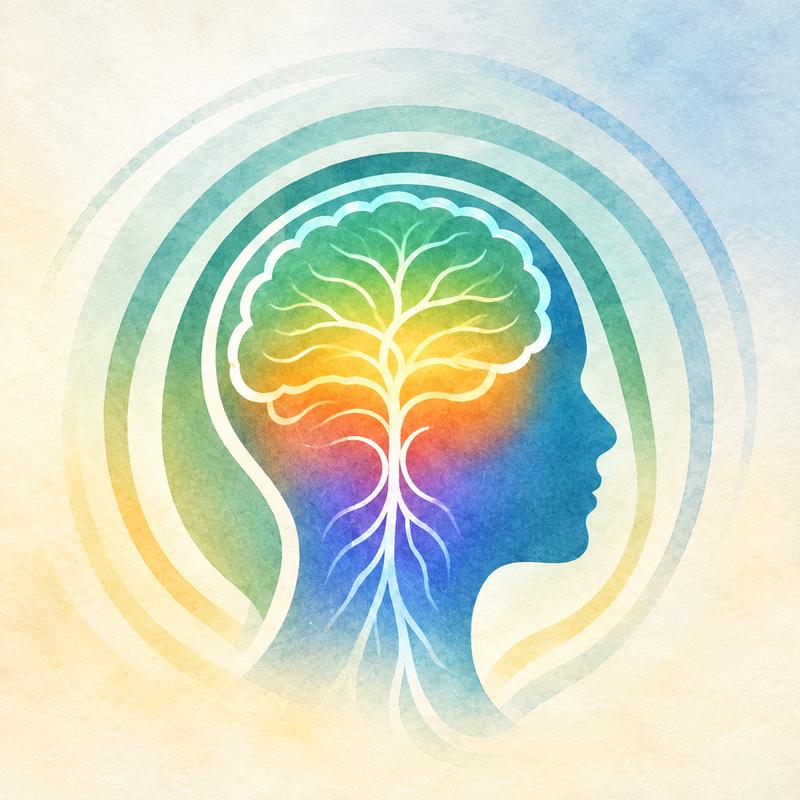
The question that has driven almost everything in my career as a nurse, a school counselor, a learning support teacher, and a Compassionate Inquiry practitioner is what Dr. Bruce Perry captured in the title of his book with Oprah Winfrey, What Happened to You? Not "what's wrong with you." That shift, from pathology to story, is what I mean by trauma-informed practice. It’s about looking at behavior as communication from a student’s nervous system, not as a discipline problem to be corrected. Two phrases ground me before any hard conversation: intonation before explanation and curiosity before judgment. How I say something regulates a nervous system before the words even land. Curiosity, offered first, opens a door that judgment shuts down.
I want to share an example from my own experience because this isn't only a framework for the students and colleagues we support. It's one I have to apply myself. I was consulting with a teacher, advocating for a student moving through a crisis at home. I couldn't disclose the details, so I simply asked whether she could offer the student some additional time on an assignment. She wrote back that she couldn't accommodate it because then she'd have to do the same for other students, not seeing the need for an exception in this case.
Reading her response, I felt upset, even angry. I was advocating for a student in desperate need, and in that moment I didn't feel heard or supported in my role as a counselor. What I needed was to be understood and to have compassion shown for the student.
Reflecting on it afterward, I asked myself: what might have been underneath her response? Perhaps she was working from her own need for a clear outcome and a consistent, fair deadline policy. She may have been dealing with her own version of not feeling understood or not feeling able to be flexible at that moment. We were two people, each convinced the other wasn't hearing them. Neither of us was wrong to feel the way we did. Curiosity gave me a way to step back from my own interpretation and consider what might have been happening for both of us.
A question worth carrying into your next difficult exchange is: What was the underlying need driving your own reaction, and what might have been under the other person's trigger?
Challenging behavior is rarely a discipline problem. As Dr. Gabor Maté writes in The Myth of Normal, co-written with his son Daniel Maté, it is a nervous system doing exactly what it was trained to do to survive. The student who explodes, shuts down, disappears into a hoodie, is not being defiant. That is a body telling a story it doesn't yet have words for. And as my own example shows, this isn't just for students, it's the colleague holding firm to a policy, and it's the counselor feeling unheard in a short email. We are all nervous systems doing our best with what we have at each moment.
Trauma doesn't stay contained in one student. It moves through a system. A dysregulated student affects a classroom's nervous system. A classroom in chronic stress affects a teacher's capacity to co-regulate. A colleague running on empty affects the whole staff culture. And sometimes school leaders absorb all of it, often without anywhere to release it. Trauma-informed schools are not a program for "those kids." They are an ecosystem, encompassing students, educators, administrators, and every adult in the community.
In our international school communities, that ecosystem carries an extra layer. Our students aren't just navigating ordinary stress; many may be in their third or fourth country, grieving friendships and homes they didn't choose to leave, holding identities that don't map neatly onto any one culture. What safety has meant to them before is rarely simple. And the adults around them are often mid-transition too: teachers newly relocated, managing their own nervous systems while trying to co-regulate a room. A trauma-informed lens in this setting has to hold both the student's history of movement and the fact that the adult steadying them may be steadying themselves at the same time.
In the short term, trauma shows up as, but isn't limited to hypervigilance, difficulty concentrating, irritability, or complete withdrawal. A nervous system scanning for threats can't learn at that moment. Over the long term, it can reshape a person's baseline entirely in many ways. For example, a lower threshold for threat detection, difficulty with trust and attachment, chronic shame, and a pattern that can look exactly like a behavior problem for years before anyone asks the real question underneath it.
Polyvagal Theory, developed by Dr. Stephen Porges, is the science of how our autonomic nervous system reads cues of safety or danger, often below conscious awareness, and shifts our physiological state in response. There are three broad states according to Porges.
Ventral vagal is safe and social, the state in which connection and learning happen.
Sympathetic is fight or flight, the body mobilizing against threat.
Dorsal vagal is shutdown and collapse, the freeze state that emerges when fighting or fleeing isn't an option.
A "disruptive" student may be sympathetic. A "checked out" student may be dorsal. Neither is trying to make bad choices. Both are asking, underneath it all, am I safe here? As the saying goes, the student isn’t giving you a hard time, they are having a hard time. Our job isn't to punish the state, it's to help the nervous system find its way back to ventral, back to safety and connection. And there's no single template for what that state looks like: a five-year-old, a 15-year-old, and the teacher down the hall will all respond to threat differently, shaped by temperament, history, emotional triggers, and what safety has meant to them before.
Internal Family Systems (IFS), developed by Dr. Richard Schwartz in No Bad Parts, offers a simple map: we're not one voice, but a system of many complex parts. Exiles carry old pain or shame. Protectors guard that pain from surfacing — through control, perfectionism, shutdown, or explosive reactivity. What looks like "bad behavior" in a student, or defensiveness in a colleague, is often the Protector part doing its job. Looking back at my own example, that teacher's firm "no" may well have been the Protector part holding the line on policy and fairness and guarding something that had nothing to do with me at all.
Underneath all our Parts sits Self, and IFS names its qualities as the eight Cs: Calm, Curiosity, Compassion, Clarity, Confidence, Courage, Creativity, Connectedness. Sitting across from a dysregulated student or colleague, it's worth asking: which of these eight Cs am I leading with right now? Locating even one like curiosity or calm is often enough to begin co-regulating the room. A flooded nervous system borrows yours before it can access its own.
Before I step into a hard meeting, I move through a short checklist of my own that you may find useful:
A few minutes of breath work, focusing on the exhale, or a few stretches to settle my own vagal tone
A quick body scan to notice where I'm holding tension and what that might be telling me
A one-line check-in with my own Cs. Which one do I need most in this room?
A named person to debrief with afterward, such as a trusted colleague or supervision contact, so I'm not carrying it alone
This isn't reserved only for the counselor's office. Trauma-informed practice means moving away from behavior charts and more toward relationship-first responses. Another helpful saying is connect before correct. Build it into the whole classroom, not just for "the kids who need it."
We also need to think of staff wellbeing as infrastructure, not a check-the-box afterthought or a luxury. In practice, that can be as simple as replacing accusatory questions with curious ones. With a student, "What do you need right now?" instead of "What is wrong with you?" With a teacher, "What did you notice in your own body at that moment?" instead of "What should you have done differently?"
This matters most with adolescents. David Yeager's research in 10 to 25: The Science of Motivating Young People shows young people this age are acutely attuned to signals of respect and status. They read every interaction for signs of whether they're being honored or dismissed. If the goal is for a teenager to actually talk to you, then a good question has to come before the verdict, assumption, or judgment.
Trauma-informed practice isn't a curriculum. It's a lens, and underneath it sit two very important questions, asked with real curiosity: What happened to you and what do you need to feel safe here again? Those questions aren’t only for our students. They’re for the colleague who says no in an email. And, if I'm honest, they were for me too, reading her reply and needing, underneath the anger, to feel understood. The invitation is to bring those two questions into your school this week, and see what shifts.
References
Maté, G., with Maté, D. (2022).
The Myth of Normal: Trauma, Illness, and Healing in a Toxic Culture. Perry, B. D., & Winfrey, O. (2021).
What Happened to You? Conversations on Trauma, Resilience, and Healing. Porges, S. W. (2011).
The Polyvagal Theory: Neurophysiological Foundations of Emotions, Attachment, Communication, and Self-Regulation. Schwartz, R. C. (2021).
No Bad Parts: Healing Trauma and Restoring Wholeness with the Internal Family Systems Model. Yeager, D. (2024).
10 to 25: The Science of Motivating Young People.
Neila Steele is a Canadian and former registered nurse, Compassionate Inquiry practitioner, and whole school wellbeing counselor with over 25 years of experience in international education across Japan, Azerbaijan, Cambodia, China, Saudi Arabia, and Belgium. She currently serves as whole school wellbeing counselor at Antwerp International School, where she is dedicated to fostering wellbeing and belonging across the entire school community. A qualified yoga teacher since 2005 and experienced workshop leader, she brings a uniquely holistic approach to her work, drawing on her foundations in nursing, mindfulness, and intercultural awareness. Since entering the international school system in 2001, she has developed a deep commitment to supporting individuals through self-compassion, human connection, and the creation of safe, nurturing spaces for growth and self-discovery.
LinkedIn: https://www.linkedin.com/in/neila-steele-7aa45a2a1/