

Lee Shulman (1986, 1987) first articulated the idea of Pedagogical Content Knowledge (PCK) as a theory of teacher professional knowledge in the mid-1980s. He argued that it wasn’t sufficient for teachers to just have knowledge of their subject-matter, nor, he argued, should the development of teachers only focus on pedagogical methods. Shulman (1987) theorized that PCK represented a “special amalgam of content and pedagogy that is uniquely the province of teachers, their own special form of professional understanding” (p. 8). In other words, the professional knowledge that characterizes expert teachers is an amalgam of both content knowledge and pedagogical knowledge, but – and this is essential – it’s formed through the actual practice of teaching.
In this way, the professional knowledge of expert teachers is analogous to a metal alloy. It is a unique material formed from the merging of two different elements, which emerges only under certain conditions. Take bronze, for example. The Bronze Age in the development of human civilization is so named because of the discovery and wide use of bronze as a metal alloy. The formation of bronze requires the melting, combining, and cooling of copper with tin. The result that emerges requires both original metals, combined under specific conditions. In a similar way, PCK is a unique knowledge domain, alloyed from content knowledge and pedagogical knowledge under the conditions of teaching distinct subject-matter topics to particular students in a specific context.
PCK is a recursive and generative knowledge domain. To use another Shulman (1987) term, teachers enact their PCK to “transform” subject matter for teaching. Each time a teacher engages in this work of subject-matter transformation, they further develop and refine their PCK, which they can then apply to more effectively transform the subject-matter in the future. Transforming subject-matter for teaching requires one to consider not just the subject-matter itself, but the teaching context and the students. Teachers must consider their students’ relevant cultural knowledge, preconceptions, misconceptions, interests, motivations, etc. Park et al. (2018) argued that PCK consists of two key components: “knowledge of instructional strategies and representations” (KISR) and “knowledge of student understanding” (KSU). In other words, it’s teachers’ PCK that enables them to examine the subject-matter, consider the students in the room, and transform the topic into representations and instructional strategies that will help those particular students come to understanding.
As teachers know from observation, there is a difference between teachers with experience and expert teachers. The recursive and generative process of PCK growth that I’ve described above is not automatic. Teacher PCK growth requires that teachers take a deliberate approach to their craft. This was the focus of my recent Ed.D. capstone research (Haines, 2026). Working with several secondary teachers at an international school in the East Africa region, I explored the efficacy of some different protocols intended to prompt teachers toward a more deliberate and reflective approach to their teaching practice in order to promote their PCK growth. One of the protocols I explored I borrowed from Loughran et al. (2004). They called it a Content Representation protocol, or CoRe for short. While Loughran et al. (2004) developed the CoRe protocol in the context of science teachers, I applied it with secondary English and Social Studies teachers and found it to be a useful tool. Figure 1 depicts Loughran et al.’s (2004) original CoRe protocol.
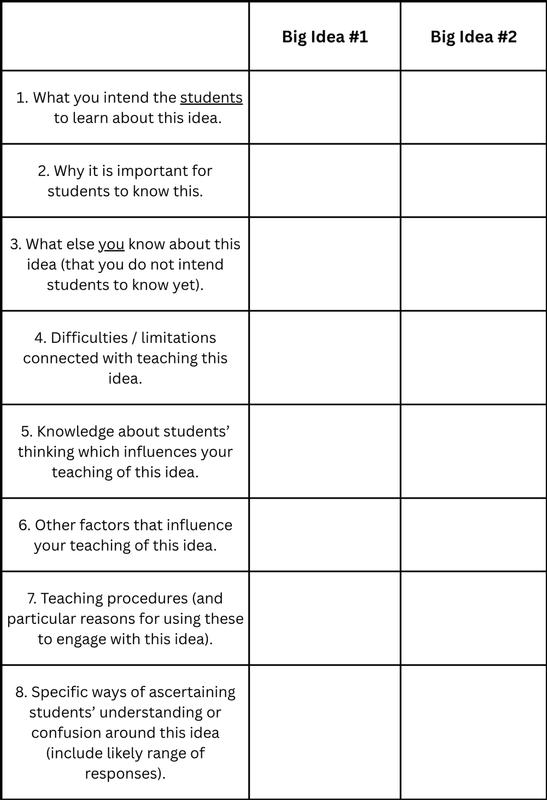
Content Representation, CoRe (Photo source: Loughran et al.'s, 2004)
Loughran et al. (2004) initially developed the CoRe tool to document science teacher PCK. They and others later studied its use as a tool for also promoting science teacher PCK growth (Bertram, 2014; Bertram & Loughran, 2012; Hume & Berry, 2011; Loughran et al., 2008; Nilsson & Karlsson, 2019). Its use has not been well studied outside of the context of science teaching. One of the goals of my research was to explore its value with teachers of English and Social Studies. The CoRe could be described as a tool that compels teachers to engage in pedagogical reasoning; it guides teachers through a deliberate process of transforming a subject-matter topic for teaching. Loughran et al. (2012) state that the tool was designed to “encourage teachers to problematize the content and teaching” (p. 25). The protocol requires teachers to first articulate one or more big conceptual ideas for the topic they will be teaching. It then requires teachers to consider eight questions about each of those big ideas. Related to the conceptual big ideas, the first several questions demand that teachers “problematize the content”, while the remaining questions push teachers to “problematize the… teaching” of those ideas. Figure 2 is my slightly tweaked version of the CoRe protocol, which I used with teachers during my research.
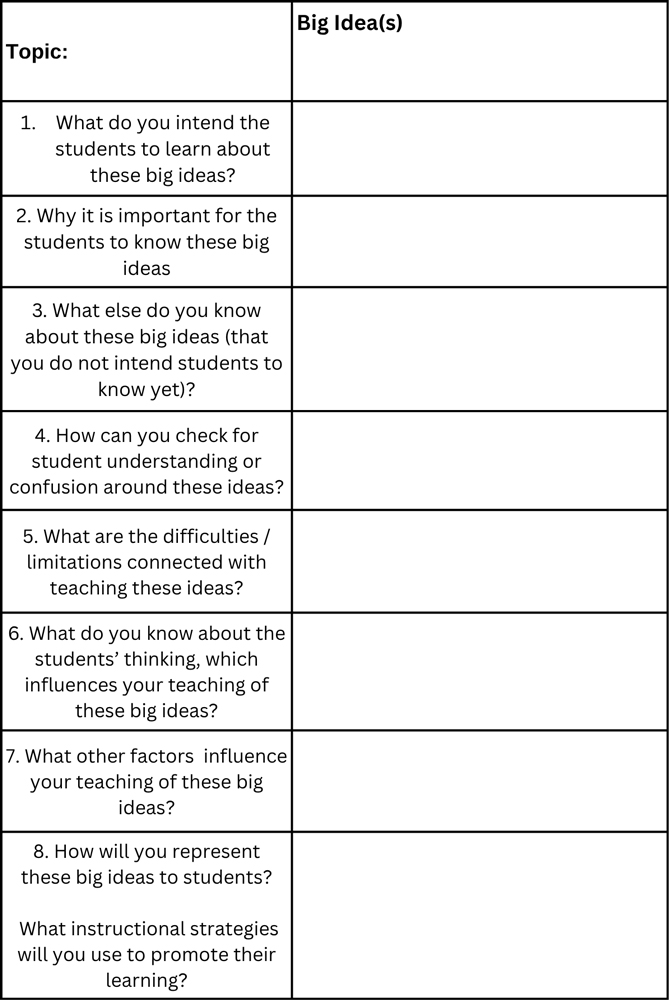
Adapted version of CoRe protocol that I used in my research. (Photo source: Nathan Haines)
The CoRe protocol is a useful tool for teachers to use independently. It can guide teachers through the thinking necessary to determine how best to approach teaching a specific topic with particular students. I would recommend that teachers use it to prompt their thinking – their pedagogical reasoning – as they approach a new topic with their students (even if they’ve taught that topic to other groups of students before). I would also recommend that teachers not worry about an exhaustive written response to each question on the protocol; if they do, it may quickly begin to feel arduous and inflexible.
Though the CoRe protocol can be very useful for teachers to use individually in their planning, in my research I used the tool as a collaborative discussion protocol. Prior to a teacher beginning a new topic, I would sit with that teacher and use the CoRe protocol to guide a discussion about how the teacher could approach teaching the topic with his or her students. While my role was primarily to ask the questions to prompt the teacher’s thinking, it was also a dialogue in which I provided my own ideas and thoughts where relevant. To allow the teachers the freedom to brainstorm, I also assumed the task of recording the ideas that we discussed. Again, the focus was not to record an exhaustive response to each question; rather, I focused on documenting the key ideas that we discussed so that the teacher could refer to them later and build on them as he or she wished.
From my research experience, I’ve come to believe that the tool can guide the work of instructional coaches in three ways:
1. The CoRe protocol helps to shift the coach-teacher relationship from one that is hierarchical to one transpiring between collegial partners. There are likely times when an instructional coach must assume the role of expert when working with teachers, but my research suggested that teachers may respond better to peer-to-peer collegial discussions, and when focused, these can promote teacher professional learning. The CoRe protocol can provide that focus.
2. By using the CoRe protocol to engage in collegial dialogue with teachers, the instructional coach can help to facilitate the teachers’ professional learning through a more deliberate enactment of their own PCK, which, recursively, can then help to grow their PCK.
3. The protocol can be used as a focusing instrument for larger coaching cycles with teachers. Instructional coaches can use the protocol to guide brainstorming and planning discussions prior to teachers beginning a new topic with their students. The protocol can then provide a lens through which an instructional coach can observe the teachers’ lessons on that topic. It then provides the focus for powerful reflection questions after the lessons. However, as noted in #1 above, with the use of the CoRe protocol, the coach assumes the role of colleague and thought-partner, with the goal not to mentor or provide advice, but to prompt and guide a teacher’s deliberate and reflective approach to their own teaching practice. It’s about making the use of teachers’ own professional knowledge – their PCK – more explicit so that teachers grow that PCK.
Research suggests that teachers often struggled to step back from their daily teaching to overtly reflect on their own practice (Forsler et al., 2024; Nilsson & Karlsson, 2019). Teachers need to focus on student understanding and periodically step back and ask: what worked, what didn’t, why, and how can they do it better next time? The growth of teachers’ PCK requires this deliberate type of reflection. Schön (1983) called it a mode of reflection-on-action. Instructional coaches can play a role with this by partnering with teachers, not as an expert telling them how to teach better, but as a colleague who, using the CoRe protocol, helps to prompt the teacher toward a more deliberate and reflective approach to their practice, for the purpose of helping them enact and grow their PCK.
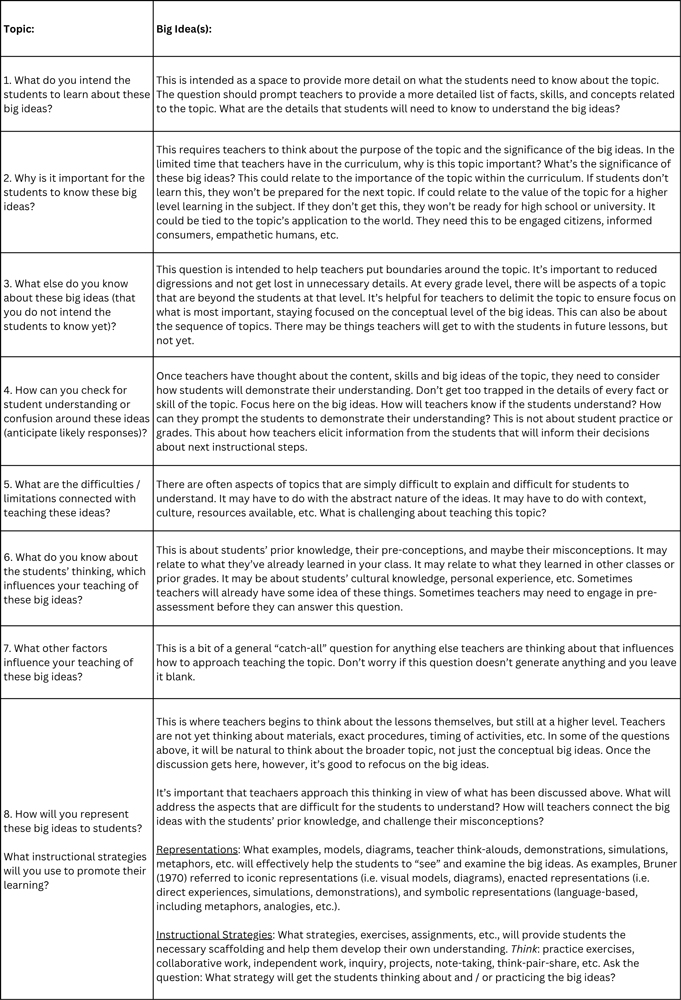
To conclude, in Figure 3, I’ve included one more version of the CoRe protocol. In this version, next to each of the questions I’ve added some further explanation and tips that developed out of my experience using the tool.
References
Bertram, A. (2014). CoRes and PaP-eRs as a strategy for helping beginning primary teachers develop their Pedagogical Content Knowledge. Educacion Quimica, 25(3), 292–303. https://doi.org/mhrm
Bertram, A., & Loughran, J. (2012). Science teachers’ views on CoRes and PaP-eRs as a framework for articulating and developing Pedagogical Content Knowledge. Research in Science Education, 42(6), 1027–1047. https://doi.org/ccnqb9
Bruner, J. (1970). The course of cognitive growth. In B. L. Klintz & J. Brunig (Eds.), Research in Psychology (pp. 289–296). Scott, Foresman & Co.
Forsler, A., Nilsson, P., & Walan, S. (2024). Capturing and developing Teachers’ Pedagogical Content Knowledge in sustainable development using content representation and video-based reflection. Research in Science Education, 54(3), 393–412. https://doi.org/gs9x8w
Haines, N. F. (2026). Exploring a Model of Teacher Professional Learning Through Guided, Deliberate, and Reflective Cycles of Teaching Practice. Doctoral dissertation, University of Virginia. LibreATE. https://doi.org/10.18130/p5tm-dk06
Hume, A., & Berry, A. (2011). Constructing CoRes: A strategy for building PCK in pre-service science teacher education. Research in Science Education, 41(3), 341–355. https://doi.org/bgsfhx
Loughran, J., Berry, A., & Mulhall, P. (2012). Understanding and developing science teachers’ Pedagogical Content Knowledge (2nd ed.). Sense Publishers.
Loughran, J., Mulhall, P., & Berry, A. (2004). In search of Pedagogical Content Knowledge in science: Developing ways of articulating and documenting professional practice. Journal of Research in Science Teaching, 41(4), 370–391. https://doi.org/dn88xt
Loughran, J., Mulhall, P., & Berry, A. (2008). Exploring Pedagogical Content Knowledge in science teacher education. International Journal of Science Education, 30(10), 1301–1320. https://doi.org/bm5vv7
Nilsson, P., & Karlsson, G. (2019). Capturing student teachers’ Pedagogical Content Knowledge (PCK) using CoRes and digital technology. International Journal of Science Education, 41(4), 419–447. https://doi.org/gftpfv
Park, S., Suh, J., & Seo, K. (2018). Development and validation of measures of secondary science teachers’ PCK for teaching photosynthesis. Research in Science Education, 48(3), 549–573. https://doi.org/gdm4pp
Schön, D. A. (1983). The reflective practitioner. Routledge. https://doi.org/fkfk
Shulman, L. S. (1986). Those who understand: Knowledge growth in teaching. Educational Researcher, 15(2), 4–14. https://doi.org/bg52xz
Shulman, L. S. (1987). Knowledge and teaching: Foundations for a new reform. Harvard Educational Review, 57(1), 1–22. https://doi.org/gc8qnc
Nathan Haines has been a secondary level English and Social Studies teacher for 18 years, 13 of which have been in international schools in Ethiopia and Rwanda. Nathan stepped aside from teaching for the 2025-26 school-year to complete his Ed.D. research related to Pedagogical Content Knowledge and teacher professional learning. After five years in Rwanda, he has recently returned to Ethiopia, and is teaching International Baccalaureate Diploma Programme Psychology and Theory of Knowledge at the International Community School of Addis Ababa.