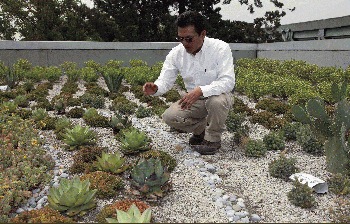
Biologist Jerónimo Reyes, from the Universidad Nacional Autónoma de México, checks up on the indigenous plants covering an ASF green roof (photo: ASF). ---------------------------------------------------------------------------------------------------------------------- There are garden spaces on the campus of The American School Foundation (ASF) in Mexico City that provide a home to some four dozen native plant species, and cover 1,400 square meters. Yet many students, parents, staff members and visitors, going about their normal routine on campus, may never see these impressive green areas. That is because these garden delights are up on the roofs–some atop the Jenkins Foundation Wellness Center, and most adorning the recently (April 2013) opened “green roof” of the Ángeles Espinosa Yglesias Fine Arts Center. These rooftop green spaces are lovely, tranquil and welcoming. In neatly arranged plots of random shapes, the low-lying plants are outlined by smooth stones in various shades of gray, beige and white. Gravel walkways encompass the gardens, which are easily accessible by elevator or stairs. The Wellness Center garden, with much space taken up by tennis courts, lends itself more for casual viewing or to sit down on a bench, while the Fine Arts Center green roof offers more to ponder and can be used for many purposes. One of those purposes is of course didactic: the Fine Arts Center green roof is a botanical garden of native Mexican plants. The two genera most represented are Echeveria, including the largest species, Echeveria gigantea, which resembles a large rose, and Opuntia, which includes the nopal species seen in Mexico’s coat of arms. There is also the golden ball cactus, which is endangered in the wild. A special section includes succulents native only to the Pedregal de San Ángel section of Mexico City! There is also an area for students to grow crops such as corn, radishes and assorted greens for human consumption. There is more to ASF’s green roofs than educational gardens atop new buildings. Several years ago, ASF embarked on an initiative to bring its infrastructure in line with “green building” and “green spaces” standards. The requirements are demanding, and the certification process is complex. What does “green” really mean in the context of infrastructure? It means that ASF has committed itself to ensuring that all new construction and other campus improvements have a minimum negative impact on the environment, and a maximum positive impact on the health of students and employees. Determining whether those goals are met falls to a body called the U.S. Green Building Council, or USGBC. It grants the Leadership in Energy and Environmental Design (LEED) certification, one of the most prestigious certifications in building planning, design and construction. And the degree of difficulty in obtaining this certification is high. This is not lost on César Buenrostro (’85), the ASF Board of Trustees member who chairs the Buildings and Grounds Committee. “The USGBC is one of the world’s most highly regarded organizations,” he said. “LEED certification enforces integral, sustainable policy beginning with the planning process, which may include meeting criteria for site selection.” In fact a long list of criteria is examined, down to very specific details such as orientation for sunlight entry and sound and lighting intensities within the building structures. Construction materials are looked at, as are the processing and disposal of waste. Those criteria and many more are evaluated in their aggregate. “Points are earned based on measures taken for sustainability and positive environmental impact,” Mr. Buenrostro said. ASF’s implementation of its sustainability initiative began with the renovation of the Upper School Building and Sheila Rafferty Ahumada Administration Building that was completed in 2009, its first “green” building. It earned LEED certification–the first known school building in Latin America to do so. The effort was further rewarded in 2012 when the office of Mexico’s then-President Felipe Calderón presented ASF with the Eco CIHAC Award for sustainable reconversion. A few examples of the sustainability efforts that ASF makes to meet LEED guidelines include energy-efficient lighting, water conservation through high efficiency urinals and toilets, on-campus sewage treatment and rainwater collection tanks, recycling opportunities and much more. And now we can add green roofs to the list! ASF’s new green roofs replenish green space taken away during construction processes. There are, however, many more benefits to these gardens. They help to: • Decrease the effect of urban heat islands in the city. Rooftop vegetation naturally absorbs heat. • Regulate temperature inside the building. Again, this is accomplished by absorbing radiation from the sun that would otherwise penetrate the building. • Reduce degradation caused by rainfall on structures. Rainwater can erode both roofing and ground surfaces. The plants absorb most of the water through high particulate, permeable soil. • Attract beneficial local wildlife, such as insects and birds. • Provide for cross-pollination. This beneficial effect takes place both within and outside of the ASF grounds through the distribution of pollen and seeds. • Lower maintenance and care burdens. The rooftop vegetation requires little care because the plants are indigenous, and therefore already adapted to such environmental factors as rain cycles, air quality and seasonal weather changes. In addition to all this, Mexico City offers property tax discounts for properties with green roofs–an added, very quantifiable, bonus! One person closely involved from the start with the ASF green roof project is José Carlos Alaniz, an Upper School biology teacher and head of the school’s Sustainability Committee. He worked in conjunction with UNAM biologist Jerónimo Reyes and José Moyao, the architect who designed the Fine Arts Center and Wellness Center, to plan the green roofs. “ASF is the only educational institution to have implemented this type of project in Mexico,” said Mr. Alaniz of the green roofs on new buildings in the process of gaining LEED certification. ASF Upper School biology students also played a role in the green roofs, with roughly 80 of them researching and learning to identify the native succulents that are now growing on the roofs. During a taxonomy unit in class last spring, the students created a web site with information on many of the species. “This project allows us to learn more about Mexican biodiversity and witness how some plants in the Mexican ecosystem work and breed,” said one student. “Once we know about these plants we can learn how to take care of them.”
Please fill out the form below if you would like to post a comment on this article:
Comments
08-Apr-14 - Patty Montes
Excellent article Sharmila! Thank you for showing people what ASF is doing. =)
The articles presented in TIE are a reflection of the variety of perspectives within the international school community and do not necessarily reflect the views and opinions of the organization.