
I have been a school and university counselor for more than 15 years, across international schools in China, Malaysia, Brazil, Switzerland, and now South Korea, where I worked with internationally mobile families whose ambitions run overwhelmingly toward the United States (US). Every year I tell myself I have seen it all, and every year the admissions cycle proves me wrong. But this past year was different, and if I had to give the 2025-2026 cycle a single word, it would be: volatility.
The US Visa Environment
A year ago, even with frozen interview slots and new rules and regulations, every one of my graduating students obtained their US F-1 student visa. Twelve months later, over the summer, we saw more unsettling headlines that put the future of international students in the US into an even bigger state of flux. A new rule proposed replacing “duration of status” with fixed admission periods of up to four years. It has since been blocked by a federal judge (interestingly, the day before it was due to take effect in September) and the traditional framework remains in place while the legal challenge continues. However, the general direction remains, and this is not the first time the rule has surfaced. It was first proposed in 2020, but was withdrawn the following year without ever taking effect. Under a fixed-period system, extensions beyond four years would need government approval rather than university discretion, and even switching a major in the first year would no longer be a free move. Entry restrictions affect nationals of dozens of countries, social media screening is part of the application process, and our students have spent the year reading headlines about visas being revoked.
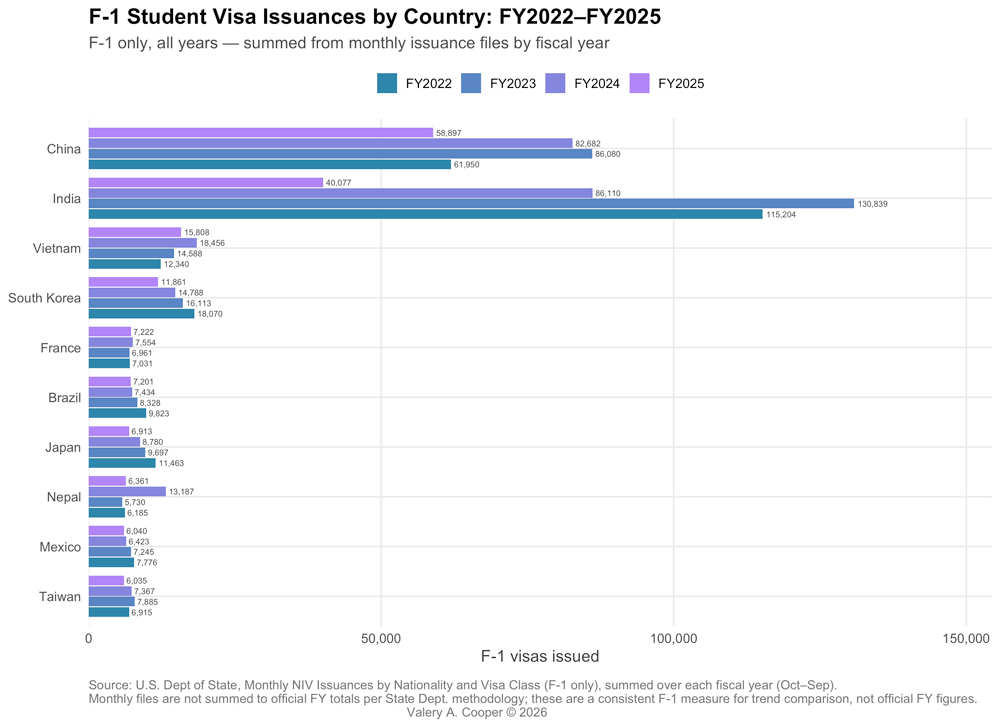
I wanted to attach numbers to what we were all feeling, so I pulled the US State Department's monthly F-1 issuance data and summed it by fiscal year for the heaviest applicant pools. Every country has been affected, but China and India, the two largest sending countries, have been hit hardest. India's F-1 issuances fell from over 130,000 in 2023 to roughly 40,000 in 2025.
In my context, none of this has dampened ambition. Families I work with still want the US, and they still want the same university names they always wanted. But I will say that visa logistics is now an early conversation with every family, not something we leave until the spring of senior year. And the way I see it, a conversation about other destinations as a plan B is no longer optional.
Previously Safe Harbors and the Wider Map
Which brings me to the second shifting trend: backup options – except they're no longer backups. A year or two ago, a “plan B” meant one or two likelies in the US, or an application to a destination like the United Kingdom (UK) or Canada, often added as an afterthought rather than a specific strategy. What I see now are real parallel campaigns, with families actively planning for a second or third destination alongside the US.
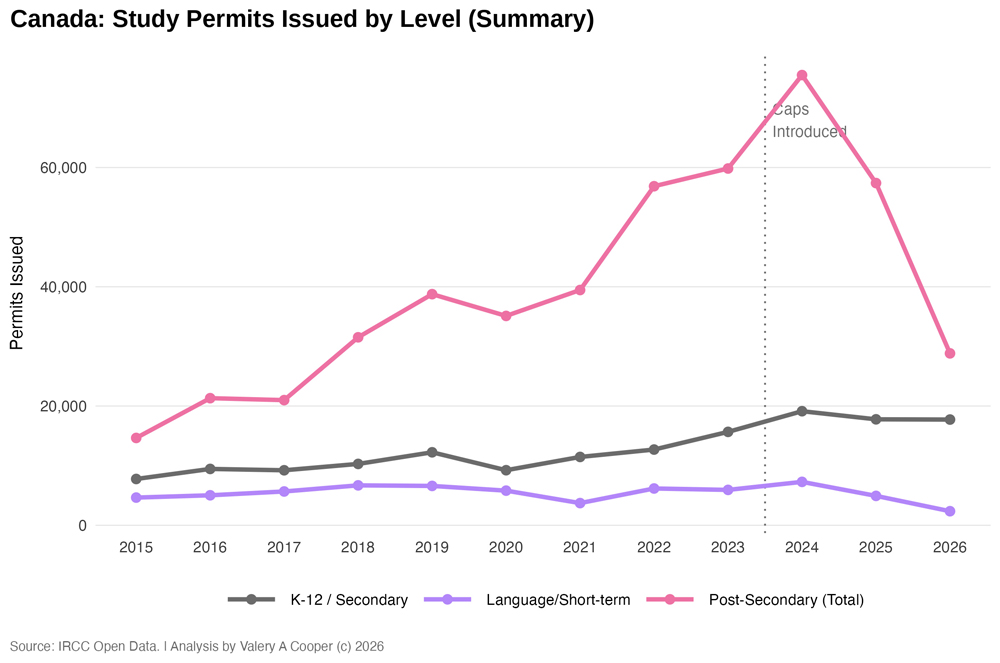
But tightening policy for international applicants is not just a US story. Canada spent a decade campaigning as the friendly alternative destination, but since the 2024 cap on study permits, post-secondary permits that steadily climbed for nearly a decade have now fallen to levels last seen almost ten years ago.
The UK has moved in the opposite direction. UCAS's data for the 2026 cycle recorded 148,350 international applicants, the highest number on record. But the UK is also rethinking how it treats international students. We recently saw this in the shortening of the Graduate Route post-study work visa, which drops from two years to eighteen months for applications from 1 January 2027.
When I build a parallel application strategy with a family now, part of the conversation is around the trends we're noticing in our field, and which doors are opening and which are closing. It matters even more to put emphasis on these conversations, because the answer changes every year.
I want to reflect on the bigger picture too, because the world map is larger than three countries. In the last few years we've seen Chinese universities climb the world rankings. Meanwhile, campuses are coming to the student. With dual-degree and branch campuses from Abu Dhabi to Indonesia to Astana, destination risk and brand prestige are starting to decouple. A family that would not consider a less famous country might happily consider a famous brand in another country. And if you work with families in Asia, you will know they run on rankings logic. Logic that does not care about geography. Could it be that the very system pointing them at the US Top 50 today will, before long, point at least some of them east instead?
For counselors, the practical consequence of this is workload. A student running the US plus Universities and Colleges Admissions Service (UCAS) plus, say, the Netherlands is managing three different essay types, several timelines, and different sets of expectations about what a strong application even is. The personal statement that works for the Common App does not work for UCAS, and students who try to recycle end up with something that serves neither system. So to serve our families well, fluency in global applications matters more than ever. Go to conferences, attend workshops and webinars, and learn as much as you can, because I suspect more of this shift is coming. The per-student load has grown, and it needs to be budgeted into our planning. And when we are still supporting Grade 12 students through April, the timeline to prepare Grade 11s and advise on Grade 10 course selection has shrunk.
Institutional Data Literacy is Now Part of the Job
I know many of us are doing some of this already, but this year it stopped being optional. As some of us can infer anecdotally, international students are disproportionately full-pay. When a university loses hundreds of them, that is a budget hole that needs to be plugged. And universities under revenue pressure behave differently. In the US specifically, I am watching some institutions become more generous with merit aid, discounting to fill seats and protect net revenue, while others lean harder on early decision instead, locking in their class early without needing to discount at all. I suspect most of us have sensed one or both of these shifts over the past couple of years.
I have no intention of talking families out of ambitious lists. But I do need to share these shifts so they can make informed decisions. Families need to know where the leverage is, whether an early application gives an advantage, and what this means for long-term planning. All of that comes from digging into the data and monitoring trends over years, and I no longer believe we can serve students well without it.
This year I went much deeper into one specific question: what does the data actually say about international applicants? I have been pulling apart Common Data Set filings and College Scorecard data back to 2013. I looked into international admit rates versus overall rates, how many international students are actually on each campus, and how those numbers have moved. Some of it is immediately useful for list-building. You can see which campuses are heavily international and which have quietly shrunk their international intake.
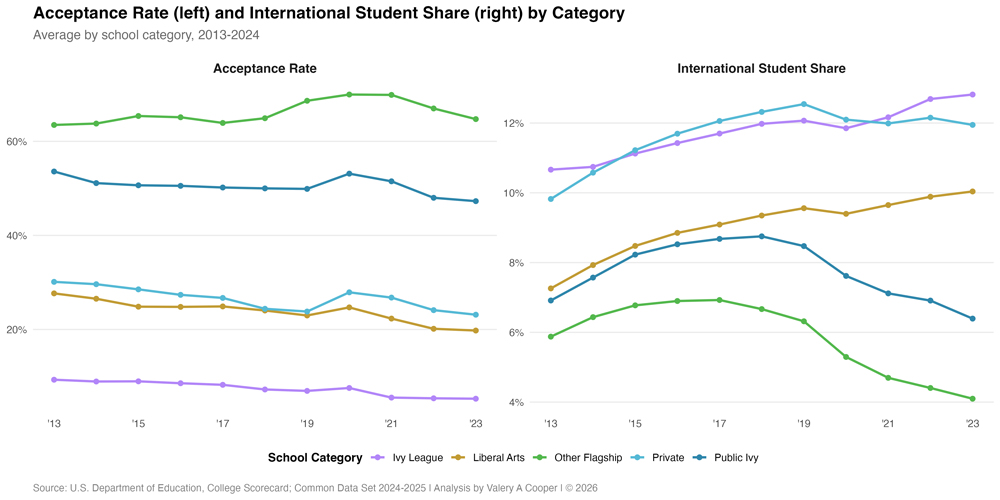
The pattern is not uniform either, once you divide colleges and universities into categories.* Public flagships and the “Public Ivies” have been losing international share since around 2019, well before the current policy environment, while private universities and the Ivy League held steady or grew. That is particularly useful in a conversation when a family insists a big public flagship is their “safety,” and exactly the kind of data point families will thank you for.
It's important that I also share some caveats about the data. Institutional priorities and policies change, and we know that has a direct impact on enrollment trends. But the fundamental problem with this data is that it is slow. The most recent filings reflect decisions made a cycle or two ago. However, none of it is predictive on its own. Trend data has to be paired with what is actually happening in the news to mean anything, and finding time for that second habit around a full counseling caseload is its own challenge. But even an imperfect version of that work will give families information they would not otherwise have. I have been publishing some of this analysis on my free Substack, and colleagues are welcome to use it with their own students.
Counseling through volatility, then, isn’t a different job so much as the same one done earlier, more broadly, and with the numbers to back it up. The rules will keep changing, and most of that will never be in our control. What is in our control is how early we start the honest conversations, how well we know the systems beyond the one our families default to, and how carefully we read the evidence before we advise.
*See my breakdown of colleges by category and the reasoning behind the groupings on my Substack.
Valery Alexandra Cooper is an international school counselor and advocate for global learning with over 15 years of experience in university counseling at schools in China, Malaysia, Brazil, Switzerland, and South Korea. A third culture kid herself, she knows the internationally mobile student from both sides of the desk. The Counselor Training Center invited her to share her thoughts on emerging admissions trends for its University Counseling in the International School course, and those observations grew into this article. A regular presenter at International ACAC, NACAC, and CIS-EARCOS conferences and a mentor to new counselors, she is the author of Beyond Borders: The Complete Guide to Global University Admissions and shares her admissions data analysis on her free Substack of the same name.