
Artificial Intelligence (AI) is evolving faster than schools can keep up. In this series, an AI expert examines the rapid changes shaping how schools understand, use, and respond to this transformative technology. In the first article in this series, we explored how futures literacy can help educators look beyond familiar narratives about AI, imagine alternative possibilities, and shape conversations about the future of learning.
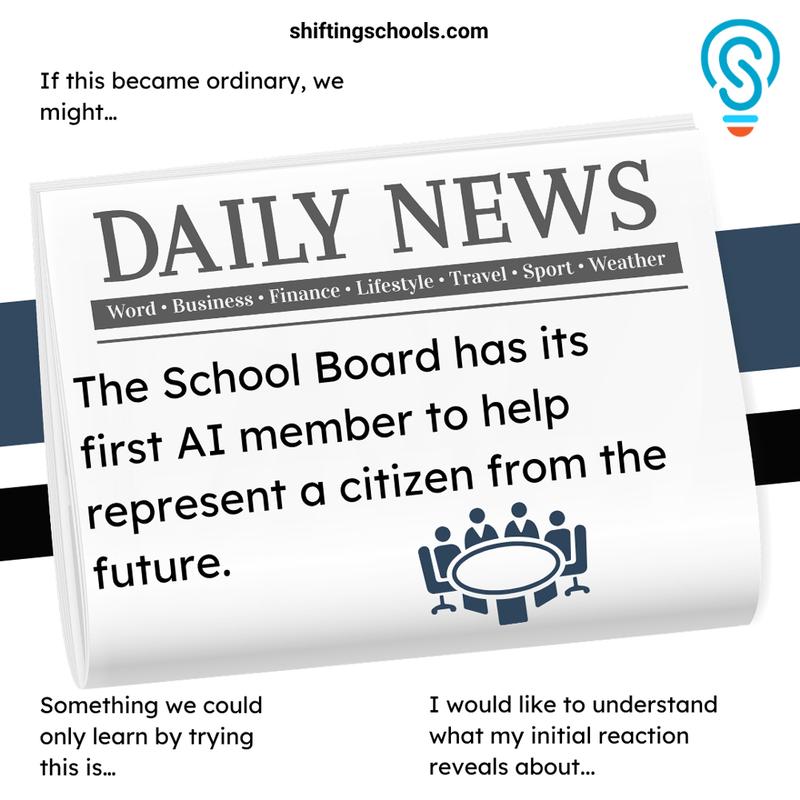
Imagine arriving at a school board meeting and being introduced to its newest participant: an AI bot asked to represent a prospective student who has not yet been born. The agenda is fairly familiar: we have a building to maintain, a budget to discuss, and a decision about technology that’s been polarizing the people gathered. But this meeting has an unusual participant, one expected to raise questions on behalf of someone who will live with the consequences of decisions made today.
What might change if we invited the future into our conversations about education?
For educators, this scenario opens up questions that reach well beyond artificial intelligence. Whose perspectives are missing when schools make decisions? How might today's priorities shape students' experiences years from now? And how can we help learners recognize the assumptions they bring to problems, consider unfamiliar perspectives, and imagine possibilities beyond the status quo?
The AI representative is fictional, but the questions are practical. They offer a starting point for exploring how we make decisions, whose interests we consider, and what it takes to imagine a different future together.
What was your first reaction to the appearance of this AI representative? Perhaps you welcomed the possibility of making long-term consequences harder to ignore. Perhaps you wanted to know who had written the instructions for the representative. Perhaps you rolled your eyes and laughed.
Each reaction offers a different starting point for learning.
This imagined board member is one of eight headlines in Tomorrow’s Front Page, a resource I created to help spark conversations about AI and possible futures. Each headline comes with two sources documenting related developments already happening in the world. The headlines bring those developments into a setting where people have decisions to make together.
The two accompanying stories for this headline offer intriguing real-world connections to our imagined boardroom scenario.
In February 2024, International Holding Company announced that an AI called Aiden Insight would become a non-voting observer on its board, supporting directors’ deliberations with analysis. That is a specific and limited role within a corporate investment company. It gives us one example of an institution making room for AI in its decision-making process. The announcement also gives us a reason to ask how that room is arranged.
Separately, researchers at MIT and their collaborators developed Future You, a system that lets people converse with a simulated older version of themselves. The simulation draws on information users provide about their lives and aspirations to construct one possible future self.
Put those developments beside each other, and our fictional school board becomes easier to imagine. There are still considerable distances between a corporate observer, a personal simulation, and a legitimate representative of future citizens. Those distances are full of questions about authority, accountability, and whose imagination gets built into the system.
Who would decide what this future citizen values?
Would it inherit the school’s current assumptions about achievement, belonging, and success? Could it help us notice a consequence we had overlooked? How would we recognize an answer that simply returned our own preferences to us, wearing a slightly more futuristic outfit?
The headline is just the first step, and it is worth asking what we need to do in order to ensure the conversation that follows can go in several directions.
UNESCO’s work on futures literacy invites us to explore different kinds of futures and use that exploration to see the present anew. In a school, that might mean noticing how quickly we assume that tomorrow’s priorities will resemble the ones already printed in our strategic plan.
It might also mean becoming curious about our own preferences.
Every card in Tomorrow’s Front Page offers three sentence stems. One asks:
“I want to understand what my initial reaction reveals about…”
Returning to the school board, I might discover that my reaction is tied to a concern about the training data. Someone else might realize that they have been waiting for any mechanism that could make an institution think beyond its next budget cycle. We could read the same headline, feel equally strongly about it, and be responding to remarkably different things.
That seems worth finding out before we begin trying to persuade each other. This is why the activity isn’t just about finding possible futures, it is about pausing to pay attention to our peers in the now.
Putting this into practice:
The value of these headlines lies not only in the questions they raise, but also in how we use them to help learners think. Here’s how you can use this activity in your classrooms. Let’s check out another card from the deck of headlines.
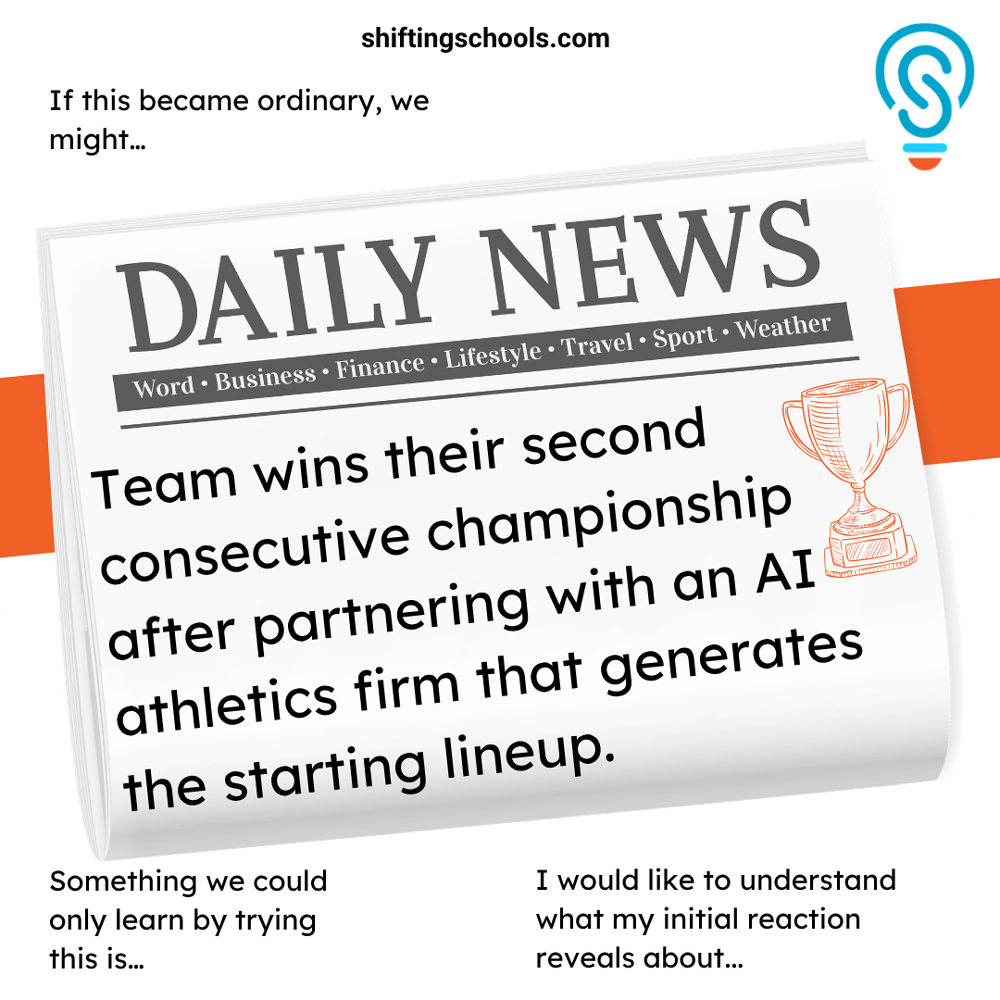
Share the headline with students at least one day before the discussion to give them time to consider its implications. When you bring the class together, invite students to share their initial reactions, examine the assumptions behind their responses, and consider perspectives different from their own. The goal is not to reach a single answer, but to explore how people interpret the same scenario differently and what those differences might reveal.
For the activity and optional media literacy expansion see here.
If you feel more comfortable running it as a game, see “The Long Game,” here.
Ready for another example?
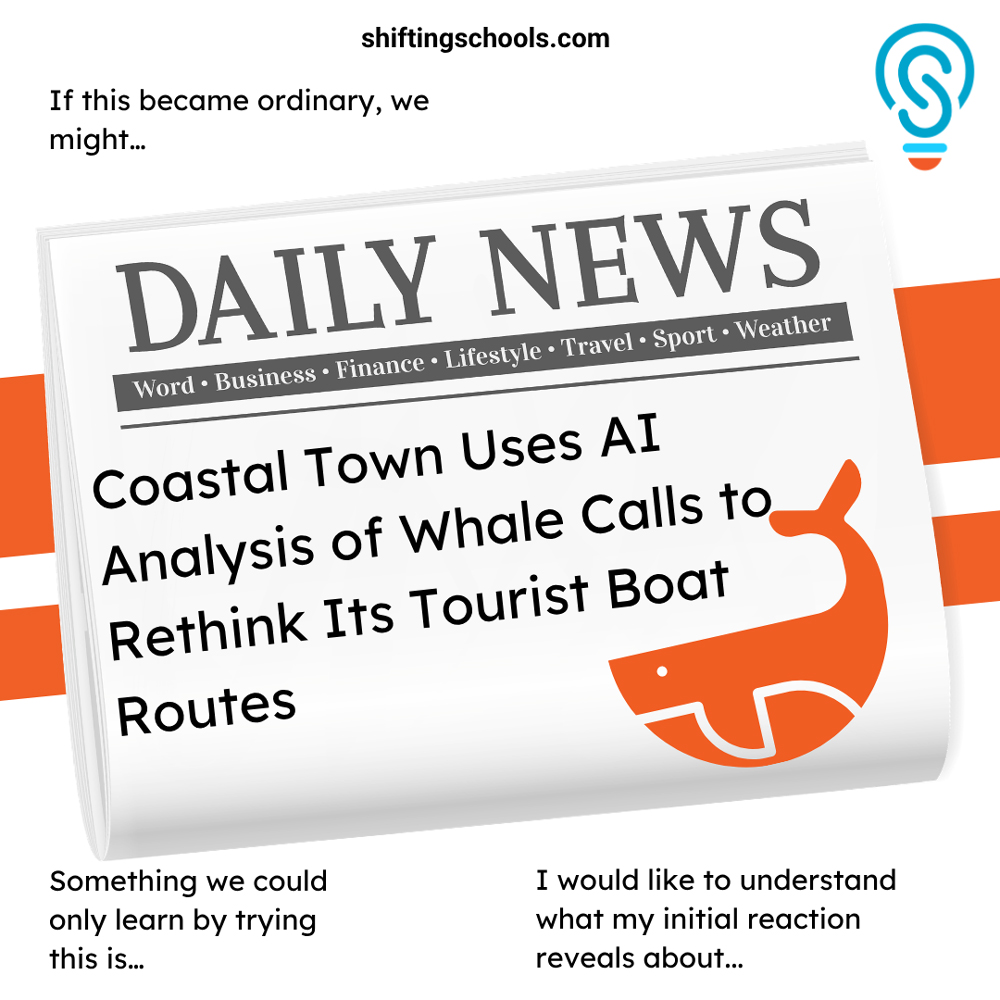
Another headline imagines a coastal town using AI analysis of whale calls to reconsider its tourist boat routes. There is already relevant work to explore here. At the University of California, Santa Barbara, Whale Safe combines acoustic and visual detections with habitat modelling to provide information about whale presence in busy shipping areas. Mariners can use that information to support speed reductions and voyage planning, with the aim of reducing collisions.
(Photo source: Tricia Friedman, Shifting Schools)
Our imagined town takes that capability into a local conversation about tourism.
As systems thinking becomes something many schools begin to engage with, another stem asks us to keep it in mind:
“If this became ordinary, we might…”
We might get better at adjusting human activity around the presence of other species. We might also begin to expect businesses to explain how they respond to ecological information. A school excursion could become an opportunity to examine how a community makes decisions when livelihoods and conservation meet.
Stay in the water for a moment, and shift your attention to dolphins.
In April 2025, Google, working with Georgia Tech and the Wild Dolphin Project, introduced DolphinGemma, an AI model trained on recordings of wild Atlantic spotted dolphins. The model learns patterns in their vocalizations, predicts sounds that might follow, and can generate dolphin-like sound sequences. This is what is known as “interspecies communication.” The researchers’ account makes clear how exciting the possibilities for interspecies communication are.
Decades of research have led us to a brand new horizon, a new frontier of understanding our world. DolphinGemma gives us another development to think about as we imagine how our relationships with marine life might change.
If tools like this eventually helped us understand more about another species’ communication, what might we become willing to change about our own behavior?
Students could investigate how their community responds to knowledge about the animals living nearby. Perhaps we would discover that our enthusiasm for understanding another species becomes more complicated when listening asks something of us.
When we talk about ethics and AI, it helps to ground those conversations in exact examples like this one. As an added classroom discussion, here is a sample fishbowl activity to try out in your classroom: Listening to Whales, Deciding as Humans
Each Headline changes the questions we would want to ask.
This is where I find one of the headlines useful: we start with an idea, trace it back to the evidence that the idea is plausible, and then we push our collective imagination forward to ask “what if…?”
This also encourages learners of all ages to realize the significance of the human imagination.
The third stem makes room for that:
“Something we could only learn by trying this is…”
Naming how learning relies on experimentation reminds us that when we talk about taking risks as learners we should be pausing to imagine what could be gained. If we’d like our learners to feel like the cognitive struggles are “worth it,” it is worthwhile to stop and actually give conversation time to the question of how.
Tomorrow’s Front Page is designed to give these conversations a little structure. The opening move is deliberately quiet: read a card and respond to all three stems alone, before hearing anyone else’s interpretation.
A person concerned about the fictional board member might become more specific about accountability. A person excited by it might begin to articulate the conditions under which they would welcome it. The point of engaging with these provocations isn’t to be right, but to see how we learn to question our own certainty when we make space to listen to what our peers have imagined.
Could your class explore the headlines and then generate their own collection of headlines?
You might not only learn about the future, but about how students are feeling today, about what they hope to learn more about, and how we can support them in those journeys.
Tricia Friedman is a futures literacy practitioner and AI literacy advocate who works with K-12 school leaders internationally. She is the co-owner of Shifting Schools, co-hosts the Shifting Schools podcast, and writes the AI Forward – K12 Leadership Brief on Substack. She is also a gigantic fan of dogs.
Website: triciafriedman.com
LinkedIn: https://www.linkedin.com/