

International teaching has a particular kind of loneliness built into it. Your average tenure at a school is short, unless you find an idyllic bubble. In a large public/state school there's usually a colleague down the hall who specializes in your subject or area of interest. In international schools, there often isn't, and a Facebook group helps about as much as a Facebook group ever does. So most of us do the same thing: we become self-reliant, adapting existing resources to meet our students' needs. We never teach anything straight off the shelf. We make it our own.
That instinct to borrow and tweak is changing shape right now, and international educators should pay attention. The reason is vibe coding: describing what you want to an AI tool and working with it to build a digital resource. It hooks you because you can experiment with ideas and build things that previously would have been beyond your technical skills. With this, I became just as excited about lesson planning as I was when I first started teaching. Communities don't form around a place to meet. They form when people have something useful they can't wait to share. That matters for international educators because the colleague we’re missing does exist, just not down the hall: they’re teaching the same International Baccalaureate or Advanced Placement syllabus in another time zone, and a resource built to be shared and adapted can reach them in a way a stack of photocopies never could.
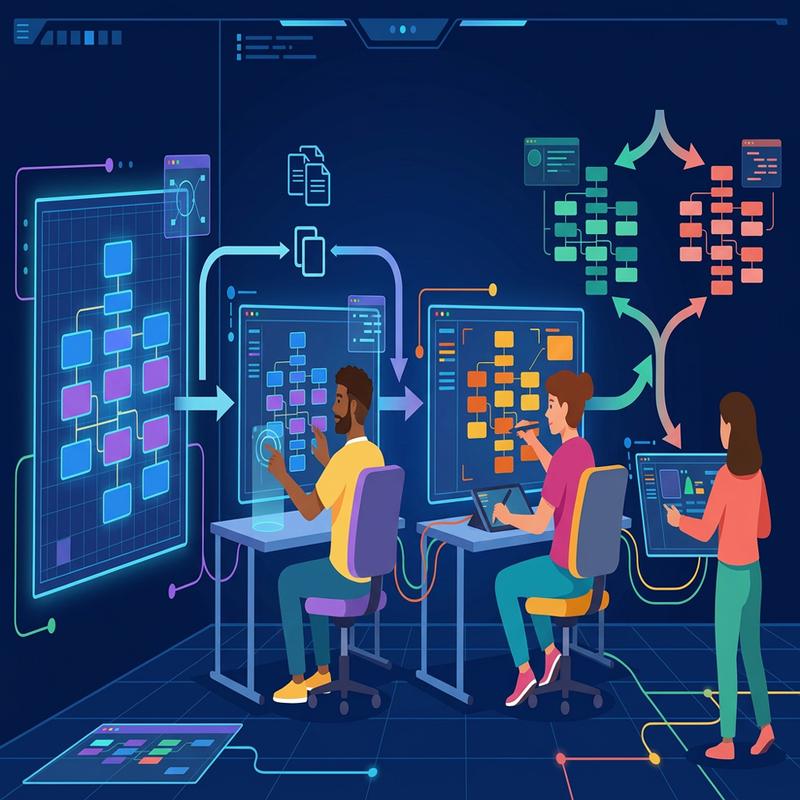
A colleague andI tested that idea by starting a podcast, Free Period, to build a community around a simple premise: vibe coding could become a new way for teachers to share and adapt one another's resources. Not lesson plans in a shared drive, code you can fork: copy it, and it's yours to rebuild for your learners. Unlike a rigid subscription site, this approach lets teachers adapt resources to what their students need.
Here's what it looks like in practice. I built a game called Linky. It organizes biology into core topics, then displays five randomly selected keywords on a slot-machine-style wheel. Students have to link them. No answers given, just a structure for thinking out loud. I used to run this with five physical spinning wheels, which worked, but a colleague wanting to borrow it would have to print, laminate and build the lot. The digital version is ready to use, can be shared via a link, and requires no setup. I removed the friction (techy term for "making it far easier") that would have stopped an overstretched colleague from ever trying it.
The interesting part isn't the game. It's what happened after I shared it. Because it lives in a public GitHub repository, a teacher preparing GCSE students reached out wanting a version with three topics instead of five, and different keywords entirely. That's normally where EdTech sharing breaks down. Someone hands you a resource that's 80 percent right for your class, and the remaining 20 percent requires either a rebuild or a compromise. Not here. They forked (copied) the repository and used Claude Code to swap the word lists and topic count. The interface, mechanics, engineering, was already done. All that remained was adapting the resource to their students' needs.
It may sound complicated, but using Claude to adapt the resource can be as straightforward as tweaking a colleague's lesson plan to suit your learners. This approach could also support universal design for learning (UDL) which asks us to plan for learner differences from the start rather than add support later. When a Turkish-speaking student in my biology class needed help with terminology, I added Turkish keyword support to one of my interactive guides. The option is now there for any student who needs it, and another teacher could fork the guide and swap in Spanish.
Free Period is applying the same idea through Claude Skills, reusable instructions that work like a standard operating procedure. They give Claude guardrails and a clear picture of the desired output, so the teacher doesn’t have to start each conversation from scratch. One Skill reviews a slide deck and gives me informal feedback, suggesting Socratic questions that could connect two ideas and identifying slides that might be out of sequence. Useful, because delivering a lesson well is still hard even when building the deck takes seconds, and often there's nobody to discuss it with. Another builds what I call WebSheets: small interactive HTML resources with IB-style questions that sit alongside a lab. Developing both resources took an extended conversation with Claude to refine the results. Now that the instructions are saved, teachers can reuse them without having to repeat the entire process.
We built a space on Free Period specifically for sharing these resources: Claude Skills, code repositories, WebSheets, and more. It’s not a marketplace; it’s a swap shop, a place for teachers to exchange resources and find out how to get started. I’ve also started a vibe coding community with the Educational Collaborative for International Schools (ECIS), so these conversations can continue across schools. The goal isn't to hand teachers a finished product. It's to give them a resource they can adapt, take apart, and rebuild for their own learners, much as they would revise a colleague's lesson plan.
If you've got a skill, a repository, or a half-working WebSheet, bring it. Broken is fine.
I suspect this becomes a normal part of school life faster than we expect. Schools already have technology specialists; AI integration specialists are not far behind. That doesn't mean everything becomes an app. It means teachers spend less time building resources from scratch and more time on the work that requires human judgment: sitting with a student and identifying where their thinking went off track.
We've always forked each other's lessons. We just called it the photocopier. The corridor is still empty. The repository isn't.
Adam Bradford teaches at Leysin American School and has taught IB and AP Biology for 15 years. He co-hosts Free Period (freeperiod.ai), a community for educators building and sharing AI-made classroom tools.
LinkedIn: https://www.linkedin.com/in/adam-bradford-543508252/