
The SENIA International Inclusive Practice Standards provide schools with a roadmap for examining the systems, structures, and practices that allow a wider variability of learners to thrive. In the first article, we explored how leadership, vision, mission, and admissions can lay the foundation for meaningful disability inclusion. In the second article, we examined how Universal Design for Learning can anticipate barriers and build flexibility into instruction and assessment. This third article turns to the adults who help bring inclusive practice to life, exploring how intentional professional learning and growth pathways can expand the role and impact of teaching assistants.
A Moment in the Sensorimotor Playground
The late morning sun stretches across the elementary playground as a group of students take turns attempting cartwheels. Laughter, encouragement, and the soft thud of feet on the ground fill the space. Just off to the side, one student stands frozen at the edge. His two friends are doing cartwheels, but his body doesn’t seem to follow the same sequence. His frustration is visible. He tries once, stumbles halfway, and steps back.
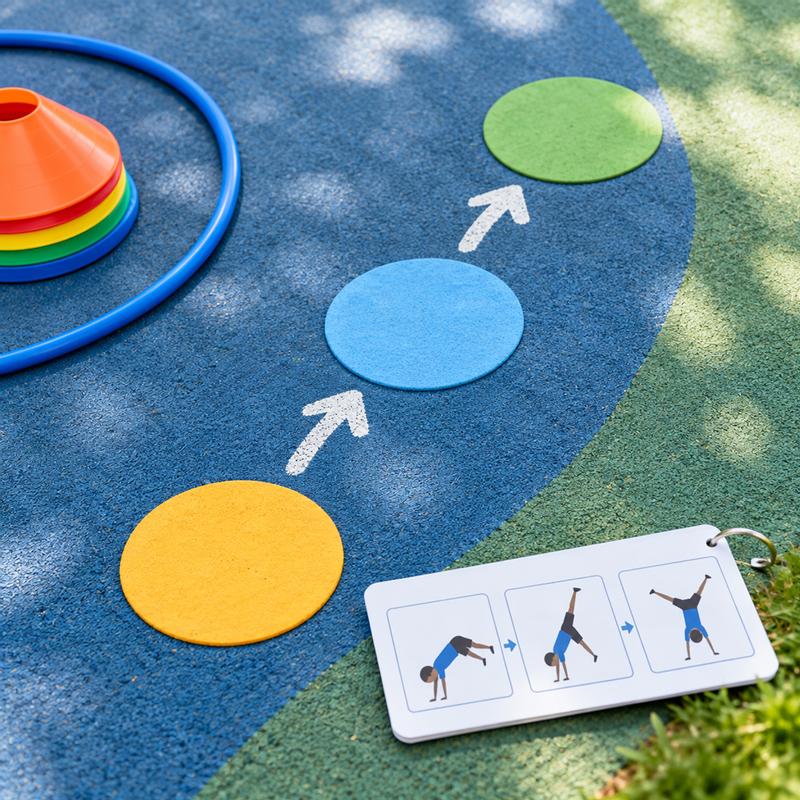
A teaching assistant notices and walks over, lowering herself to his level. She doesn’t rush. She watches first. Drawing on a recent professional development training led by an occupational therapist, she starts with one simple strategy: breaking the cartwheel into three steps.
“Let’s try just the first part,” she says, placing her hands on the ground. Instead of saying everything at once, she narrows his focus: “First: Hands down. Then: Now kick one leg up. Next: Let the other leg follow.”
She places a wood chip as a visual marker on the ground, a simple cue showing where his hands should go, so he has something concrete to aim for. She then clears the space around him, gently moving other students back to give him room for wider, less restricted movement.
Next, she invites two peers to demonstrate the same three steps slowly. “Can you show us just step one? Now step two.”
The student watches. The cartwheel suddenly looks doable. He tries again. Hands down. One leg lifts up. Then the second, uneven, slightly off balance, but this time he gets over. He did it! The teaching assistant (TA) has successfully enabled access by translating a complex motor task into something the student could attempt to experience.
This moment might seem small, but it was built. It came from intentional investment in how we develop our TAs as skilled practitioners who can read a situation, break it down, and open it up for a child in real time.
What We Do at Western Academy of Beijing
In many schools, professional learning is still largely teacher focused. Teaching assistants (TAs) are included, but not always in a systematic or intentional way, even though they are often the adults who spend the most consistent direct time supporting students. In international schools like WAB, TAs are often highly qualified, holding master’s degrees or prior teaching experience. They bring deep institutional knowledge through their longevity within the school and are frequently trusted partners for families. Yet without intentional systems for growth, their expertise can remain underutilized.
At the Western Academy of Beijing (WAB), this realization became a catalyst for change. Because we see inclusion as a whole-school responsibility, our goal was to rethink the role of TAs within an inclusive system. Central to this shift was ensuring that professional learning is embedded in their daily lived experience, in classrooms, on playgrounds, in hallways, and on school buses.
This sits closely with SENIA Standard 3.5, which emphasizes continuous, relevant professional learning for all staff, and Standard 3.7, which calls for clearly defined roles and ongoing development for TAs.
TA Professional Growth Pathways
WAB has redesigned TA roles, moving away from administrative positions toward student-facing roles for all TAs. This reinforces the message that every TA is an educator. Recognizing that professional growth must be connected to real opportunities and pathways, WAB intentionally creates flexible pathways that allow TAs to grow their skills, take on new responsibilities, and transition toward more teaching opportunities.
For some TAs, the transition to teaching begins with taking on lead teaching responsibilities within specific blocks, stepping into instructional roles, and being compensated at a teacher's salary rate. Others gain experience through substitute teaching opportunities, allowing them to apply their knowledge in different classroom contexts and build confidence in leading learning.
Leadership opportunities are created within the TA structure. The lead TA role provides experienced TAs with responsibility for mentoring their peers, supporting coordination, and contributing to team effectiveness.
At the same time, we recognize that not all pathways should lead to classroom teaching. Some TAs may choose to deepen their expertise within inclusive learning and support. For these individuals, we provide opportunities to become a specialized teaching assistant (STA), working more intensively to provide 1:1 support for students with moderate to complex needs.
Together, these pathways reflect a core belief that supporting TAs to grow is about expanding what a TA role can be. This becomes most visible in the lived experiences of our TAs. The following two stories illustrate how these pathways support growth in different ways.
The Story of J: From Isolated Training to Embedded Learning
WAB focuses on designing professional learning that is continuous, accessible, and directly connected to daily practice. All TAs at WAB participate alongside teaching faculty in whole-school professional learning structures, including professional book clubs and professional learning networks. While these structures provide consistency, the emphasis at WAB is on learning that continues beyond sessions and is embedded into daily interactions with students and daily practice through coaching, modeling, and collaboration with teachers and specialists.
J’s journey reflects how professional learning becomes powerful when it is embedded as part of the daily experiences. She began at WAB as a receptionist who became inspired to pursue her teaching qualifications. During the pandemic, when many teachers were unable to return to Beijing, J stepped in to support elementary classrooms. This revealed her natural strength as an educator, particularly her ability to build strong, trusting relationships with students. She then transitioned into an STA role, working closely with students with emotional-behavioral needs. During this time, she completed the two-year SENIA Academy training required for STAs. More importantly, she consistently translated that learning into practice, applying strategies in real time, adapting support, and refining her approach based on each student’s response.
Her growth did not stop with completing the SENIA Academy training. It deepened through ongoing, embedded professional learning experiences. When WAB opened a pathway for TAs with teaching qualifications to apply for full-time supply teaching roles, J was one of six successful candidates. As a supply teacher, she continued to learn in context. She did not limit herself to one grade or subject but intentionally stepped into diverse teaching situations. Along the way, she engaged in coaching and mentoring conversations with homeroom teachers and sought out peer observation opportunities to visit different classrooms, noticing and reflecting on effective practices before adapting them into her own teaching.
Professional development, for J, was always part of her daily work. Each classroom, each collaboration, and each student interaction became a site of learning. Her story illustrates SENIA 3.5 in action: professional learning that is continuous, contextual, and directly tied to student impact.
The Story of A: From Passive Support to Professional Identity
One of the most significant shifts has been moving away from seeing TAs as recipients of training toward recognizing them as contributors to professional learning. WAB TAs share their expertise, both through external conferences (e.g. SENIA Beijing Conference and SENIA Collaborative) and through in-house workshops (e.g. TAs Lunch and Learn), where TAs are leading sessions, modeling strategies, and contributing to the professional growth of their peers.
Organizationally, just like teachers have Teaching Staff Association, theTAs at WAB have their own staff association that meets monthly with the Head of School. TA reps are also included in the Board of Trustees and sectional professional development committees, so they have insights into how school leadership and governance functions in international school settings. Over time, this has supported a shift in identity, from “assistant” to “educator with a voice and area of expertise.”
A’s journey at WAB reflects what can happen when TAs are given both opportunity and trust to step into their professional identity. Originally trained overseas as a teacher, A joined WAB as a teaching assistant in the visual arts department. Within her first year, she began leading learning experiences and developing community-based art projects, and by the second year, she was offered a teaching block in early years. Beyond the classroom, A actively contributes to school life: co-leading the musical team, coaching girls’ soccer, running a mahjong club for staff, and working within the staff association to bridge the divide between teachers and TAs.
Her growth trajectory is also self-driven. In her second year, she began a master's degree in art therapy. This year, A extended her role even further by contributing to WAB’s Dog Therapy Pilot Project. She designed and facilitated art-based therapy activities during lunchtime wellness sessions, integrating her developing expertise with student wellbeing needs.
A’s journey illustrates the pathway from a support position to a leader, innovator, and connector within the school. She is identifying needs, designing initiatives, and contributing meaningfully to both student learning and community culture. Her story is linked to SENIA Standard 3.7: when roles are clearly defined but also intentionally expanded, teaching assistants develop voice, leadership, and professional identity.
Conclusion
SENIA Standards 3.5 and 3.7 remind us that inclusion is not only about student support structures, but also about how we develop the adults within them. By embedding TAs into meaningful professional learning, creating space for reflection and leadership, and ensuring equitable access to growth opportunities, we move closer to a model where inclusion is truly shared. And sometimes, that impact is visible in small but meaningful moments like a student completing a cartwheel. Not by chance, but by design.
References
Agustian, H. Y. (2021). Disability inclusion in international schools: Challenges and opportunities for equitable education. Journal of Research in International Education, 20(3), 247-262.
Ainscow, M. (2020). Promoting inclusion and equity in education: Lessons from international experiences. Nordic Journal of Studies in Educational Policy, 6(1), 7-16.
Hattie, J. (2023). Visible learning: The sequel. Routledge.
Roldan, M., Ferro, J., & Hill, D. (2021). Benefits of inclusive education: A qualitative study of student and community outcomes. International Journal of Inclusive Education, 25(12), 1369-1385.
SENIA International. (2026). Faculty, support staff & professional growth: Disability inclusive practice standards. SENIA International.
UNESCO. (2021). Reimagining our futures together: A new social contract for education. UNESCO Publishing.
United Nations. (2006). Convention on the Rights of Persons with Disabilities (Article 24: Education). United Nations. Retrieved from https://www.un.org/development/desa/disabilities/convention-on the-rights-of-persons-with-disabilities/article-24-education.html
Wenger, E., Trayner, B., & de Laat, M. (2011). Promoting and assessing value creation in communities and networks: A conceptual framework. Open University.
Dr. Christin Topper is the head of student support at Western Academy of Beijing.