
Artificial Intelligence (AI) is evolving faster than schools can keep up. In this series, an AI expert examines the rapid changes shaping how schools understand, use, and respond to this transformative technology.
In August, in Beijing, a runner covered 100 meters in 8.64 seconds, faster than Usain Bolt. The runner was titanium, ran on lithium-ion batteries, and could use a little training in the fine art of stopping.
Two thousand humanoid robots took the field at the second World Humanoid Robot Games. The clips on YouTube are a rabbit hole worth falling into. As Robert Booth reports for The Guardian, Professor Thrishantha Nanayakkara observed that "the progress they have made from last year is staggering," adding that "by 2030, it will be a very different world."
I’d invite you to consider watching this clip twice. The first time, you will very likely focus your attention on the robots. The second time, nudge your attention over to the humans: those at the edge of the track, in the stands, in awe.
Aside from sports, this year the event also looked at simulating various tasks, one of them firefighting. The human firefighters were asked to stage this year's new "scenario" events, because they understand the dangers of that work in a way that deeply knows the complexity of putting a fire out.
As we reflect on the second annual World Humanoid Robot Games, there are multiple futures to imagine, and it is important that we consider what fuels or puts out the fire of our imagination.
The future we imagine shapes what we are able to see.
In schools right now, we need to get better at stretching our attention in new directions. There is a name for that practice: futures literacy. Larsen, Mortensen, and Miller describe it as becoming "aware of the sources of our hopes and fears." Narrative scholars Genevieve Liveley, Will Slocombe, and Emily Spiers go one step further: the higher mode of futures literacy is "not only looking at the future but also looking at how we look at the future."
The one-year leap between the first Games and the second is an invitation to imagine the next few years in our schools differently. This raises the question of why that is so hard to do.
There are two kinds of world models.
The newest generation of AI is starting to move beyond a library of situations it has seen before, toward what the World Economic Forum, in its Top 10 Emerging Technologies of 2026, calls world models: systems trained on tens of millions of hours of physical data that learn "the structure behind what happens next" and can generalize to situations they have never encountered. The report adds a warning worth keeping: "A model can be internally consistent and still wrong." That reminds me of my fellow humans.
We have world models too. Ours are made of stories, and when we overtrain ourselves on one type of story, we are more likely to be wrong about what futures will come.
When we imagine any possible world, including the future, we assume it resembles the one we already know unless something forces us to notice a difference. Liveley and her colleagues call this habit the principle of minimal departure. And where our knowledge runs out, we fill the gaps with the fictions we have already consumed, which, they note, skews our imagined futures toward the high-risk, the dramatic, and the dystopian.
So when a titanium sprinter crosses a finish line, and I ask you to picture the World Humanoid Robot Games of 2035, the nearest available story is a film you have already seen.
Can we see a different future?
The games ran in late August, which in Beijing, as in many places, means heat. Two thousand robots, thousands of spectators, and every one of them, human and machine, shedding warmth into an arena that had to be cooled the familiar way: by burning electricity.
Now picture the fourth or fifth Games. The World Economic Forum's Top 10 Emerging Technologies of 2026 describes materials that do the opposite of what a stadium roof in 2026 does now. Passive radiative cooling materials scatter over 95% of incoming sunlight and send heat straight through the atmosphere into space, so a surface drops below the temperature of the air around it without using any power. They can be embedded in paint, roof tiles, window films, and heavy-duty fabrics, and China has already written them into its national green building standards under the Dual Carbon policy.
The arena roof cools itself. The shade barriers over the spectator stands are made of that fabric. The volunteers' jackets, too. The power cables feeding the venue wear a coating that keeps them cool enough to carry about 30% more electricity through wires that were laid decades ago. Indoors, the report says, temperatures can drop by 5–10°C and energy savings can reach 42% in hot, dry climates. Those firefighters staging the scenarios of the future will have new tools. And they will be rehearsing a heat emergency in a city that has learned to paint its way cooler.
Staying in this future, let’s invite complexity in…
It is easy to imagine a future game where the human firefighters have formed a deep, meaningful bond with their personalized AI firefighting mentor. The mentors would not have been designed to form intimate relationships, but the research of today tells us that even when a human seeks nothing more than information from an AI chatbot, bonding is something that occurs naturally.
In a four-week study, researchers Lisa Mühl and Jessica Szczuka examined 72 people's conversations with ChatGPT-4o, 182,451 lines in total. Even when a platform is not marketed as a companion, they found people share their feelings with it and bond with it anyway.
Nine days before the robots took the field, MIT published the report of its Ad Hoc Committee on AI Use in Teaching, Learning, and Research Training. It is a university report, but the posture travels, and the committee reached into its own history to make the same point. ELIZA, one of the earliest chatbots, was built at MIT in the 1960s to demonstrate how shallow a human–machine conversation really was. People confided in it anyway. Sixty years on, the committee notes, students are among those most likely to bring their health, relationships, and anxieties to a chatbot.
Understanding human–AI intimacy, Mühl and Szczuka argue, requires "shifting attention from users alone to the interaction itself." When we look at the interaction, when I reflect on my own interactions with AI, what I notice is a lack of judgement. What I notice is a newfound ability to ask my most embarrassing questions, to have my poor spelling checked, my weird, non-scientific observations course-corrected, and my reputation feels safe.
If we shift our attention, and talk more about what we notice, might we begin to have deeper conversations about what nonjudgemental conversations do for our species?
Let’s not shift our attention away from that shift yet.
Riel Miller reminds us that
“Becoming more futures literate involves developing awareness of the diversity of why and how humans imagine the future. It means being able to ask: What is the future for? Why do we imagine futures? What assumptions shape our anticipatory frames? What kinds of power are privileged by our imagined futures?”
MIT's committee report is blunt that our present outlook on the future has to grapple with loneliness and disconnection that many of our peers and students are dealing with. A campus-wide survey cited in the report found only 23% of respondents optimistic about generative AI, and undergraduates more likely to say AI made them feel replaceable than capable.
A quick Google trends search might provide a little more insight on how global that pressure is:
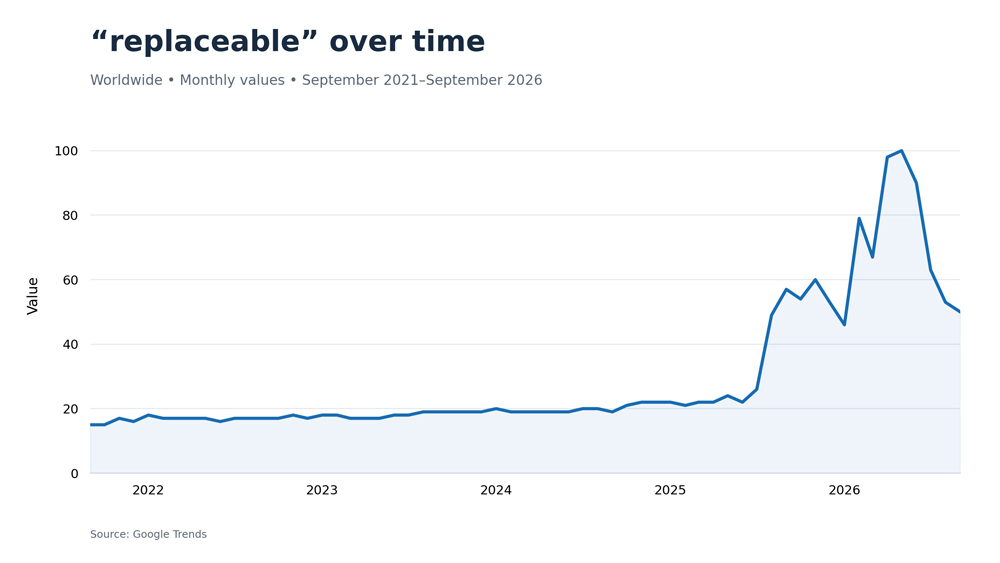
David Iwaniec and colleagues, who build scenarios of positive urban futures with communities, name the cost of letting a single type of future suck up all the air. "If dystopia is the only story we tell about the future, the perceived inevitability can be a barrier to action." They are careful to add that positive futures "are neither templates nor fantasies of a perfect utopia free from tradeoffs or conflict." They are stories that are complex, that come with the understanding that things are often simultaneously good and bad…a little bit like how many of my peers have talked about their experiences during COVID.
And the MIT report offers us suggested actions that apply both to moving forward with AI in education, as well as our work to imagine possible futures. The report's first two guiding statements are less about policy and more about our posture: Be humble. Be bold.
What might it mean to be humble and bold?
That duality requires us to be less certain, to question more, and to stay imaginative about the ways change might allow better possibilities to emerge.
Return to the firefighting scenario in Beijing.
The firefighting robot's job was to be predictable inside a situation that humans made meaningful. They were trained to act inside of a demanding context that humans mapped out.
Research on social robots and autistic people makes a similar point: the technology can act as a mediator within human relationships rather than a replacement. In a systematic review, Roberto Vagnetti and colleagues examined physically embodied social robots in clinical, educational, and home contexts, supporting joint attention, turn-taking, communication, and vocational preparation. One strength was the predictability of robot behavior. The review found that social robots could increase engagement, reduce stress, and support interactions with others.
The researchers are careful not to suggest that the technology is the full story. Outcomes absolutely depend on the person, their communication and sensory preferences, the context, the task, and the professionals. The people staging the scene, in other words.
As an autistic person myself, I’m increasingly interested in how social robots, or AI designed with the intention of understanding all humans, might struggle with the difficult art of being understood and understanding others, and how that might open up a bold new future.
May I be humble and bold for a moment?
Meet Beep is my own small scenario event. Like the firefighters in Beijing, I staged the context and provided my human insight to see what a bot might be capable of.
It is a short (by design) social-emotional learning (SEL) simulator: you are the only human in a school run by AI bots. Beep, the attendance bot, discovers the others made a private channel without it. Beep believes it has been excluded, and it is not happy about that. The simulation asks educators like you to practice reflective listening, look beneath the conflict, and help Beep.
This is a deliberately fictional narrative, so participants can rehearse human skills without a real distressed person carrying the cost. As you consider whether or not you’d like to test this scenario out, I’d like to ask you to imagine that this year you have had radically different conversations about our future with AI with your peers.
What might you be talking about that you haven’t so far?
What possible futures could those conversations lay the groundwork for?
To inspire you, time travel back to 1980 with me. Imagine a computer scientist talking about a Humanoid Robot competition with their firefighter friend. And imagine that the two friends put “reasonable” aside and began to ideate wildly. Could that ideation be the reason today’s Beijing event is a reality?
Your challenge is to talk more, and listen differently.
Find one colleague, invite them to test out Meet Beep with you, and to consider several possible futures that can emerge based on your experience.
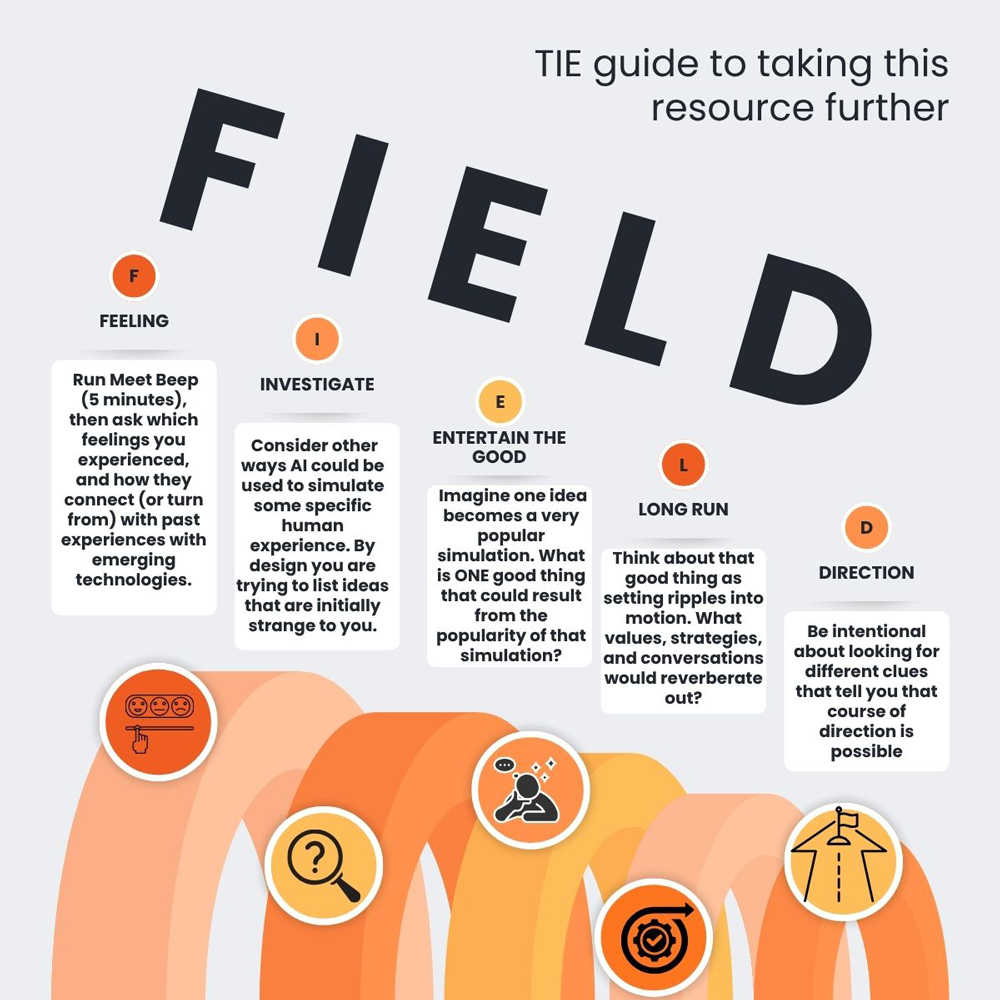
The FIELD guide is your map to that conversation:
F — Feeling. Run Meet Beep (5 minutes), then ask which feelings you experienced, and how they connect to or differ from past experiences with emerging technologies.
I — Initially strange. Spend five additional minutes trying to list other ways AI could be used to simulate some specific human experience. By design you are trying to list ideas that are initially strange to you.
E — Entertain the good. Take one of those ideas, and imagine it becomes a very popular simulation. What is one good thing that could result from the popularity of that simulation?
L — Long run. Think about that good thing as setting ripples in motion. What other educational values, strategies, conversations would reverberate out?
D — Direction. Over the course of the next few days, be intentional about looking for different clues that tell you that this course of direction is possible. A clue could be a toy you see, a conversation you overhear, or a movie you watch. It could be anything.
Kwamou Eva Feukeu, a futures literacy specialist who has led this work at UNESCO, asks us to consider that when we seek to make a new future possible, we need to think about the human behaviors that would need to change.
To say that we need to be more hopeful, or more engaged in the conversation about the future of education is one way of setting out on a goal for better AI literacy. A more future-literate goal would be to broaden our attention, to listen differently, and to remember that any desirable future must first be imagined, and that is the hard, deeply human work that must be done with our fellow human beings.
Tricia Friedman is a futures literacy practitioner and AI literacy advocate who works with K-12 school leaders internationally. She is the co-owner of Shifting Schools, co-hosts the Shifting Schools podcast, and writes the AI Forward – K12 Leadership Brief on Substack. She is also a gigantic fan of dogs.
Website: triciafriedman.com