

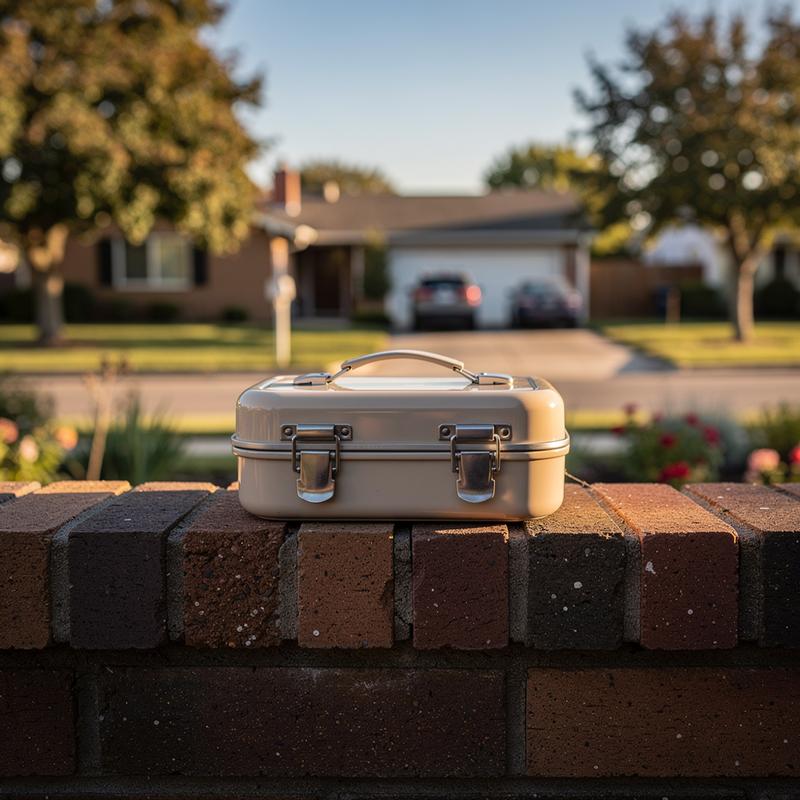
When I was 13 the local police blew up my friend’s lunchbox. She had gotten off the school bus and casually left it on the wall outside her house in a quiet residential area. A vigilant neighbor, and member of the local “neighborhood watch,” had seen the abandoned lunchbox and diligently reported it to the police. It caused great excitement at school the next day when the story appeared in our local newspaper. In our pre-internet era, she rode her newfound celebrity status for a whole week.
This may have seemed like an extreme reaction from the neighbor, but the incident fell not long after the IRA had detonated an explosive device outside of Shrewsbury Castle, so there was a sense of high alert among the community at the time. In hindsight, what stayed with me was not the lunchbox itself, but how quickly an ordinary object became something potentially dangerous because of the context in which it appeared.
Fast forward a few years and my husband and I were living in Brussels with our two small children. One evening we received a knock at the door and opened it to find a policeman standing on the doorstep. An unidentified package had been left in our street. The bomb disposal squad had been called in and we were strictly instructed to stay indoors until we were given the all clear. My family and I watched from an upstairs window as the WALL-E style bomb disposal robot whirred down the road in the direction of the unidentified package, its robotic arm/proboscis protruding out front. Thankfully it was an uneventful outcome. There was an underwhelming “phut” sound and shortly afterwards the policeman returned to tell us all was well.
Again, this may have seemed like an extreme reaction, but the truth is that the incident occurred at a time when the community was once again on high alert, recovering in the aftermath of the Brussels Bombing back in 2016. Once again, circumstances had heightened everyone's sensitivity to potential threats, and caution was the appropriate response.
These experiences have stayed with me because they illustrate how context shapes the way we respond to uncertainty and perceived risk. The same dynamic plays out in schools. Our role as school leaders can often require us to diffuse potentially hostile moments, causing us to frequently be on “high alert.” We are, in a sense, metaphorical experts in handling explosive situations, whether they involve students, parents, faculty, or staff. And in our current climate of increased polarization, this is more so than ever before.
Extreme levels of emotion (oftentimes rage) have become currency. We see it weaponized against compassionate, ill-prepared, and kind elementary faculty members, as well as our admin team and staff. This is evident in parental demands for "witness statements" during run-of-the-mill student disagreements, "incident reports" for lost items, and heightened reactions when English language learners communicate bluntly in their second (or third or fourth) language. Empathy is lacking as these learners are left unforgiven for not having yet adopted the nuances of anglophile linguistic etiquette. From our perspective as educators, it can feel confounding as the oxygen of benevolence is sucked from our community, and the space to make mistakes (at least amongst our students) becomes constricted.
What then might our leadership approach be?
Perhaps the first step is to recognize that leadership is a paradoxical, esoteric experience. We must simultaneously remain rooted in the core situation, hyperaware and fully connected, while also retaining the ability to float in the ether around it and objectively observe the external factors contributing to it. We must both associate and disassociate in order to navigate the complexities of human dynamics and their context.
As leaders, it is our role to be especially vigilant to the way dysregulation and extreme behaviors can infiltrate our communities in a hostile and disharmonious way, and to mitigate the risks calmly, firmly, and intentionally.
This approach is supported in Management in the Age of Outrage, a 2024 article by Khartik Ramanna, published in the Harvard Business Review. Ramanna reminds us that the heated situations we encounter are oftentimes symptomatic of much larger issues at play, issues beyond our control. It is highly possible that we are encountering individuals at the apex of a series of challenging situations, which may or may not be school-related. This is not about making excuses for unreasonable behaviors; it is a reminder that our temperaments are the product of a myriad of factors, and this is something to bear in mind when facing down a volatile parent, student, or colleague.
The article was later developed into a book, The Age of Outrage: How to Lead in a Polarized World. Here Ramanna suggests that while traditional management may involve a significant amount of time putting out fires, in this current age of polarization, the ground is permanently hot.
So what are we to do to temper the ground we walk on? We have to cool things down. De-escalate. Diffuse. Lead with compassion. Just as bomb disposal experts don't rush toward an unidentified package, leaders benefit from slowing down long enough to understand what they're actually facing.
Here are three strategies to catch ourselves with when faced with highly charged encounters:
The strategic pause
Consciously pausing ourselves and allowing the other person to let off steam is akin to taking the lid off a saucepan. The journey to school, or the interim period between an incident and arriving at the Principal’s office has provided “boiling time” within which a premeditated set of points has been constructed, and conversations rehearsed. Denying the opportunity to vent these will only add to a heightened sense of frustration. The strategic pause occurs without interruption, correction, or defensiveness. Its power comes in the validation of the other person’s emotion, and not, necessarily, their version of the facts. The strategic pause allows the listener to absorb the other person’s reality, while the speaker decompresses and has the opportunity to be heard. The strategic pause creates the space to remind ourselves we are not personally under attack. We are experiencing advocacy at work: a parent advocating for their child, a teacher advocating for a pedagogical belief. Leading with a sense of compassion in these moments has, in my own experience, led to stronger parent partnerships, and more trusted relationships with colleagues.
Separate the person from the problem
Just as my friend’s abandoned lunchbox was never the true issue, the person standing in front of us is rarely the whole problem. A compassionate approach stops to diagnose the systemic pressure point rather than the person. What is it about our systems that may have brought us to this point? Was communication timely and comprehensive? Was knowledge assumed rather than explicitly taught? Did the system operate as intended? As we pause to suspend judgement, we also need to scrutinize our infrastructure and identify where vulnerabilities within our system can lead to miscommunication, frustration, and, in a worst case scenario, fear-based responses of anger, threats, and upset. Separating the person from the problem creates an opportunity for inquiry into the wider context. What can we diagnose in this situation? How might we treat it? What might healing look like? It is a pseudo-bedside manner approach, where, like the Hippocratic oath, our guiding principle must always be to “do no harm.”
Co-regulation over co-escalation.
High-alert environments require calm professionals. The final recommendation is to pay attention to our own emotional balance, and intentionally de-escalate tension through remaining regulated ourselves. Vulnerability is woven through the fabric of our schools as parents entrust their children to us, children entrust their mistakes, and we lay bare our skills. It is no surprise then that emotions run high. It is surprisingly easy to dysregulate on something that carries so much affective burden. The amygdala is on overdrive in our educational settings and so we need to consciously pay attention to it, to override the nervous system’s descent into “fight, flight, freeze, or fawn.” If we approach with compassion, we can recognize that our role in heightened situations is to be the other person’s anchor and to act as a co-regulator. This is one of the many reasons why inclusion activities, which help to acknowledge the energy we bring to a meeting, hold such value, and the work of Garmston and Wellman’s Adaptive Schools retains its value as a doctrine for leadership skills in education almost thirty years after its initial publication. It reminds us to pay attention to ourselves, so that we may also pay attention to others.
Unlike the lunchbox and the unidentified package, today's alarms are often intentionally manufactured. Increasingly, the media environments our communities inhabit reward outrage, urgency, and polarization. Whether driven by social media algorithms, political discourse, or broader societal pressures, many people arrive at our schools already on high alert. Great leaders don't ignore potential threats, but neither do they react to every lunchbox as though it contains a bomb. We must pause, assess, seek understanding, and respond with intention. In doing so, we can create communities where people feel both safe and seen.
Jenny-Lee Moore is the Assistant Principal at the International School of Manila, elementary school.
LinkedIn: https://www.linkedin.com/in/jenny-lee-moore-a27990153/
X: @moore_jennylee