

Note: Lin is a composite character and does not represent any real student at any school. She is drawn from the collective experiences of multilingual learners across international school contexts. All identifying details are fictional and are used solely to illustrate the framework.
Lin is fourteen years old. She speaks Mandarin at home, Cantonese with her grandmother, and English at school. Her teachers describe her as a strong student: her test scores are above average, she participates in class, and she turns in every assignment on time.
At school, Lin's multilingualism is invisible in the data because it is never measured as an asset. Her MAP scores are strong. But her language profile has never been formally updated because in many international schools, once a multilingual learner reaches academic proficiency, the system stops asking deeper questions about their linguistic identity. Her teacher does not know she speaks three languages because no formal structure exists to surface that information.
"They see my grades. They don't see me."
Lin belongs academically. What she has never experienced is the other two kinds of belonging, the ones that are harder to see in the data because our systems were not designed to measure or produce them.
The Belonging Trifecta
In my work as a multilingual learning specialist, I have come to understand that belonging in school is not a single condition. Dr. Virginia Rojas (2026) names the paradox that makes this understanding urgent: international schools embody a monolingual habitus, what Gogolin (2013) first defined as the deeply ingrained institutional assumption that one language is the natural default of schooling, even as they claim commitment to multilingualism. The Belonging Trifecta is a framework for what genuine multilingual belonging looks like when a school finally chooses to deliberately dismantle that habitus by design. It names three dimensions, each anchored in a practitioner mnemonic, Visibility, Voice, and Value, that must operate simultaneously.
V1 — Visibility: Academic Belonging is what Lin has. It is the experience of intellectual dignity: high-demand tasks, rigorous scaffolding, and the message that a student's mind is capable and expected to grow. A school produces Academic Belonging when it designs Tier 1 instruction for all learners, not just those whose language of thinking matches the language of teaching.
V2 — Voice: Linguistic Belonging is what Lin is missing. It is the experience of having your full linguistic identity recognized as a cognitive asset, not just tolerated until your English improves. A school produces Linguistic Belonging when it builds translanguaging into policy, treats multilingualism as a resource in curriculum design, and stops measuring language as a deficit.
V3 — Value: Social-Cultural Belonging is what Lin has never fully experienced in her school's systems. It is the experience of seeing your culture's deep knowledge embedded in what is taught, not added as a token celebration in October and ignored for the rest of the year. A school produces Social-Cultural Belonging when it uses students' funds of knowledge, the valuable cultural, social, and intellectual resources that students bring from their homes and communities, as a design principle, not a supplementary resource (Moll et al., 1992).
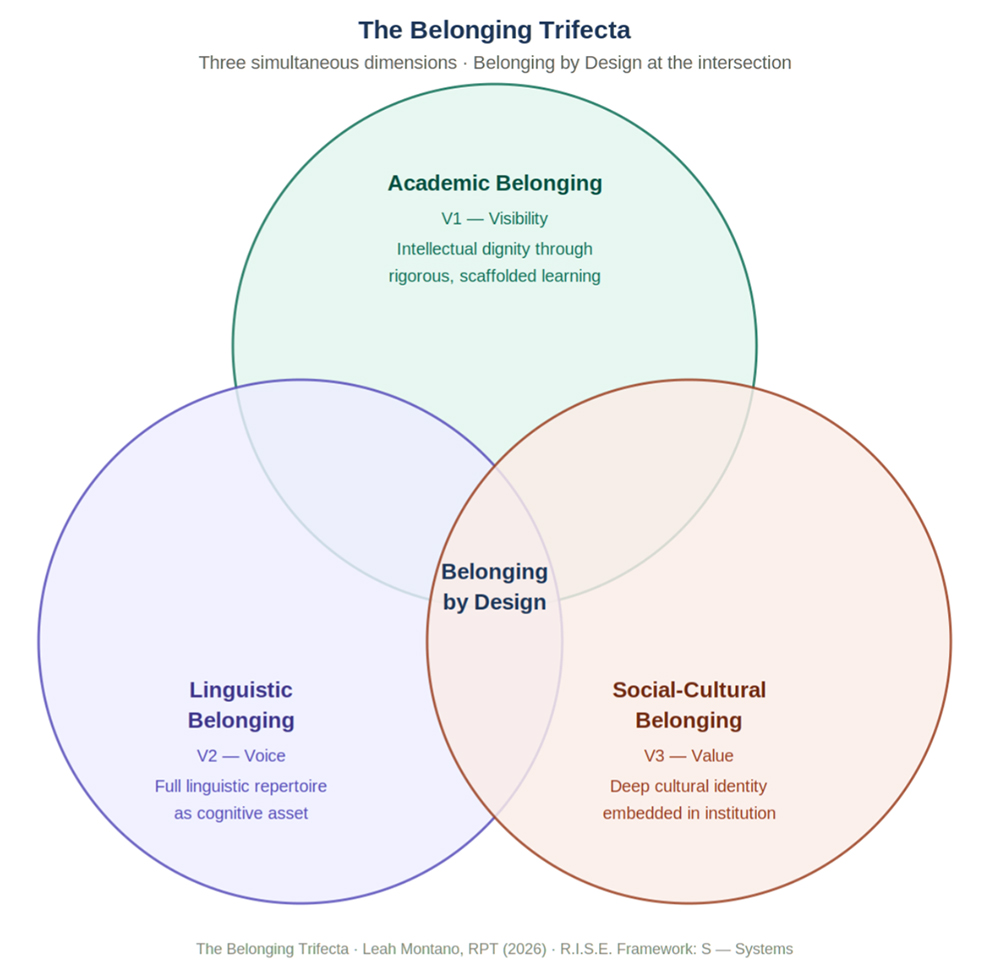
The Belonging Trifecta: Three simultaneous dimensions of belonging whose intersection produces Belonging by Design. (Photo source: Leah Montano, 2026)
What the Trifecta Reveals
Return to Lin. She has Academic Belonging: Her teachers see a capable student and the data confirms it. But the Trifecta asks two more questions. Linguistically: Does her school know she thinks in Mandarin? Has it ever invited that thinking into the classroom? Socially and culturally: has her cultural heritage and identity ever been treated as a curriculum worth studying? The answer, in most international schools, is no. Lin is succeeding in one dimension while remaining silenced and unvalued in the others. The Belonging Trifecta makes visible what the data cannot.
Now consider a school that has worked hard on V1 and V3. Academic rigor is high. Cultural celebrations are genuine and frequent. Student artwork in twelve languages covers the hallway walls. But the school has an English-only policy in classrooms. Students are gently corrected when they slip into their home language to process a difficult concept. The message, unintentional but structural, is clear: your languages are decorative, not cognitive. Without Voice, the Visibility and Value the school has worked to build remain incomplete.
The Belonging Trifecta is not a checklist. It is an architecture. Remove one dimension, and the structure does not hold.
Three Kinds of Belonging Require Three Kinds of Systems
The Belonging Trifecta is not a wellbeing framework. It is a systems design framework. Each layer requires specific structural conditions that no individual teacher can produce alone. They require school-wide decisions about scheduling, curriculum, data, assessment, and professional learning.
Visibility: Academic Belonging requires language-responsive Tier 1 instruction, Multi-Tiered System of Supports (MTSS) systems anchored in quality core teaching rather than pull-out intervention, and assessment practices that separate language proficiency from content mastery. Systemically, this demands a complete rejection of "tracking," the institutional practice of separating students into lower-level academic pathways based on their current language proficiency. Tracking conflates temporary linguistic barriers with permanent cognitive ability, creating an artificial glass ceiling. Visibility requires heterogeneous, co-scheduled classrooms where language and content specialists co-teach.
Voice: Linguistic Belonging requires school-wide translanguaging policies, multilingual scaffolds as standard Tier 1 infrastructure, and data systems that track linguistic assets rather than language deficits. A school that intentionally builds Linguistic Belonging might begin, as one international school in Southeast Asia did, by dismantling its English-only policy. Students like Lin were encouraged to use their home language as a thinking tool before producing in English. The visible outcome was not immediately measurable in test scores. It was reduced anxiety. The language students thought in at home was finally welcome in the classroom. Lin no longer had to suppress her primary identity to participate in learning; her voice became an asset to the collective classroom discourse.
Value: Social-Cultural Belonging requires a curriculum that embeds cultural funds of knowledge at the design stage, physical and digital environments that reflect the school's full linguistic landscape, and family governance structures that include multilingual communities as decision-makers rather than passive recipients of school communication. A school building Social-Cultural Belonging might invite students like Lin to bring their cultural heritage and identity into a unit: the stories passed down through generations, the lived experiences that shaped their family's understanding of the world, the knowledge and identity they carried into the school building long before the first lesson began. Their culture becomes content. Their lived experience becomes curriculum.
Jomar Conde, creator of the R.I.S.E. Framework, writes that multilingual learners are not broken wheels. They are simply a different shape traveling a road that was not designed for them. The Belonging Trifecta is a tool for redesigning the road. When all three conditions are present simultaneously, when the school produces Academic, Linguistic, and Social-Cultural Belonging by design, engagement is not a goal to pursue separately. It is the natural result of the architecture (Cohen, 2023; Pope & Miles, 2022).
When Lin is visible in the intellectual life of the room, when her voice carries the full weight of her linguistic repertoire, and when her cultural heritage and identity are valued as a design principle rather than a decoration, that is when the Belonging Trifecta is complete. That is when Lin stops waiting.
The question is not whether she belongs. She does. The question is whether our systems are designed to tell her so.
References
Anthropic. (2026). Claude (claude-sonnet-4-6) [Large language model]. https://claude.ai
Cohen, G.L. (2023). Belonging: The science of creating connection and bridging divides. W.W. Norton.
Conde, J. (2026). Multilingual learning through belonging. The International Educator. https://www.tieonline.com
Gogolin, I. (2013). The "monolingual habitus" as the common feature in teaching in the language of the majority in different countries. Per Linguam, 12(2), 38–49.
Hammond, Z. (2015). Culturally responsive teaching and the brain. Corwin.
Moll, L.C., Amanti, C., Neff, D., & Gonzalez, N. (1992). Funds of knowledge for teaching: Using a qualitative approach to connect homes and classrooms. Theory Into Practice, 31(2), 132–141.
Montano, L. (2026). Engineering the road: Systems as the architecture of belonging. In J. Conde (Ed.), R.I.S.E.: Engineering Belonging for Multilingual Learner Success [Forthcoming].
Pope, D., & Miles, S. (2022). A caring climate that promotes belonging and engagement. Phi Delta Kappan, 103(7), 8–13.
Rojas, V.P. (2026). Dismantling the monolingual paradox of multilingual schools. The International Educator. https://www.tieonline.com
WIDA. (2020). WIDA English Language Development Standards Framework. University of Wisconsin–Madison.
Leah Montano is a multilingual learning specialist at CIA FIRST International School in Phnom Penh, Cambodia, with over a decade of experience supporting multilingual learners across Southeast Asia. She is a chapter author for the forthcoming R.I.S.E. Framework book edited by Jomar Conde, where she developed two original frameworks — the Belonging Trifecta and the Water Level Principle — for belonging-centered systems design in multilingual education. She is a member of TESOL International Association, ASCD, and the Association for International Educators and Leaders of Color (AIELOC).