
Beyond “One Medium Fits All”
As art educators, we often pride ourselves on exposing students to a wide range of art forms, techniques, and materials. From acrylic painting to printmaking, clay, collage, and digital media, these experiences enrich students’ visual vocabulary and creative confidence. I strongly believe that introducing students to diverse artistic practices is essential. However, alongside this exposure, I also believe we need the flexibility within our units to allow students to explore the same concept through different materials.
Art education should not only teach technique; it should create opportunities for every child to discover where they thrive. The question, then, is not whether students should learn different mediums. They absolutely should. The deeper question is: Should all students be required to express understanding through the exact same medium?
A Classroom Experience That Changed My Thinking
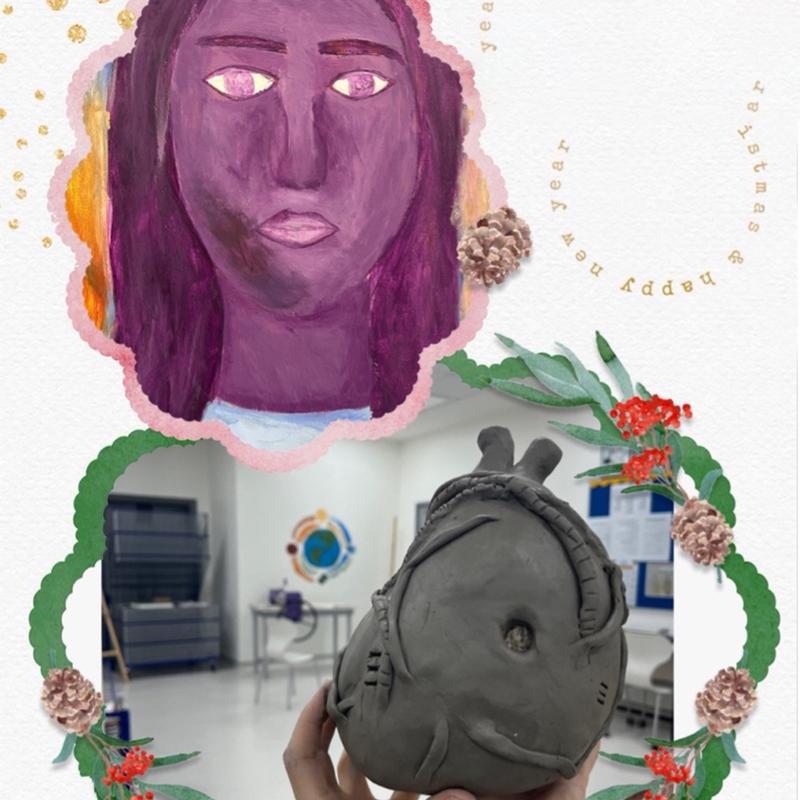
I began reflecting on this more deeply through an experience with a student in my own classroom. We were working on a unit exploring self-portraits and identity. Students were creating acrylic self-portraits on canvas. The unit itself was thoughtfully scaffolded: we explored mark-making exercises, fast sketching, mirror drawing, collage work, and discussions around cultural identity and personal narratives. I was genuinely proud of how the unit had been designed and how it encouraged students to reflect on themselves and their connections to culture.
Among the students was one learner with ADHD. Throughout the unit, she participated, but remained average in her engagement and output. She constantly needed reminders to stay on task, repeated prompts for submissions, and frequent redirection. By the end of the unit, she managed to complete the work and earn a satisfactory grade, but the process felt exhausting for both the student and the teacher.
Then we transitioned into our next unit: clay work. And suddenly, everything changed. Her attitude shifted completely. She finished work within class time. She began asking permission to visit the art room during breaks and after school. On days she did not even have art, she would stop by just to check on her clay artifact. The same student who previously needed constant prompting was now independently motivated, curious, invested, and excited.
Watching this transformation made me pause and reflect: Had I been too rigid in my approach? Would this student have engaged more deeply with the previous unit if she had been allowed to explore identity through sculpture instead of acrylic painting?
Material Choice and Neurodivergent Learners
Research in personalized learning consistently highlights the importance of student agency, autonomy, and differentiated pathways in education. According to the principles of Universal Design for Learning (UDL), students benefit when they are offered multiple means of engagement and expression, allowing them to demonstrate understanding in ways that align with their strengths and needs.
For neurodivergent learners, especially students with ADHD, sensory and tactile experiences can significantly affect engagement and focus. Hands-on mediums like clay offer movement, texture, physical interaction, and immediate sensory feedback, all of which may support concentration and emotional regulation more effectively than a static painting process.
This does not mean acrylic painting is less valuable. Rather, it reminds us that different materials invite different ways of thinking, feeling, and creating. Students process and express understanding differently. Some learners may flourish through spatial and tactile experiences, while others connect more strongly through visual observation or narrative symbolism.
The Challenge of Flexibility
Of course, flexibility is easier to discuss philosophically than to implement practically. In a classroom of 27 students, differentiated material choices can become logistically overwhelming. Teachers already balance preparation, assessment, classroom management, clean-up, and curriculum expectations. Offering entirely open-ended mediums for every project may not always be realistic.
However, acknowledging the difficulty does not mean dismissing the possibility. Perhaps the answer lies not in abandoning structured units, but in building intentional flexibility within them.
These are difficult questions, but important ones.
Observing Students Beyond GradesOne of the most valuable tools an art teacher possesses is observation.
Often, students communicate their strengths and struggles through behavior long before they articulate them verbally. The student who appears “lazy” during one unit may simply not have connected with the medium. The student who struggles with focus may become deeply attentive through tactile processes. The child who resists drawing may communicate brilliantly through sculpture, textiles, or mixed media.
When we observe carefully, we begin to shape our teaching not around an imagined “ideal student,” but around the real learners sitting in front of us.
Personalized Learning in the Arts
Personalized learning in the art classroom is not about lowering expectations or allowing students to avoid challenges. It is about recognizing that meaningful learning can emerge through different pathways.
Educational researcher Lev Vygotsky emphasised the importance of meeting learners within their zone of proximal development, the space where challenge and support coexist. In art education, this may mean helping students stretch themselves while still allowing them to work through mediums that support engagement and expression.
When students feel ownership over their process, motivation often increases naturally. Student agency encourages intrinsic motivation, problem-solving, experimentation, and resilience, all qualities that art education seeks to cultivate. Most importantly, it creates space for every child to feel capable.
Making Space for Every Child
The ideal art classroom is not one where every artwork looks identical. Nor is it one where every student follows the same path at the same pace. The ideal art classroom is one where every child can find an entry point into creativity. Some students may discover themselves through paint, others through clay, others through digital media, textiles, photography, collage, or installation.
Our responsibility as educators is not simply to teach materials. It is to help students discover the conditions under which they can think, express, and flourish.
Five Practical Ways to Introduce Student Agency in the Art Classroom
1. Offer Limited Material Choices
Instead of complete open-ended freedom, provide two or three carefully selected material options connected to the same learning objective. This keeps classroom management realistic while still supporting student agency.
2. Assess Concepts, Not Just Medium Mastery
Design rubrics around conceptual understanding, creativity, process, and reflection rather than solely technical perfection within one medium.
3. Use Diagnostic Observation Early
Pay attention during exploratory exercises. Fast sketching, collage, sensory tasks, and experimentation sessions can reveal which materials students naturally connect with.
4. Build “Choice Days” Into Units
Allow specific sessions where students can reinterpret ideas through another material. Even occasional flexibility can significantly increase engagement.
5. Create Reflection Opportunities
Ask students to reflect on why certain materials helped them express ideas better. These conversations develop metacognition and help students understand their own learning preferences.
Rethinking Success in Art Education
That student taught me something important: engagement is not always a behavioral issue; sometimes it is a material mismatch.
As teachers, we carefully design units with clear intentions, thoughtful scaffolding, and meaningful themes. Yet sometimes, despite all that planning, the breakthrough comes not from changing the concept, but from changing the medium.
Perhaps true inclusion in art education is not simply ensuring every child participates in the same activity. Perhaps it is ensuring every child has the opportunity to find where they belong creatively.
References
Meyer, A., Rose, D. H., & Gordon, D. (2014). Universal design for learning: Theory and practice. CAST Professional Publishing.
Vygotsky, L. S. (1978). Mind in society: The development of higher psychological processes Mind in Society. Harvard University Press.
Dr. Debjani Mukherjee is an International Baccalaureate Middle Years Programme and Diploma Program art and design teacher working at Gems World Academy, Dubai.
LinkedIn: https://www.linkedin.com/in/drdebjanimukherjee/