
10 - 정
Whenever someone asked me where I was from, I would always reply, “South Korea.” But I was born and raised in America. My ethnicity felt more important than ever. There was a closeness I wanted to foster with my culture. But if 8-year-old me saw how separated she would become from her culture just a decade later, I wonder if she would be eager to raise her hand in pride again.
9 - 윤슬
Seojun Nam — Korean, grew up in Korea, Spain, London, and Hong Kong
“I feel very close to my Korean heritage. Although I've spent half of my life in a foreign country, my parents have always taught me the importance of not forgetting my own culture and its principles.
I definitely faced a lot of challenges as I was always put in the EAL (English as a Second Language) class, and some of my friends would make fun of me for that. Adapting to English was not easy, but the fear of being made fun of was what motivated me to learn English faster.
Ever since I became fluent in English, I have mainly communicated with my mom and my sister in English. However, although my dad understands what we are saying, he struggles to speak it, which also reminds me not to forget my Korean, as it is the only means of communication between my dad and me.”
8 - 답답하다
2023
“어… uh-huh…”
The pronunciation is stuck on my tongue—unable to create a correlation of words with respect to their sound. Confused. My brain tries its best to untangle the wires of fading words.
Holding the phone to my ear, my lips press into a thin line while I call my grandma.
Then, after exchanging a few more “어”s, a sigh of relief exhales from my lungs as I click to end the FaceTime call.
2026
“Somang-ah, when are you going to call 할머니 or 아빠? 할머니 misses you; you should still keep in contact with her. Same with your dad,” My mom expresses.
When was the last time I called my grandma? A few days… turning into a few weeks… and months pass by.
Three years.
As much as I loved my grandma, every FaceTime call went through the same process as the last one. Each time I hear the call ring, I feel a line of connection disintegrating. Verbal communication felt stagnant as well.
“Hi Halmoni.”
“우리 소망이!”
…
“우리 소망이 너무 예뻐졌어”
“Jal.. Jal Jine…seo? Na—Halmoni nomu bogoshippeo.”
My Mom interrupts, “Somang-ah, you should tell 할머니 ‘Happy New Year’.”
I scrunch my eyebrows in response as I look around the room to remember how to say “Happy New Year” in Korean. How embarrassing is this?
I remember it had something to do with saying… sebon? Sebo mani badasaeyo? My palms start to become clammy as my eyes dart from the dining table in front of me to my mom, “Uhhh..”
“It’s ‘새해 복 많이 받으세요’.”
I repeat after her, “Halmoni, Saebo mani bada… badaseayo…” I look away from my phone screen, which shows my grandma's expression of interest. My jaw clanks against each other, grinding my teeth in response to how bad my pronunciation was.
After exchanging a few more repeated “어”s again, and stutters of words, the call eventually ends.
“Since you’re done calling your 할머니, why don’t you call Dad next?”
“Ok. I think I’ll call him later, just not right now.” I want to spare myself from further sinking into embarrassment and shame.
7 - 소확행
Siwoo Park – Korean, grew up in Japan and Singapore.
“I feel very close to my Korean heritage, mainly because of my close relationship with my Korean relatives. I never lived in Korea, but I understand Korean culture and fit in well because I am very close to my Korean cousins.
Since I never lived in Korea, my parents did their best to make sure I knew how to read, write, and speak Korean. Since I only spoke Korean to my parents, English was my second language, and it was hard to practice it on a daily basis. I remember growing up watching a lot of cartoons and learning how to speak English.
...If I couldn't speak Korean, my cousins wouldn't be able to communicate well with me, and I would be seen more as a foreigner than someone with whom they can be comfortable and be friends. Without my fluent Korean, I wouldn't have had a close relationship with my relatives, and I would feel more distant from my Korean heritage.”
6 - 애틋
December 2024
Loud chatter surrounds our table, where my dad and I sit, waiting for our food to come by. I suggested we get dinner together, since our last father-daughter meeting was last year.
My father and I live on opposite sides of the world, and it's been difficult to stay in touch. Time zones and schedules would interfere with our daily FaceTime calls, so we would resort to text messages sent once every few weeks.
“학교는 어때?”
“Hak-yeo has been okay.” Unsure what to say and what more I could say, without him misunderstanding or not understanding me, “It became a lot more difficult, more stressful.”
Once we got our food, I kept staring at the chicken on my fork.
What do I say? What can I say?
There’s so much I want to tell him, yet I don’t think my tongue holds the native pronunciation anymore.
It’s starting to slip.
5 - 순리대로
Within immigrant families, language proficiency plays a strong role in family communication. Emotional gaps and misunderstandings can form when a child and their parents do not share a common language fluency. A study found that a child’s personal, cultural, and historical background is connected to the language used at home, which is vital for children’s development.
“Shared Language Erosion” is a term that describes the process by which adolescents rapidly adopt a new language while losing their heritage language, while parents learn the new language more slowly. Due to this language gap between parents and children, communication is affected, leading to increased parent-child conflict.
4 - 저리다
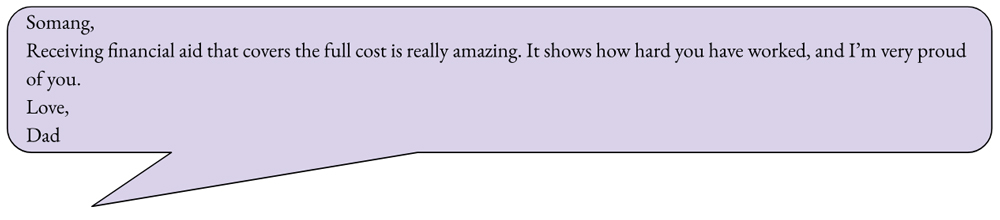
0:51 PM March 10, 2026
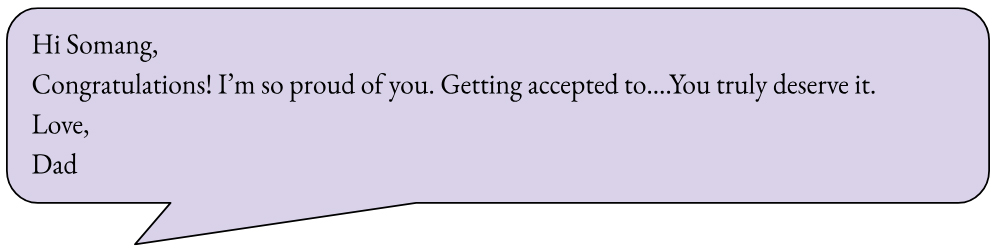
0:22 PM March 7, 2026

8:19 AM January 1, 2026
A set of words I should feel appreciative of, yet as I read each message, I read it in a tone of a dead voice. All of these messages sent by my dad are written by generative AI. My dad isn’t very fluent in English, but before AI came along, he would always message me in Korean.
As I stayed in America longer, I used Korean at home less and less. My mom would speak to me in Korean, but I would always respond in English to practice my proficiency.
As I grew up in the States for 90% of my life, I lost the art of Hangul across most areas: comprehension, reading, and writing. Whenever I mention my ethnicity, I’m always confronted with the same expression, “You’re Korean? No way! It must be so nice to be bilingual.”
I would give an awkward laugh and default to, “I guess, but I’m not very proficient. My listening comprehension is very limited,” knowing that my proficiency is at the same level as a Korean elementary student, if not lower.
3 - 효
At the start of 2023, developments in generative AI began to emerge, reaching more than 100 million users online. The widespread popularity of AI and its many applications, such as chatbots, virtual assistants, and language translation tools, has led to significant improvements in modern technology.
A study examining the dimensions of AI impacts on family communication was conducted by Nada Mohammad Alfeir. With 300 participants recruited, through a series of surveys, respondents feel positive, agreeing that AI has reduced communication barriers regarding language translation. This has improved cross-lingual communication by enabling high-quality AI translations (Alfeir 2024).
Although the use of AI has improved direct communication between my father and me, I wouldn’t mind translating or listening to an audible message in Korean. I would do it with patience. Although the hangul would always mix and mingle as I stare at them, my heart and stomach clench in shame and regret. I’m sure my dad has done this out of care.
2 - 검정새치
Mika Furukawa-Lee — Japanese-Korean American.
“Growing up, surrounded by Japanese culture, they felt distant from their Korean heritage. At a Japanese school, they never had the opportunity to learn Korean properly and rarely visited Korea. Additionally, they rarely saw their Korean relatives.
This created a gap between their identity and their identification as Korean. However, being able to eat the Korean food their grandma has made and visiting their grandpa more often significantly supported their connection to being Korean.
Their family communicates using Google Translate; however, communicating with older family members has remained difficult since they speak little to no English.
Even though other family members may translate for them, Korean to English, they still felt a distance because the translation wasn't always 100% accurate.
Every time they visit Korea, they feel more like a foreigner, despite having Korean blood. They also face the same challenge when in Japan, feeling like an outsider, “I just don’t feel like I’m part of the culture.
∞ — 낙엽귀경
2015
“야, look, she can’t even hold her chopsticks properly.”
One chopstick kept slipping between my index and middle fingers. Scrunching my eyebrows with determination, I refuse to be ridiculed—it would be a shame for a Korean not to know how to hold chopsticks.“Yes, I can.” Sharp words force themselves out of my lips as I reach for the kimchi, swishing my fingers and tightening the grip once I put the kimchi in my mouth.
A sizzle of sharp pains jumps around my mouth. My eyes close and scrunch together, trying to keep my composure.
“Pfft, look, she can’t even handle the spice of Kimchi. You’re Korean, aren’t you?”
Just like the sting of the kimchi in my mouth, my heart stings after each rebuke.
“Hey, I can eat Kimchi, and I know how to use chopsticks. It’s just…” I look at my bowl of white rice, fighting the watery force against my eyes.
“She doesn’t even know Korean that much. When you listen to K-pop, can you even understand what they’re saying?”
“Uh, yeah, I’m Korean.”
“Right.”
Growing up in America.
Korean blood.
Foreigner.
Yet I keep returning to the language anyway. Whenever the voice of my 할머니 or 아빠 rings silent during our calls, I reach for the scraps of Korean and half-finished sentences. And after every call, I always tell myself to relearn the words I lost. I ask my mom about the structure of reading 한글 or what a word means. Then I forget it. Then ask again a few months later.
In the States, I would only be considered Korean. In Korea, I would only be considered American. My two identities clashed, moving back and forth until they overlapped. The constant loop of interchanging my identities—I wonder if I will ever learn how to move between the two worlds, even if I never fully belong to one.
References
"Artificial Intelligence's Use and Rapid Growth Highlight Its Possibilities and Perils." U.S. Government Accountability Office, 6 Sept. 2023, www.gao.gov/blog/artificial-intelligences-use-and-rapid-growth-highlight-its-possibilities-and-perils. Accessed 4 Apr. 2026.
Cox, Ronald B., et al. "Shared Language Erosion: Rethinking Immigrant Family Communication and Impacts on Youth Development." Children, vol. 8, no. 4, 25 Mar. 2021, p. 256, https://doi.org/10.3390/children8040256. Accessed 1 Apr. 2026.
"Dimensions of Artificial Intelligence on Family Communication." Sec. AI for Human Learning and Behavior Change, vol. 7, 2024, https://doi.org/10.3389/frai.2024.1398960. Accessed 1 Apr. 2026.
Furukawa-Lee, Mika. Interview. Conducted by Somang Choi, 4 Apr. 2026.
Nam, Woochan. E-mail interview. Conducted by Somang Choi, 4 Apr. 2026.
Park, Jay-Z. E-mail interview. Conducted by Somang Choi, 4 Apr. 2026.
Valdes, Guadalupe. "Bilingualism, Heritage Language Learners, and SLA Research: Opportunities Lost or Seized?" The Modern Language Journal, pp. 412-24, https://doi.org/10.1111/j.1540-4781.2005.00314.x. Accessed 2 Apr. 2026.
Somang H. Choi is a 12th-grade student ('26) at the American School in Japan who has recently discovered her love for creative nonfiction writing. Her multicultural experiences and perspectives growing up as a Korean-American inspire a wide range of her creative pieces. She tries her best to incorporate different creative styles and techniques into her writing, while hoping to improve every day.