As the demands of the 21st century evolve, these types of systems are proving insufficient to meet the complex academic, social, and emotional needs of students. There is a growing recognition that mental health and SEL must be integrated as core components of education rather than treated as supplemental. Frameworks such as Multi-Tiered Systems of Supports for Behavior (MTSS-B) offer a promising path forward by aligning academic and social-emotional supports within a proactive, data-driven model. In doing so, schools can move beyond reactive responses toward fostering holistic development and long-term student success.
SEL and Mental Health as Core Educational Domains
Defining the Core Competencies
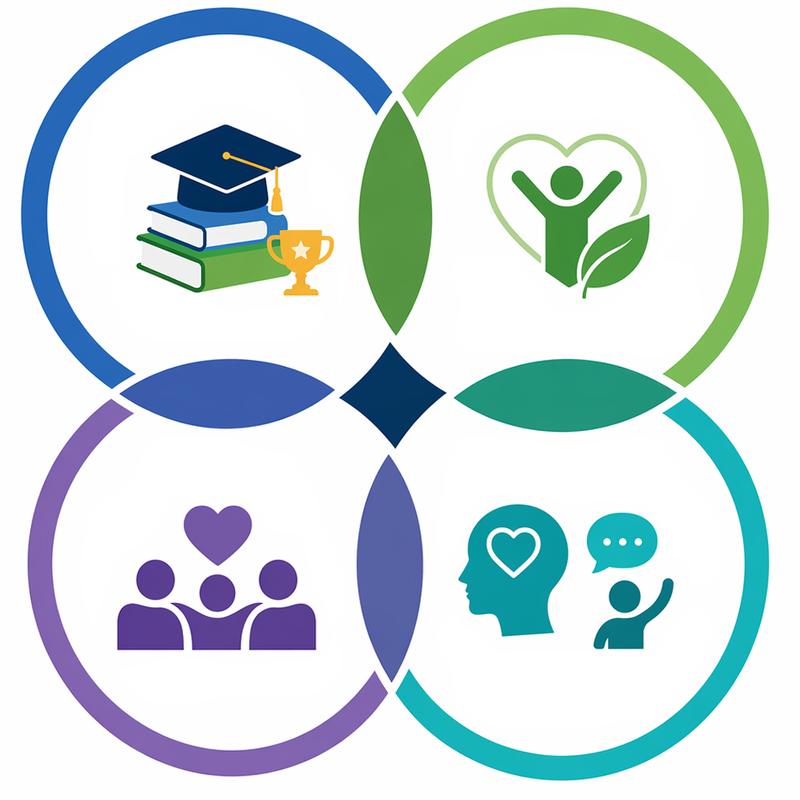
A holistic view of education often includes interconnected domains such as academic success, student health and wellness, a sense of belonging, and social, emotional, and behavioral development. One of the most well-known foundational organizational structures for SEL is provided by the Collaborative for Academic, Social, and Emotional Learning (CASEL). This widely adopted framework helps schools cultivate skills and environments essential for student development through five core competencies: Self-Awareness, Self-Management, Social Awareness, Relationship Skills, and Responsible Decision-Making. Fostering these competencies lays the foundation for applying evidence-based strategies across a school community.
Successful implementation of SEL is directly linked to preventive mental health and wellbeing measures. The competencies developed through SEL programming, such as emotion identification and self-management, actively enhance young people’s coping skills and resiliency, which can help reduce symptoms of depression and anxiety in the short term.
Quantifiable Outcomes of SEL Integration
Embedding SEL and mental health into the educational model is supported by exhaustive, high-quality peer-reviewed evidence from large-scale meta-analyses.
- Academic Achievement: SEL interventions that successfully addressed the five core competencies increased students’ academic performance by an average of 11 percentile points compared to students who did not participate. This impact translates to higher levels of “school functioning,” evidenced by improved grades, test scores, attendance, and homework completion. Furthermore, long-term follow-up assessments demonstrated that academic performance was, on average, 13 percentile points higher for students exposed to SEL programs, with benefits lasting up to 18 years post-intervention.
- Behavioral Transformation and Wellbeing: Participation in SEL is consistently linked to decreased emotional distress, fewer externalizing behaviors, and a significant reduction in discipline problems. Teachers who use SEL frameworks report that students develop higher levels of coping with their feelings and show improved skills in handling aggression. These behavioral improvements directly contribute to reductions in bullying and aggression school-wide.
- Economic and Societal Value: Investment in SEL yields significant long-term societal benefits. Students with stronger social and emotional skills are more likely to achieve crucial milestones, including high school graduation and stable, full-time employment. Fiscal analysis estimated a net societal return of $11 for every dollar invested in SEL. Furthermore, investing in school-based mental health care reduces future costs and increases students’ lifetime economic productivity.
The MTSS-B Framework: A Blueprint for Integrated Service Delivery
Achieving these outcomes requires a structural, proactive approach. MTSS is a preventive framework that uses a continuum of evidence-based, systemic practices to provide a rapid response to students’ academic, emotional, and social-behavioral needs.
MTSS as a Proactive, Data-Driven System
MTSS is grounded in the public health model of prevention. When applied to behavior and wellness, “MTSS-B,” it provides a cohesive system that integrates formerly separate supports, such as Response to Intervention (RtI) for academics and Positive Behavioral Interventions and Supports (PBIS) for behavior.
As a framework, MTSS is structured into four essential components:
1. Universal Screening: Assessing all students early in the year to identify those needing additional support and to evaluate the effectiveness of Tier 1 practices. Screeners must possess diagnostic accuracy and consequential validity—the capacity to promote positive intervention outcomes.
2. Tiered Interventions: Providing appropriate support levels (Tiers 1, 2, 3) based on student needs.
3. Progress Monitoring: Ongoing, frequent collection of data to quantify a student’s rate of improvement and evaluate the effectiveness of the intervention.
4. Data-Driven Decision-Making: Using data from screening and monitoring to inform decisions, evaluate student response, and adjust interventions.
Leveraging the Tiered Continuum
The MTSS-B framework uses the same structure to organize support into three increasing levels of intensity:
- Tier 1: Universal Prevention: Tier 1 encompasses universal instruction and school-wide practices provided to all students. At this level, there is a double focus. One focus provides high-quality, explicit instruction on SEL skills and mental health literacy. A concurrent focus is on integrating the core SEL curriculum and promoting a strong school culture rooted in a sense of belonging as well as incorporating trauma-sensitive practices. SEL is embedded across the school day, much like reading. In international schools with Cross-Cultural Kids (CCKs) and Third Culture Kids (TCKs), to support Tier 1, all staff must understand and policies must account for diverse backgrounds and languages, broad culture exposure, and/or mobility. For example, programs should include explicit content on themes like cultural awareness, transition, identity, and loss processing to mitigate long-term psychological risk.
- Tier 2: Targeted Interventions: Tier 2 provides targeted, evidence-based, small-group interventions for students identified through screening as having low to moderate social, emotional, or mental health challenges. For others, support may be short-term, 1:1 psychoeducational or skill-building sessions. In general, these interventions address specific skill deficits, such as executive functioning, social skills training, conflict resolution, and emotional regulation.
For highly mobile populations, as is common in many international schools, Tier 2 is essential for providing specialized support for transitions. For students who are Arrivers, Leavers, or Stayers, small-group interventions can address specific emotional needs that universal instruction cannot. Students struggling with feelings of loneliness, grief, or cultural adjustment due to transitions can be placed into small-group sessions focused on loss processing, social skill building, or acculturative stress reduction, which addresses the unique challenges of their experience and can foster a social support system for TCKs.
- Tier 3: Intensive, Individualized Support: Tier 3 focuses on students with chronic, severe, or intensive mental health needs, potentially including those diagnosed with mental health disorders. Tier 3 is characterized by highly individualized, comprehensive behavioral and clinical support, often working in partnership with external providers. In schools, the school counselor and/or teacher may be asked to offer accommodations and use specific recommendations from the external provider to provide wraparound services.
Sometimes, TCK/CCK students exhibit severe adjustment difficulties or high-risk adverse outcomes related to frequent instability. At Tier 3, they are ensured individualized, intensive support from their counselor. For other students in need of more intensive support, interventions are guided by objective criteria and diagnostic processes to intensify and customize supports accurately.
Implementation Science: Ensuring Fidelity and Sustainability of MTSS-B
The success of the integrated model depends entirely on achieving and maintaining a high level of implementation fidelity. Fidelity of implementation (FoI) refers to the degree to which an evidence-based practice is implemented as intended. Research consistently demonstrates that MTSS, when implemented with fidelity, leads directly to increased student achievement, reduced classroom disruptions, and decreased student suspensions.
Sustaining high FoI requires continuous monitoring of both system and intervention adherence. School and district staff must use fidelity assessment tools (such as the NH MTSS-B Fidelity Inventory) to evaluate the quality of service delivery across all three tiers, ensuring that low-fidelity interventions are eliminated or improved.
A critical barrier to fidelity is the human capacity required to execute a complex, multi-tiered system. Implementing the full spectrum of new programs and practices within MTSS-B places considerable demands on schools, requiring substantial training time, which can challenge fidelity management. Therefore, dedicated professional capacity building and leadership are essential. Ongoing, quality coaching, coupled with strong administrative buy-in, are crucial components for building the human capital necessary to fully adopt the MTSS-B framework.
Navigating Philosophical and Organizational Challenges
Effective MTSS-B implementation must contend with organizational complexities, particularly the need to unify interventions stemming from differing theoretical orientations—such as behavioral principles central to PBIS versus positive youth development principles underpinning SEL. Resolving these differences, or better yet, adapting the work to meet the school’s unique context, requires a unique leadership profile. The leadership should have three key competencies:
- a clear, deep understanding of the theoretical underpinnings of MTSS as a framework,
- comprehensive knowledge of child development, mental health, and wellbeing, and
- leadership skills.
When all are present, the MTSS-B administrator can create a cohesive, data-driven framework focused on shared, measurable student outcomes.
Importantly, while MTSS-B provides a powerful framework, it is not a rigid curriculum. Successful application must be adapted to local conditions and constrained resources, as is common in the uniquely complex and often transient environment of international schools. The system’s efficacy relies on leadership maintaining coherence and allocating resources strategically over time, addressing the “political dimension” inherent in large-scale system change.
Conclusion and Recommendations for Policy Adoption
The evidence is conclusive: the systemic integration of SEL and mental health support into the K-12 educational model is a necessary investment that yields significant and sustained positive outcomes, including an average 13 percentile point gain in academic achievement (
casel.org) and an $11 return for every dollar invested. MTSS-B provides the required structural framework to deliver this continuum of support with precision, intensity, and data-driven accountability.
Based on the empirical evidence and implementation science analysis, the following policy recommendations are necessary to ensure effective and sustainable systemic change:
1. Policies for Universal Screening and Data Usage: Policy should require the systematic implementation of valid and reliable social, emotional, and behavioral (SEB) screeners at Tier 1 to identify students at risk and evaluate the efficacy of universal SEL programs.
2. Fund-Dedicated Implementation Infrastructure (Professional Development): Allocate specific funding streams to establish and maintain a high-quality MTSS-B infrastructure. Experts in counseling or school psychology can be embedded as leaders, instructional coaches, etc., as they are essential for building teacher capacity and monitoring implementation fidelity, which is critical for maximizing positive student outcomes.
3. Require Culturally Responsive Practice: Integrate comprehensive professional development that supports staff in understanding and responding to the diverse cultural and linguistic needs of all students, including TCKs/CCKs, to ensure equitable outcomes and effective Tier 1 universal design (
casel.org).
4. Require Annual Fidelity Assessment: Implement mandatory annual assessment protocols to measure MTSS-B fidelity across all tiers. The use of validated fidelity tools is essential for maintaining sustained system quality and guiding resource alignment.
The path forward is not about choosing between academic excellence and student wellbeing, but recognizing that they are fundamentally interconnected. Frameworks like MTSS-B offer schools a practical, evidence-based way to embed this shift into daily practice and ensure all students can truly thrive.