
The answers are often conflicting. We are bombarded with voices debating whether AI is the ultimate learning support or a tool that undermines our students' ability to think.
The Tale of Two Studies: Cognitive Debt vs. Supercharged Learning
In June 2025, the educational world was presented with two pieces of high-profile research that appeared to contradict each other entirely. On one hand, researchers from MIT published a study titled "Your Brain on ChatGPT," which painted a concerning picture. Unrestricted AI use leads to cognitive debt, where students trade immediate output for a long-term deficit in the critical thinking required for independent writing. The study showed that these students exhibited lower brain activity and critical thinking skills compared to those working without AI.
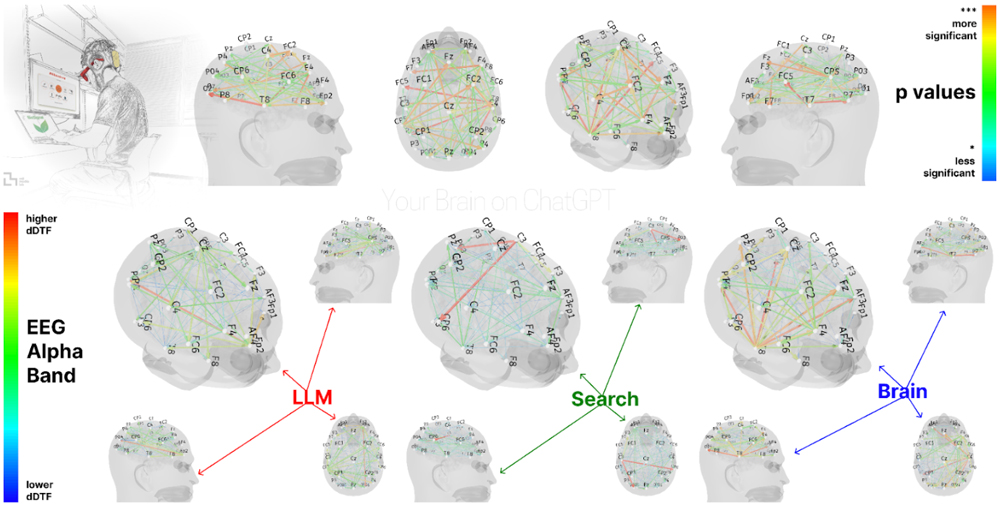
The dynamic Direct Transfer Function (dDTF) EEG analysis of Alpha Band for groups: LLM, Search Engine, Brain-only, including p-values to show significance. From Kosmyna, Nataliya, et al. "Your Brain on ChatGPT: Accumulation of Cognitive Debt When Using an AI Assistant for Essay Writing Task." arXiv, 2025.
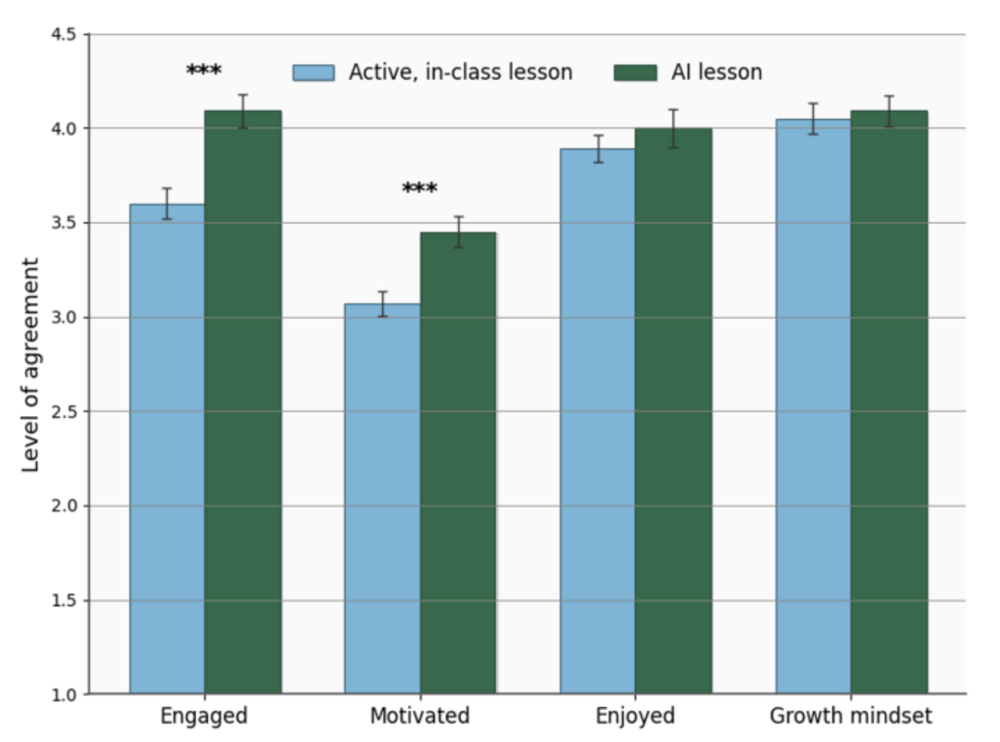
In the very same month, Harvard researchers published a study in Nature Scientific Reports with a radically different outcome. Their randomized controlled trial found that students using a customized AI tutor actually outperformed students in a traditional active learning classroom. These students learned more than twice as much in less time and reported higher engagement.
So, which is it? Is AI a shortcut to cognitive death or a tool for supercharged learning?
If you look closely at the details of these two studies, the difference becomes clear. The MIT study involved students having free, unstructured access to AI where they used it to write for them. The Harvard study, however, gave students access to a customized AI tutor designed by educators with specific pedagogical goals.
This disparity teaches us a critical lesson. Whether AI supports or undermines learning is not a matter of adoption, but of design. Its impact depends entirely on how we introduce the technology and the instructional framework we build around it.
For the Educator: C.R.E.A.T.E. Intentional Designs
In our previous article, we emphasized the importance of using school-verified platforms to ensure safety and equity. But a safe platform is just the foundation. To move from "using AI" to "teaching with AI," we must stop simply giving students free access and start curating the experience.
We need to treat AI integration like any other pedagogical strategy, with backward design. Before you create an AI activity, you must Define Your Goal. What do you want students to know, understand, and be able to do? If AI doesn't help achieve that goal, don't use it. We do not use AI for the sake of AI. We use it to support learning.
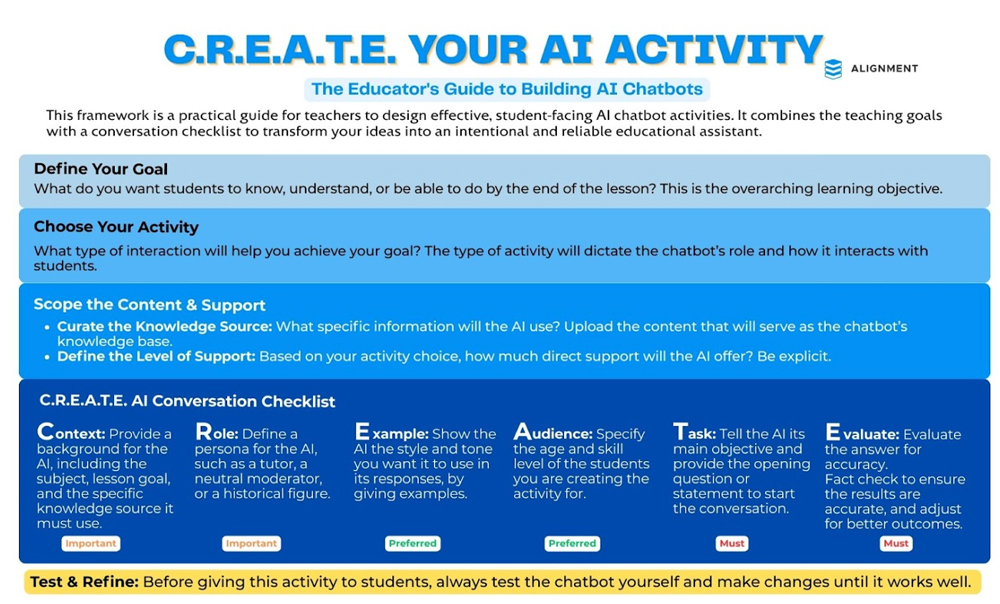
To help with this, we developed the C.R.E.A.T.E. framework to transform your ideas into reliable educational assistants:
Context: Give the AI the background, lesson goals, and specific knowledge source.
Role: Define who the AI is (e.g., a Socratic tutor, a writing coach, a debate partner).
Example: Show the AI the style and tone you want it to use.
Audience: Tell the AI who the students are (age, skill level).
Task: Be clear about the objective and the opening question.
Evaluate: Test the chatbot yourself. Does it hallucinate? Does it give the answer too quickly? Refine it until it works.
For the Student: The 3Cs and D.A.I.L.Y. Protocol
Designing a great tool is only half the battle. We also need to teach students how to self-regulate. Even the best-designed AI tutor can be misused if students view it as a solution machine rather than a thinking partner.
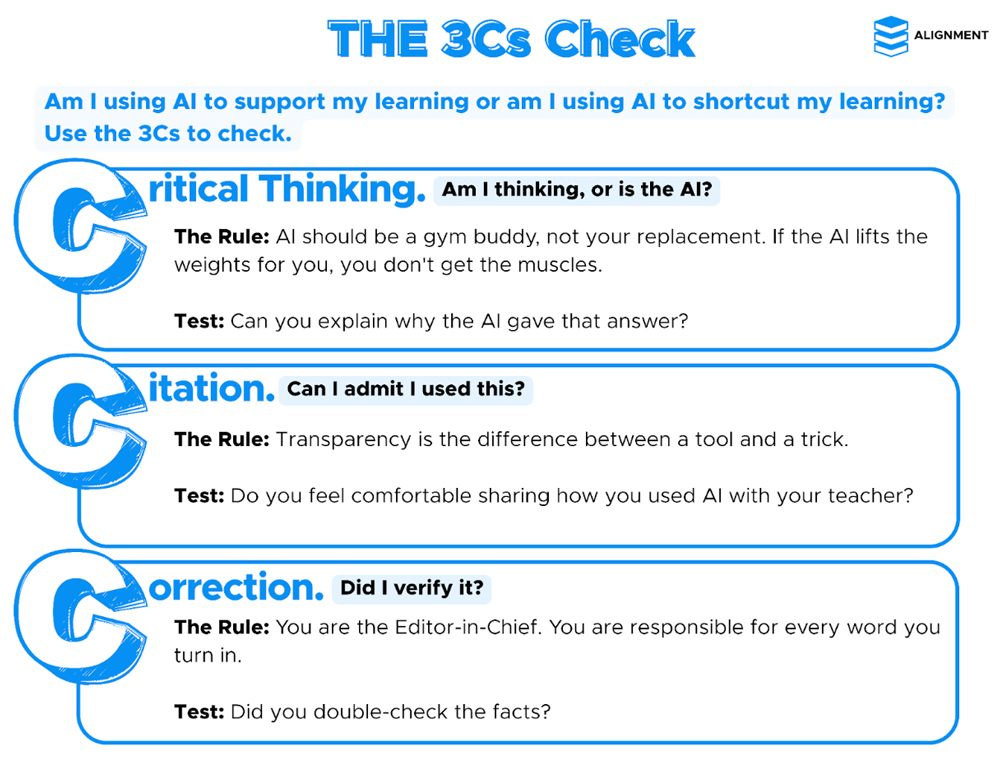
We created the 3Cs check as a metacognitive tool that students can use to check if they are using AI to support their learning. If they answer yes to each question, they are using AI in a way that supports their learning. To empower students to take ownership, we introduced the 3Cs Check:
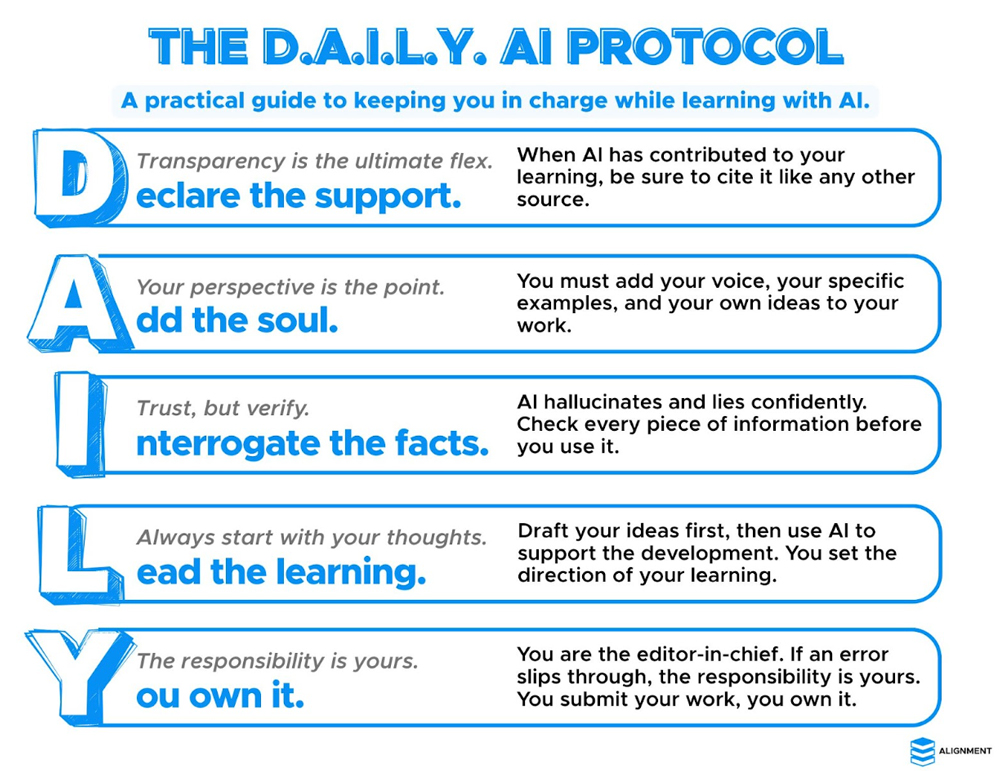
To make this actionable on a day-to-day basis, we use the D.A.I.L.Y. AI Protocol:
Putting Learning First
Ultimately, the debate isn't about technology. It is about our pedagogy, our design, and our values. By using frameworks like C.R.E.A.T.E., we ensure that AI serves our learning goals. By teaching protocols like the 3Cs and D.A.I.L.Y., we ensure students remain the "humans in the loop," starting and ending every task with their own thoughts.
As we move forward, let’s remember that AI is a powerful meaningful support, but only if we curate it carefully. It is not the problem, nor is it the magic solution. It is a pedagogical amplifier, and it is up to us to decide what we are amplifying.
Read The Inevitable Shift: AI Has Already Arrived, Building an AI Roadmap for Community-Wide Alignment, Developing Core AI Literacy: An Inquiry-Based Approach for the IB Context, and listen to Cora and Dalton chat about AI with TIE Director Stacy Stephens on the Voice of TIE Podcast: Meeting the Moment: How Educators are Embracing AI With Intention.
References
Kestin, Gregory, et al. "AI Tutoring Outperforms In-Class Active Learning: An RCT Introducing a Novel Research-Based Design in an Authentic Educational Setting." Scientific Reports, vol. 15, no. 1, 3 June 2025, https://doi.org/10.1038/s41598-025-97652-6.
Kosmyna, Nataliya, et al. "Your Brain on ChatGPT: Accumulation of Cognitive Debt When Using an AI Assistant for Essay Writing Task." arXiv, 10 June 2025, https://doi.org/10.48550/arXiv.2506.08872.
Cora Yang is a Learning Tech coach at Chinese International School Hong Kong and the co-founder of Alignment Education. She is an educational innovator who believes that technology should serve, celebrate, and elevate the human experience of learning. At her core, she is an educator, driven by a deep commitment to the growth and wellbeing of every student. In her roles, she puts this philosophy into practice. Cora partners with school leadership teams and classroom educators to demystify emerging technologies, particularly Artificial Intelligence. She excels at translating the complexities of AI into practical, actionable strategies that can be implemented school-wide. Her passion and mission are to ensure that innovation is always guided by pedagogy, creating accessible and powerful learning experiences that prepare students for the future with both wisdom and heart.
LinkedIn: https://www.linkedin.com/in/cora-yang/
Dalton Flanagan is the Learning Innovation coach and Innovation Lab coordinator at Chinese International School Hong Kong. In this role, he focuses on bridging the gap between established pedagogy and the future of technology. He is a leader in educational innovation with over a decade of experience spanning Primary Years Programme (PYP), Middle Years Programme (MYP), International General Certificate of Secondary Education (IGCSE), and A-Level frameworks. Dalton’s work is centered on designing authentic learning experiences that embed generative AI tools. Leveraging his deep background in Computer Science and Design, he equips students and fellow educators with the skills to use generative AI tools to deepen inquiry and enhance creativity. As a key voice shaping the conversation around generative AI, he has authored and implemented comprehensive generative AI guidance documents for international schools, establishing frameworks for their strategic and ethical use. He is also the Co-Founder of Alignment Education.
LinkedIn: https://www.linkedin.com/in/dalton-flanagan/