


The ecosystem, from the Greek oikos, “home” or “dwelling place” (Oxford English, n.d.), is our uniquely indispensable home. We ourselves are ecosystems, existing within our ecosystems, up to the planetary scale and even beyond. This home of homes links us to all existence. The dire state of our oikos is so urgent that we are morally (not to mention, existentially) obliged to discover new ways of existing in a strengthened harmony with it.
Yet, to consider this task of discovery some grand home repair, in any normal sense, would be misleading. In normal home repair situations, the inhabitant depends upon the shelter, but is, properly speaking, independent of that structure and master of it. Herein lies an issue recognized by many thinkers, perhaps most clearly outlined by William Cronon (1996), wherein an incessant dichotomy has been reinforced in our collective thinking about the natural ecosystem and our human social systems, misleading our intuitions. Unlike the house conceit, we are not oikos inhabitants merely, but integral parts of its structure (or, more precisely, system). All our actions are interactions with our planetary and local ecologies, even a simple breath is an act of communion with this larger system. Intellectually, we know this, but there is a persistent lack in its becoming real to us. Aldo Leopold pointed out this very problem three-quarters of a century ago (1989 [original 1949], p. 201-207). While our knowledge has since advanced, a deep instinct for ecological interdependence has not. James Lovelock, weaver of the Gaia Hypothesis narrative, has pointed out the systems-thinking inherent to his metaphor are important for consciousness change, yet most of us continue to think and feel about our world in metaphors of highly dependent but separate structures, such as that of a “spaceship Earth” container home, or something more instrumental still (2006, p. 4-5). This failure of imagination is not merely cultural; it is educational.
Thus have we spent much time pushing for atonement in the wrong direction, expecting to bring our environment into alignment with us instead of acknowledging that we must be at one with nature. Until we come to understand ecological interdependence as a real and immediate truth, we will fight the necessary and correct repair we must make with the oikos of which we are a part. If this understanding is to become real, it must be learned.
As our species and planet grapple with current and looming crises, and as we seek new ways to understand a world on the brink of drastic change and to heal our collective relationship with it, it is only responsible that our schools center this discussion and drive discovery. For this, I propose a new discipline for our times, the Ecological Humanities.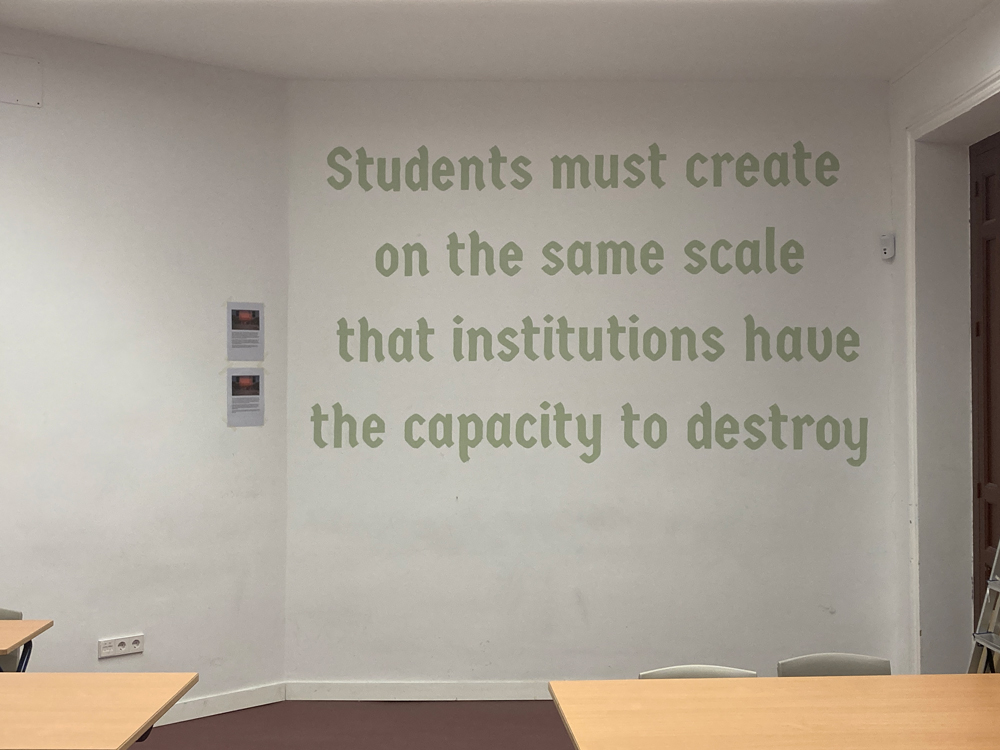
Classroom mural created by an Ecological Humanities class, adapted from a directive by Sherrie Rabinowitz. Original, 1984: "Artists need to create on the same scale that society has the capacity to destroy." (Photo source: Jared Rock)
Ecological Humanities - Planting a New Discipline
The Ecological Humanities is the name of a field to be taken up by schools, teachers, and any other learning communities that realize a time for deep change has already arrived. Our larger social values and their educational institutions will not be able to face our current and future world honestly, will not be able to discuss what constitutes the good or design new institutions for changing physical realities unless it centers an understanding of our interdependence. The goal is to create core curricula in our schools that demonstrate our ecological interdependence through experiential learning and theoretical understanding, and then re-imagine the norms, values, and institutions of our societies in response. If we are to take up the calling of our time seriously, then we are to collectively midwife a human-affirming post-anthropocentric foundation for our current and future generations.
The Ecological Humanities comes from the Humanities, now expanded, not as a scientific discipline but as one that asks the core questions of who and what we are, what constitutes the good, and what wisdom tells us about how to live and order our societies. The scientific data has made our predicament clear, but without narrative and communal discussions it will not become a felt reality in which we find purpose and mobilize to act and create.
The Humanities is radical practice, not just intellectual disciplines. The Renaissance’s studia humanitatis ushered in our modern period as a creative force advancing a new worldview that prized human dignity and flourishing for its own sake (Kristeller, 1979; Šarkan, 2021). It remains a radical endeavor, and the primary place for driving change and blooming wisdom within our academies and societies. It is no surprise that authoritarians and status-quo guardians seek to eradicate the Humanities, that corporate educational programs attempt to box it up for sale as a defanged field of unimpassioned study, that schools ensconced in capitalist power structures trim back its free growth. Yet, the forward momentum of the Humanities was bound to break, as its seed contained a flaw of perspective, of an anthropocentrism that we found neither justified nor wise. In the late Middle Ages, a direct, uncompromised acknowledgement of the central value of human flourishing made sense for progress in its time against the prevailing political and religious systems. Ecological health, we now see, is not just an instrumental means to maintain human flourishing. As the full picture of our ecological interdependence became better understood, the radical growth of the Humanities was, in essence, constrained by its root.
The revival of the Humanities, and path to exploring an expansive wellbeing already exists de facto in the work of John Muir, Emerson, Thoreau, Whitman, Rachel Carson, Annie Dillard, Leslie Marmon Silko, James Lovelock, Robin Wall Kimmerer, Lauren Bon, and others. The task of establishing the Ecological Humanities is to point to this existing root and name it as its own tradition.
As this is truly the shared inventive task of our times, cultivating the Ecological Humanities in our schools carries plenty of benefits. It brings teachers, students, and wider communities into genuine co-creation of knowledge. This learning cannot be one of passive inheritance, but looks with fresh eyes at the world through lived inquiry rooted in place, relationship, and responsibility. This brings renewed, immediate meaning to learning by reconnecting ideas to the systems that sustain life, empowering students to see themselves as active participants in shaping ethical, resilient futures. Students sense that their education is already preparation for a world that no longer exists; the Ecological Humanities invites us together into a practice of living well within a world we are creating.
Ecological Humanities Curriculum
Defining the Ecological Humanities curriculum is an important secondary step after a commitment to the discipline itself. The education this discipline seeks to impart can come in many forms, and from institutions much freer than schools to impart the wisdom and radical spirit that is its life.
Still, a formal curriculum in schools is important. For one, it revives the traditional active role of schools as institutions within our societies dedicated to empowering students and communities to form clearer understandings of our world, discuss the good life, and re-imagine how our world can and should function. As well, given the reach and educational capture of schools currently, it offers the time and space necessary for this pursuit – one which is the inherent birthright of every student who is also a social and ecological citizen.
If this is to bring energy and action into the world, the curriculum and pedagogical approach must, by necessity, be left free for each school to construct and continue evolving around its particular community and place. Yet, some common principles may be discovered for our movement.
While many schools have good outdoor education experiences, sustainability projects, gardening clubs, or other environmental literacy aspects to their programs, these are not the same thing as a coherent subject, with force and prominence of those recognized core curricula. Peripheral ecological programming is often subsumed by market-driven, commodified education, rounding out the résumés of college-application-savvy students. Schools may find that their ecological curricula are profound but not consistent or prioritized enough throughout the K-12 continuum to make a meaningful dent against the dominant values of grade-competition and education as utility for professional advancement. What the Ecological Humanities must plant and nurture are new narratives that lead to radical re-invisioning of our values and institutions, practicing education through critical progress for greater flourishing. At its heart is the recognition of a greater existence and system of meaning than the current anthropocentric paradigm that informs our educational models.
Along the lines of Gemmell’s vision (2006), Ecological Humanities must lash together many strands (from our current perspective, “multi-disciplinary”) to found a new, unitary tradition. This could take the form of Ecological Humanities dedicated schools, that teach through this tradition bringing all other core subjects’ learning under the experiential and creative umbrella of the Ecological Humanities's mission. It could take the form of a set of core classes, like many schools currently teach a successive set of math or English classes that build upon the foundations set of the previous courses. Either way, the Ecological Humanities is a tapestry that will be woven of many various threads of existing traditions, synthesized for new purposes and understandings.
Below is a four-year high school course sequence created by a group of teachers to outline what an Ecological Humanities program could look like as a continuum of core subjects. This is not offered as a model to be replicated, but as a provocation to consider what becomes possible when ecological interdependence is treated as foundational rather than supplemental. Such a sequence could be implemented in traditional class form, or delivered in a freer, more anarchic fashion by bringing mixed-grade students together to work on projects of shared interest with focuses matching their position on the continuum. Granted every school will make its own best curriculum, I strongly encourage birthing this subject in free design, place-based and experiential learning, and co-teaching across diverse disciplines.
As the interdependence of our oikos becomes more and more understood, felt, and urgent, a revised Humanities becomes necessary. A new Humanities must tie the human and non-human together in a system that is its own source of value worthy of study, dignity, and flourishing.
The etymological root of human is shared with the Latin humus, meaning “earth.” It is fitting that our new Humanities reconnect the two with a radical purpose, once again shifting our values, beliefs, and institutions. Humus is also the root of “humility” (Oxford English, n.d.), and the Ecological Humanities humbles the hubris that grew from a powerful anthropocentric Humanities. Consider the Voyager 1 probe photo of earth from six billion km away, or that when William Shatner made his real-life visit to space, he described being overcome with grief at the vast funeral that infinitely surrounds our tiny life-supporting oasis (2022). Such perspectives, accessible to us now in large part due to the progress set in motion by studia humanitatis half a millennium ago, are humbling in the ways we need. Ecological Humanities is a natural growth of Humanities, the leading edge of that radical line. As such, it is unapologetically radical in its mission to transform our world. And that, I hope, can become its accomplishment.
The time for an Ecological Humanities to take root is now.
Join the Call. Any teachers or schools that are interested in being part of an Ecological Humanities movement can email me at [email protected] to join an initial group dedicated to carrying out this project together.
References
Cronon, W. (1996). The Trouble with Wilderness; Or, Getting Back to the Wrong Nature. Environmental History, 1(1), 7–28. https://doi.org/10.2307/3985059
Gemmell, C. N. (2006). Untangling the Tangled Bank: Toward a Unitary Pedagogy of Nature. ProQuest Dissertations & Theses.
Kristeller, P. O. (1979). Renaissance Thought and its Sources. Columbia University Press.
Leopold, A. (1989 [original 1949]). A Sand County Almanac: And Sketches Here and There. Oxford University Press.
Lovelock, J. (2006). We Belong to Gaia. Penguin Books.
Oxford University Press. (n.d.). Ecology, n., Etymology. In Oxford English Dictionary. Retrieved October 13, 2025, from https://doi.org/10.1093/OED/8140041101
Oxford University Press. (n.d.). Humble, adj., Etymology. In Oxford English Dictionary. Retrieved October 27, 2025, from https://doi.org/10.1093/OED/1991117560
Šarkan, M. (2021). Humanities Studies and Jesuit Principles of Education. Horyzonty Wychowania, 20(56), 47-56. https://doi.org/10.35765/hw.2188
Shatner, W. (2022). Boldly Go. Atria Books.Jared Rock is a high school literature teacher at Brains International School in Madrid, Spain.