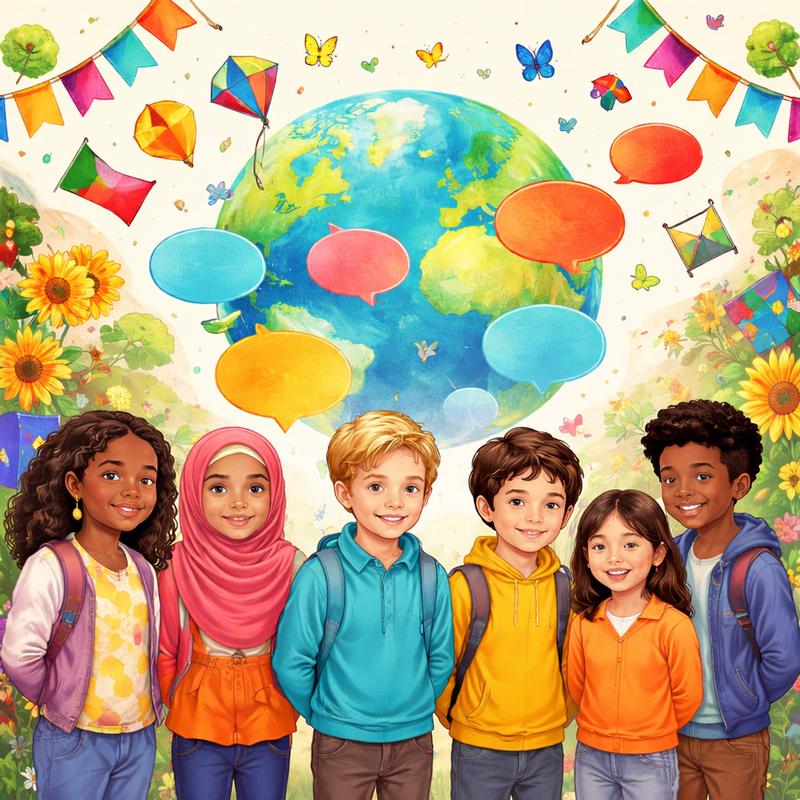
International Mother Language Day, celebrated on 21st February, offered an opportunity for international educators to pause and reflect on the value of linguistic diversity in our schools. In many schools, assemblies and other events marked the rich multilingualism of their communities. But more than this – as I have written about before for TIEOnline – International Mother Language Day serves as a reminder that we need to go beyond tokenistic or superficial celebrations of diversity to, in Paul Gorski’s (2016, p.14) words, “allow a deeper understanding of diversity to guide our practice,” to take action towards building inclusive and equitable multilingual communities.
The theme for this year’s International Mother Language Day was “Youth Voices on Multilingual Education” (UNESCO). It is a theme that, as the UNESCO website explains, “emphasizes that language is more than a means of communication: it is central to identity, learning, well-being and participation in society.”
It’s worth reflecting on this vision of language. UNESCO’s statement recognizes language as more than just communicative competence and resonates with Claire Kramsch’s (2006, p.251) call to re-define the boundaries of language education beyond a sole focus on communication skills to recognize and honor language learners “not just [as] communicators and problem solvers, but [as] whole persons with hearts, bodies, and minds, with memories, fantasies, loyalties, identities.” In this expansive vision, language education is not a neutral process of developing proficiency skills, but is always entangled with identities, cultural heritage, histories, emotions, creativity, place, and so on.
But I wonder to what extent this vision of language is alive in our schools? How expansively do we approach language within our curriculum, programming, and other aspects of school life? I worry that, as Aneesa Mahmood (2020) wrote, “under the limitations of the classroom, we reduce languages to mere words and the construction of sentences, while failing to appreciate the culture, the history and the places a given language signifies.” I worry that we have reduced languages to a one-dimensional focus on proficiency and we are missing their beautiful, messy, dynamic complexities.
I share the concern voiced by some experts within the field that our dominant neoliberal education paradigm has reduced language to a “commodified, technicized skill” (Bernstein et. al., 2015) and language education to “quantifiable measures of learning” (Rolph and Kitawi, 2025). In our desire to measure progress towards so-called “mastery”, we risk reducing language to only the bits we imagine can be “mastered” – words, phrases, chunks of grammar, repeatable skills – and giving it space only behind the closed doors of language classrooms. When so reduced, we risk drifting into deficit mindsets in which we see students who are still developing proficiency in a language, particularly the language of instruction (English in many international schools), as “problems” we need to “fix” before they can fully become part of our schools (Huckle, 2022), rather than as individuals their own rich, complex linguistic identities.
I want to move beyond narratives of “mastery” in language learning. I am inspired by Julietta Singh who, in her book Unthinking Mastery, writes that
“to be characterized as the master of a language, or a literary tradition, or an instrument, for instance, is widely understood to be laudable. Yet as a pursuit, mastery invariably and relentlessly reaches toward the indiscriminate control over something – whether human or inhuman, animate or inanimate. It aims for the full submission of an object – or something objectified – whether it be external or internal to oneself” (Singh, 2018, p.9).
In approaching language as a decontextualized set of communicative competencies to “master,” we risk reducing it to a static, stable object, thus losing its dynamic connectedness and rich complexity. In our focus on language as an object, we lose sight of the languagers who are always actively engaging in the process of languaging (Jørgensen, 2004), whether inside the language classroom or elsewhere.
What are the educational implications of this more expansive vision of language? How might we do things differently in our schools if we truly embraced language more expansively? Perhaps, we would really treat language development as a shared concern of the whole school community, not just the language teachers. Perhaps, we could broaden language curriculum aims to emphasize inquiry as well as proficiency development; we could extend learning to include personal reflection on how our identities interact with and are shaped by the language(s) we learn, or exploration of the places and histories that live within the languages we study, or critical engagement with power dynamics that position languages and their speakers within inequitable linguistic hierarchies. How might we make more space within our language curriculum for such an expansive vision to thrive?
(Table 1: A comparison of a reductive and expansive view of language in education)
Embracing a more expansive approach to language also demands that we rethink the simplistic assumptions that underpin the way we devise and structure language programming in our schools. As Ross Perlin writes in his wonderful book Language City, “familiar-seeming (English) concepts like native, fluent, and mother tongue shouldn’t be uncritically assumed” (Perlin, 2024, p.37). A reductive view of language education within a neoliberal mastery paradigm seeks to sort, categorize, and measure students’ language use. As we do so, we draw upon a catalogue of pre-formed categories – first language, second language, native speaker, heritage language, mother tongue, foreign language – onto which the complexities of languaging do not neatly map. Language learning becomes reduced to a linear progression towards mythical “native speaker” standards (Dewaele, Bak, & Ortega, 2022) that assume one idealized way of being with a language. Anything less than this idealized standard might be seen as inferior.
While we are, of course, right to celebrate “mother language” on this and all days, we should also be careful that we are not leaving this concept “uncritically assumed.” Even the apparently simple call to “celebrate your mother language” is more complex for many students than it at first seems. Which of my languages is my “mother tongue” anyway? What if I cannot read or write in that language? What if I feel like I’ve become disconnected from its cultural resonances? What if I struggle to express myself? What if I worry I will be discriminated against if I speak its words at school? What if I feel, like Sujata Bhatt captured in her poem, that I am still searching for the lost tongue that living in “a place you had to / speak a foreign tongue” had forced me to spit out? When we embrace a more expansive view of language, we embrace the reality that there are many different ways of being together with a language, many ways of caring and being cared for by a language.
Kevin M. Wong writes about the beautiful imperfection of language learning. He argues that we should move “beyond perfection” and the unrealistic ideal that being bilingual is an “all or nothing” pursuit that “demands native-like fluency in both languages” (Wong, 2024). Understanding your parents when they are speaking a “mother language” but not being able to reply in that language, for example, is not a "lesser form" of being bilingual. A “mother language” that lives only in nearly forgotten echoes or cultural resonances is just as special as one that is used regularly in daily life. When we embrace a more expansive vision of language that recognizes “its messy and vibrant reality” (Wong, 2024), we see the beauty of the many different ways we can be imperfectly or unmasterfully with our languages.
So, in reflecting on International Mother Language Day, let’s consider how we can expand our vision of language beyond communicative competence, to make more space for its entanglements with culture, identity, wellbeing, and so on. Let’s make space within our schools for all languagers and their complex, dynamic ways of languaging to thrive.
References
Bernstein, K.A., Hellmich, E.A., Katznelson, N., Shin, J., & Vinall, K. (2015). Critical Perspectives on Neoliberalism in Second/Foreign Langauge Education: Introduction. L2 Journal 7(3), 3-14.
Dewaele, J., Bak, T., & Ortega, L. (2022). Why the mythical “native speaker” has mud on its face. In N. Slavkov, S. Melo-Pfeifer, & N. Kerschhofer-Puha (Eds.), The Changing Face of the “Native Speaker”: Perspectives from Multilingualism and Globalization (pp. 25-46). Berlin: De Gruyter Mouton.
Gorski, P. (2016). Equity Literacy: More Than Celebrating Diversity. Diversity in Education, 12-14.
Huckle, J. (2022). Equity and English as an additional language: Looking beyond deficit and asset lenses. Impact Journal.
Jørgensen, J.N. (2004). Languaging and Languagers. In J.N. Jørgensen & C. Dabelsteen (Eds.), Languaging and Language Practices (pp. 5-23). University of Copenhagen Press.
Kramsch, C. (2006). From communicative competence to symbolic competence. The Modern Process Journal 90(2), 249–252.
Mahmood, A. (2020). Languages: A composition of words or identity? From Electric Bazaar: https://web.archive.org/web/20231001182120/https://www.electric-bazaar.com/post/languages-a-composition-of-words-or-identity
Perlin, R. (2024). Language City: The Fight to Preserve Endangered Mother Tongues in New York. New York: Grove Press.
Rolph, C. & Kitawi, A. (2025). Neoliberal metrics and a curriculum for competence. From BERA: https://www.bera.ac.uk/blog/neoliberal-metrics-and-a-curriculum-for-competence
Singh, J. (2018). Unthinking Mastery: Dehumanism and Decolonial Entanglements. Durham: Duke University Press.
UNESCO. (n.d.). International Mother Language Day. From UNESCO: https://www.unesco.org/en/days/mother-language
Wong, K. (2024). Beyond Perfection: The Beauty of Imperfect Language Learning. From https://www.kevin-m-wong.com/blog/2024/11/8/beyond-perfection-the-beauty-of-imperfect-language-learning
Jacob Huckle is an English language acquisition teacher and head of multilingual learning at an international school in China and a part-time doctoral student researching multilingualism and interculturality in education.