

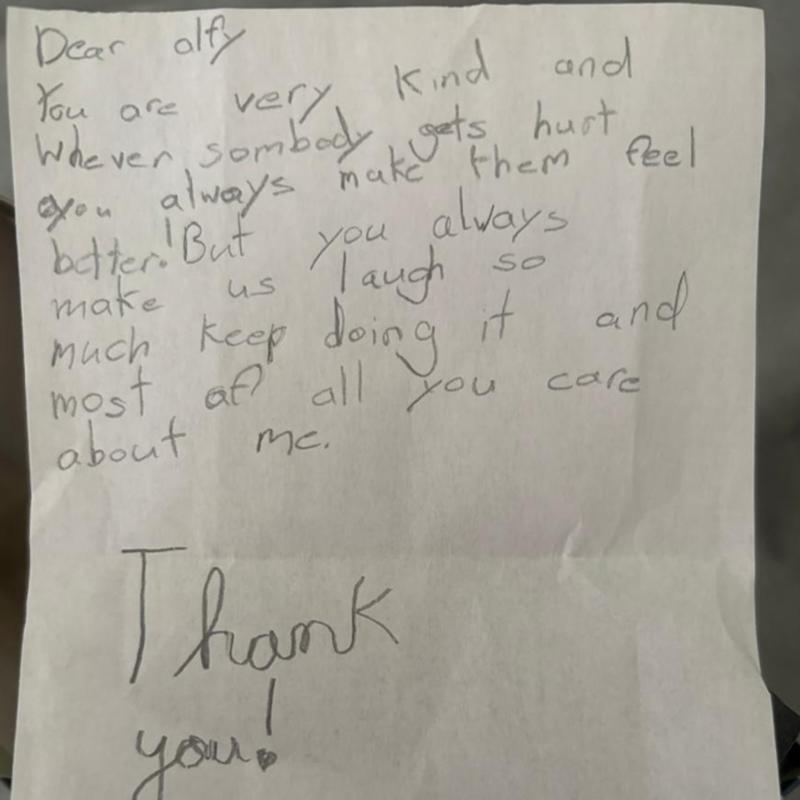
My son is seven. He has been receiving reports since he was three years old. He has had pages of detailed single-point rubrics, a single-page four-quadrant visual, and now paragraph-style narratives. They’ve all been thoughtfully produced. And yet…
Nothing has told me more about his development, about who he is as a human being, than a handwritten farewell note by one of his friends. A small, unstructured piece of writing revealed more about his empathy, relationships, and sense of self than any formal report ever has.
Every reporting season, we return to the same conversations and negotiations. Full debates ensue over:
Feedback is given to support the learning process. Its formality can range from a response on a single-point rubric to a specific comment on a topic sentence to marking annotations to student-teacher conferences to general feedback given to an entire class. To invite understanding, the nature of feedback is often more dynamic and collaborative. The more immediate the feedback, the more effective it is. Another noteworthy principle that has guided my feedback practice is this: only give learners feedback they can realistically respond to within the given time frame. Three targeted points they can act on immediately are far more powerful than a six-minute audio response. The purpose of feedback is to help learners improve. “Nice feedback” can sometimes confuse. Clear, honest feedback, paired with check-ins, promotes growth: high expectations, high support.
Reporting, on the other hand, typically happens at the end to summarize achievements… but the end of what? A unit? A semester? A year? Depending on the system, our grading structures are not easy to understand: percentages, letters (A–F), overall levels (1–7), pass/fail/exempt. Is the narrative comment meant to justify the grade, or to serve anecdotal evidence that complements the numbers? Is the goal of the report to provide both quantitative and qualitative data? Do parents know? Do teachers know? Or do we just think we know?
Can a narrative paragraph really capture a semester’s worth of learning when it is prepared at the very end, after so much has happened, often relying on rushed observations and unreliable memory? Does it truly speak to a learner’s overall growth? Student narratives in reports raise similar questions. How do they actually find their way into reports? They seem like a good idea, but in practice they seem performative, and often become another task, another checkbox. I wonder how meaningful they really are.
Instead of spending hours preparing detailed narrative reports, what about prioritizing in-person conversations? Time-consuming? So is writing narratives, but with far less return. In-person conversations allow for nuance, relationship building, and honesty that cannot be templated or automated. Think about it. Our most important transcripts contain only quantitative data, and have we ever complained? Like our students, we only wanted the numbers. They served their purpose. For the rest, if we care enough, we show up for conversations.
So, when reporting season comes around again, and the circular talks begin again — on how to improve reports, streamline them, or write them more efficiently — let us return to the purpose. Because an unclear purpose only complicates the process. Every hour spent perfecting a report template is an hour not spent in reflective conversations, helpful feedback, or fostering relationships. If the most meaningful insights into the growth of our learners are happening outside the reporting system, then we need to stop pretending the system is working. Sometimes doing something differently does not work because the real solution is to stop doing it altogether.
Dr. Sou Leong-Ellerker is the learning leader for language and literature and the Advanced Placement coordinator at the American International School of Johannesburg. Her research interest in new literacies within affinity spaces informs her design of learning experiences that challenge students through authentic projects and real-world applications.