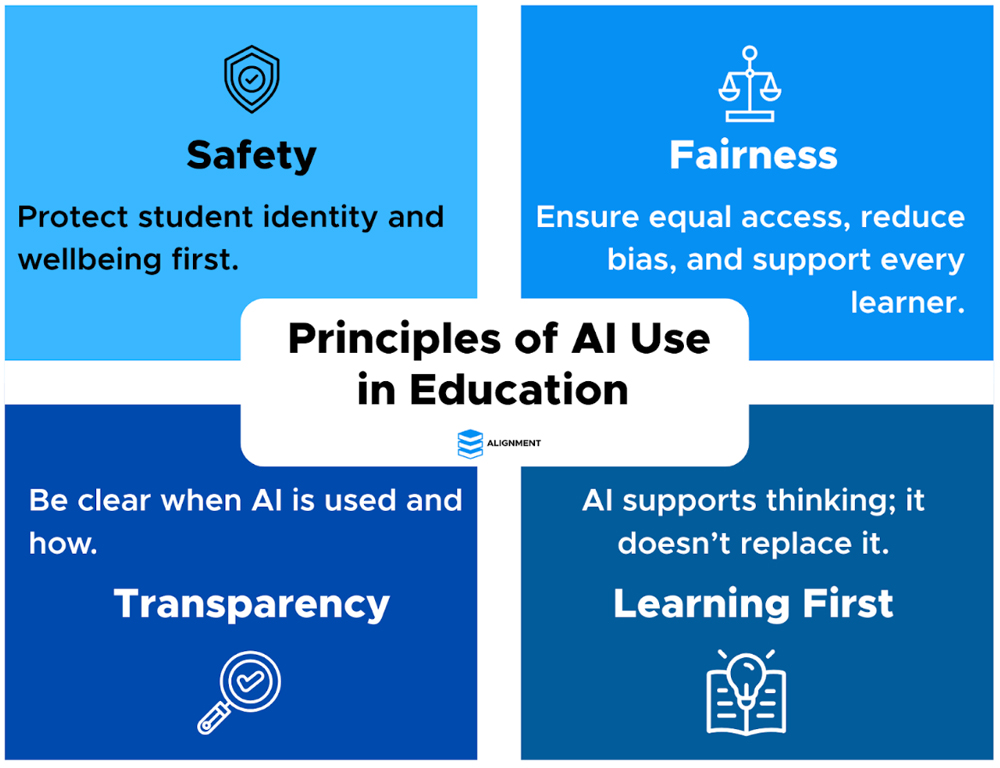
We start with four principles that guide our work: safety, learning first, transparency, and fairness. But how do we move these from abstract principles into the classroom?
The reality is that we cannot avoid introducing AI competencies. AI is an "arrival technology"(Klopfer et al.); it is already impacting our lives and will continue to do so. In a recent research report published by the College Board (December 2025), over 50% of high school students reported using AI for their schoolwork. This data gives us a clear answer: we have to guide students on how to use AI, not just technically, but thoughtfully and ethically.
If we introduce AI literacy in isolation, students struggle to see the relevance. For instance, if we teach "AI attribution" as a standalone lesson, it feels abstract. But if we embed it into a research project where students are actively grappling with sources, the need for academic integrity becomes clear. Therefore, the most sustainable way to introduce AI literacy is to build it around the context we already share.
In the International Baccalaureate (IB) context, regardless of a school's unique structure, the universal languages we speak are Approaches to Learning (ATL) skills and the Learner Profile. By connecting AI to these lifelong critical skills, we don't just teach a tool; we prepare a mindset.
To put this into practice, we have developed frameworks to help us scaffold AI literacy that fit into the IB Program.
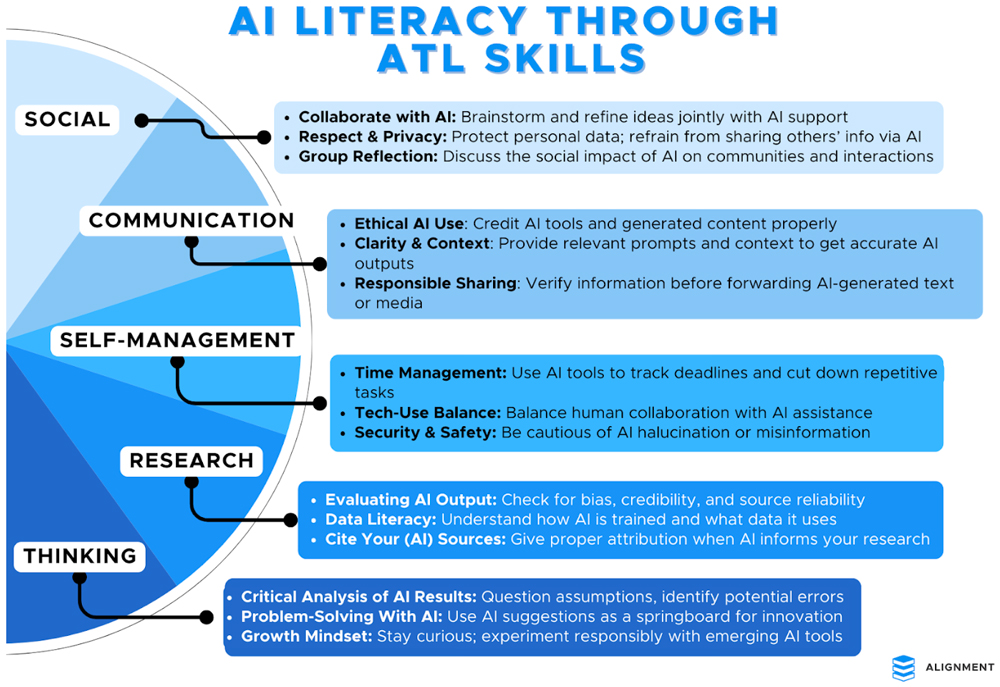
Anchor AI in the Skills They Already Know (ATL)
We looked through the ATL skills and asked, What matters most here when it comes to AI? We found natural connections across all five skill categories: Social, Communication, Self-Management, Research, and Thinking.
By linking AI literacy to these skills, we give students opportunities to practice inquiry-based learning. We want them to ask questions, identify issues, and solve them through trial and error. For example, under Communication, we emphasize "Ethical AI Use," teaching students to credit AI tools properly. Under Research, the focus shifts to "Evaluating AI Output," where students check for bias and credibility. This approach fosters intrinsic motivation because students aren't just learning "about AI"; they are using AI to become better researchers and thinkers.
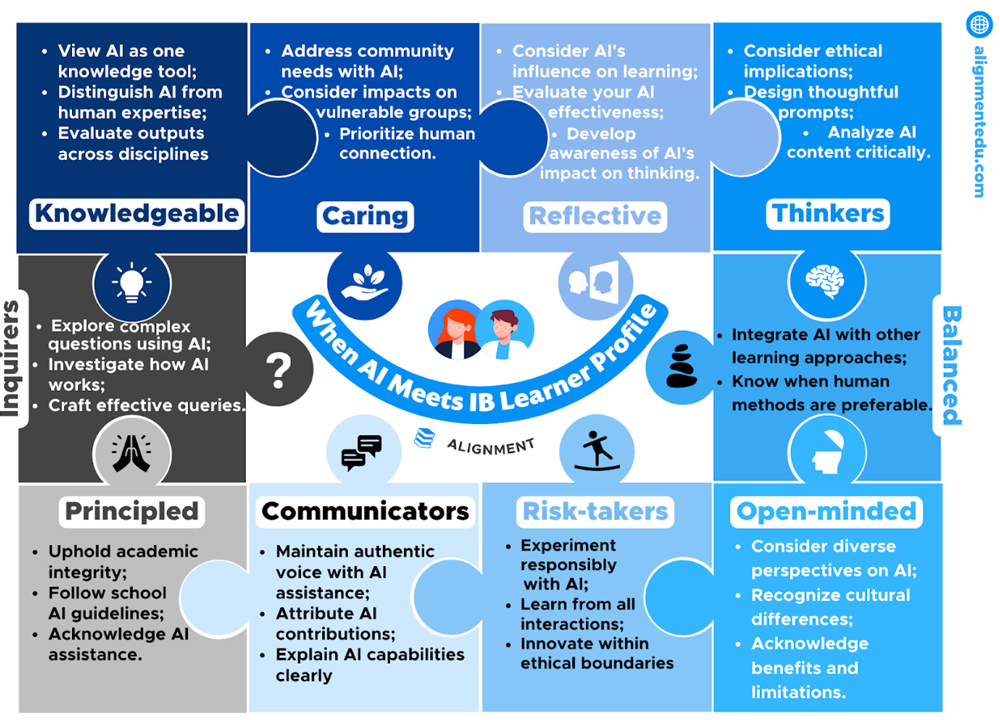
Connect to Character: The Learner Profile
We also need to consider how AI interacts with who our students are becoming. The IB Learner Profile provides a perfect lens for this. We wanted to move away from a massive, top-down lecture on ethics and instead find a systematic way to embed these values into daily learning.
When AI meets the Learner Profile, we see "Principled" students who uphold academic integrity and acknowledge AI assistance. We see "Reflective" learners who evaluate their own AI effectiveness and consider its influence on their thinking. By mapping AI behaviors to these profiles, we normalize responsible use as part of their character development.
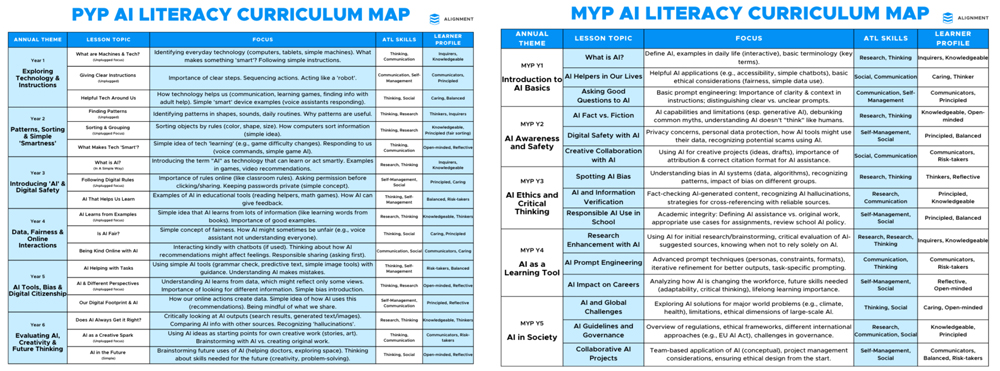
Scaffold the Journey: From "Unplugged" to "Fluency"
A common concern we hear is about younger learners, "Do young students really need to learn AI?" Our answer is yes, but that doesn't mean sticking them in front of a screen. Introducing the concept early helps get them ready for the future. We believe in a gradual introduction. For our youngest learners in the Primary Years Programme (PYP), the focus is often "unplugged": identifying patterns, giving clear instructions, and understanding what makes something "smart." As you can see in our PYP Map, Year 1 starts with "What are Machines & Tech?" with an unplugged focus on identifying everyday technology. By Year 6, students are "Evaluating AI," looking critically at outputs and recognizing hallucinations.
As students mature into the Middle Years Programme (MYP), the scaffolding becomes more complex. We move from basic awareness to "AI as a Learning Tool." In the MYP years, we tackle "AI Fact vs. Fiction" in Year 2 and advance to "AI Prompt Engineering" by Year 4, where students learn iterative refinement for better outputs. This ensures that by the time they reach Year 5, they are ready to discuss "AI in Society," exploring global challenges and governance.
Moving From Literacy to Fluency
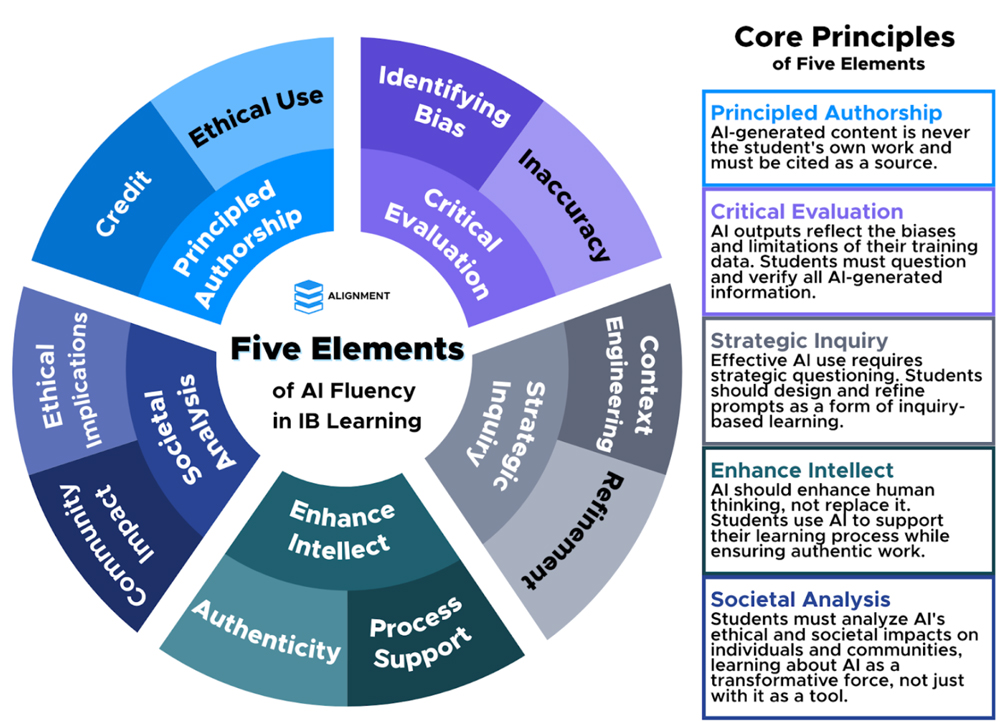
Our ultimate goal is to move students from AI literacy to AI fluency. We want them to feel comfortable using these tools to augment their intellect, not replace it. This fluency is built on five core elements. It requires Principled Authorship, where AI content is never claimed as the student's own. It demands Critical Evaluation, acknowledging that AI reflects the biases of its training data. And crucially, it focuses on Enhance Intellect by using AI to support the learning process while ensuring the work remains authentic.
We often say that we don't know exactly what future technologies will look like. However, the basic skills required remain constant: critical thinking, adaptability, and ethical judgment. We are not just preparing students for a specific app or platform; we are preparing their mindsets. We can embrace this changing landscape by planting these seeds early and nurturing them through the context we know best. By doing so, we ensure that as technology evolves, our students grow right alongside it.
References
Klopfer, Eric, et al. "Generative AI and K-12 Education: An MIT Perspective." An MIT Exploration of Generative AI, 27 Mar. 2024, doi:10.21428/e4baedd9.81164b06.
College Board Research. "Variation in High School Student, Parent, and Teacher Attitudes Toward the Use of Generative Artificial Intelligence." AI Research Brief, Dec. 2025.
Cora Yang is a Learning Tech coach at Chinese International School Hong Kong and the co-founder of Alignment Education. She is an educational innovator who believes that technology should serve, celebrate, and elevate the human experience of learning. At her core, she is an educator, driven by a deep commitment to the growth and wellbeing of every student. In her roles, she puts this philosophy into practice. Cora partners with school leadership teams and classroom educators to demystify emerging technologies, particularly Artificial Intelligence. She excels at translating the complexities of AI into practical, actionable strategies that can be implemented school-wide. Her passion and mission are to ensure that innovation is always guided by pedagogy, creating accessible and powerful learning experiences that prepare students for the future with both wisdom and heart.
LinkedIn: https://www.linkedin.com/in/cora-yang/
Dalton Flanagan is the Learning Innovation coach and Innovation Lab coordinator at Chinese International School Hong Kong. In this role, he focuses on bridging the gap between established pedagogy and the future of technology. He is a leader in educational innovation with over a decade of experience spanning Primary Years Programme (PYP), Middle Years Programme (MYP), International General Certificate of Secondary Education (IGCSE), and A-Level frameworks. Dalton’s work is centered on designing authentic learning experiences that embed generative AI tools. Leveraging his deep background in Computer Science and Design, he equips students and fellow educators with the skills to use generative AI tools to deepen inquiry and enhance creativity. As a key voice shaping the conversation around generative AI, he has authored and implemented comprehensive generative AI guidance documents for international schools, establishing frameworks for their strategic and ethical use. He is also the Co-Founder of Alignment Education.
LinkedIn: https://www.linkedin.com/in/dalton-flanagan/