

Teachers face persistent challenges converting theoretical knowledge into consistent classroom results. While research identifies effective methodologies (Richards & Rodgers, 2014), implementation varies widely, and outcomes often fall short of potential. This inconsistency suggests that pedagogical success depends not merely on selecting "correct" methods, but on understanding how multiple factors interact dynamically to produce learning.
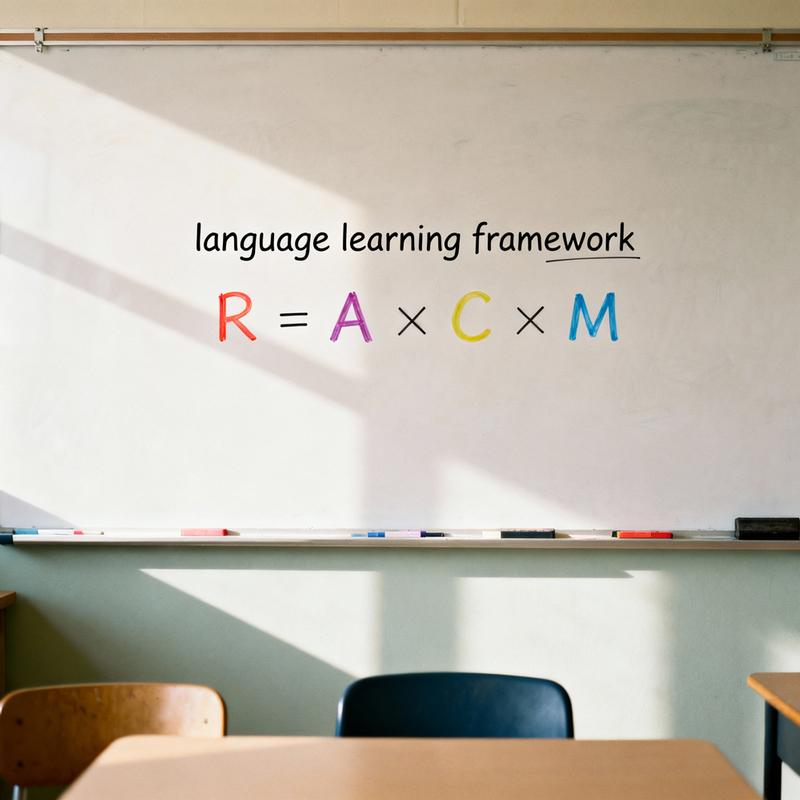
The R = A × C × M framework, adapted from Brian Tracy's goal-achievement principles (2003, 2004) and contextualized within language education through established Second Language Acquisition research and Berger's ethical imperatives (2003), proposes that educational results (R) emerge from the multiplicative interaction of three elements: Actions (A): the specific techniques and strategies teachers employ; Competence (C): the professional expertise informing pedagogical decisions; and Motivation (M): the learner engagement and investment driving participation.
R = A × C × M
The multiplicative nature is crucial. If any factor approaches zero, results collapse regardless of strength in other areas. Conversely, when all three factors are strong, they create exponential rather than merely additive gains. This framework provides both diagnostic and generative power, explaining variation in outcomes while guiding strategic improvement.
Theoretical Foundations
The framework synthesizes three research traditions. First, it draws on methodological diversity in second language teaching, recognizing that approaches from Grammar-Translation through Communicative Language Teaching each contribute unique value (Larsen-Freeman & Anderson, 2011). Second, it incorporates expertise research demonstrating that teacher knowledge—particularly pedagogical content knowledge (Shulman, 1986)— directly influences student achievement (Hattie, 2012). Third, it integrates motivation theory, particularly self-determination theory's emphasis on autonomy, competence, and relatedness as drivers of engagement (Deci & Ryan, 2000).
Berger's Ethics of Excellence (2003) provides ethical grounding, arguing that quality work, rigorous standards, and authentic purpose constitute moral imperatives in education. This framework extends Berger's principles by systematically connecting ethical commitments to pedagogical actions, professional competence, and motivational design. Each teaching method becomes not merely a technique but an ethical choice about how to honor student potential.
The Framework in Practice
Nine established methodologies illustrate the framework's application:
Rather than positioning these approaches as competing alternatives, the framework reveals their complementary contributions. Grammar-Translation's precision supports Communicative Language Teaching's fluency; Total Physical Response's comprehension foundation enables Task-Based Language Learning's production demands; Content and Language Integrated Learning provides authentic contexts for all other methods. Strategic integration creates comprehensive development addressing diverse learning needs and contexts.
Implications and Conclusion
For teacher education, this framework suggests preparation must develop not only methodological knowledge (A) but also adaptive expertise (C) and capacity to foster motivation (M). Professional development becomes a matter of strengthening all three factors simultaneously. For curriculum design, the multiplicative relationship indicates that neglecting any element (rigorous content, teacher support, or student engagement) undermines the entire teaching attempt. For educational equity, the framework highlights how systemic factors affecting teacher competence or student motivation multiply to create achievement gaps, suggesting intervention strategies must address all components.
The R = A × C × M framework offers language educators an integrative lens for understanding and improving practice. By recognizing the multiplicative interaction of deliberate actions, professional competence, and learner motivation, teachers can diagnose challenges more accurately and design interventions more strategically. Most importantly, by grounding this framework in an ethics of excellence, it reminds us that effective teaching is not merely technical proficiency but a moral commitment to every student's intellectual growth.
References
Berger, R. (2003). An ethic of excellence: Building a culture of craftsmanship with students. Heinemann.
Deci, E. L., & Ryan, R. M. (2000). The "what" and "why" of goal pursuits: Human needs and the self-determination of behavior. Psychological Inquiry, 11(4), 227–268.
Hattie, J. (2012). Visible learning for teachers: Maximizing impact on learning. Routledge.
Larsen-Freeman, D., & Anderson, M. (2011). Techniques and principles in language teaching (3rd ed.). Oxford University Press.
Richards, J. C., & Rodgers, T. S. (2014). Approaches and methods in language teaching (3rd ed.). Cambridge University Press.
Shulman, L. S. (1986). Those who understand: Knowledge growth in teaching. Educational Researcher, 15(2), 4–14.
Tracy, B. (2003). Change your thinking, change your life. John Wiley & Sons.
Tracy, B. (2004). Goals! How to get everything you want faster than you ever thought possible. Berrett-Koehler.
Scott Eder is the head of languages at Zhuhai International School.