
Generative Artificial Intelligence (GenAI) is disrupting the way schools do things. Should educators dismiss it as the latest tech fad, ban it, or embrace it with gusto?
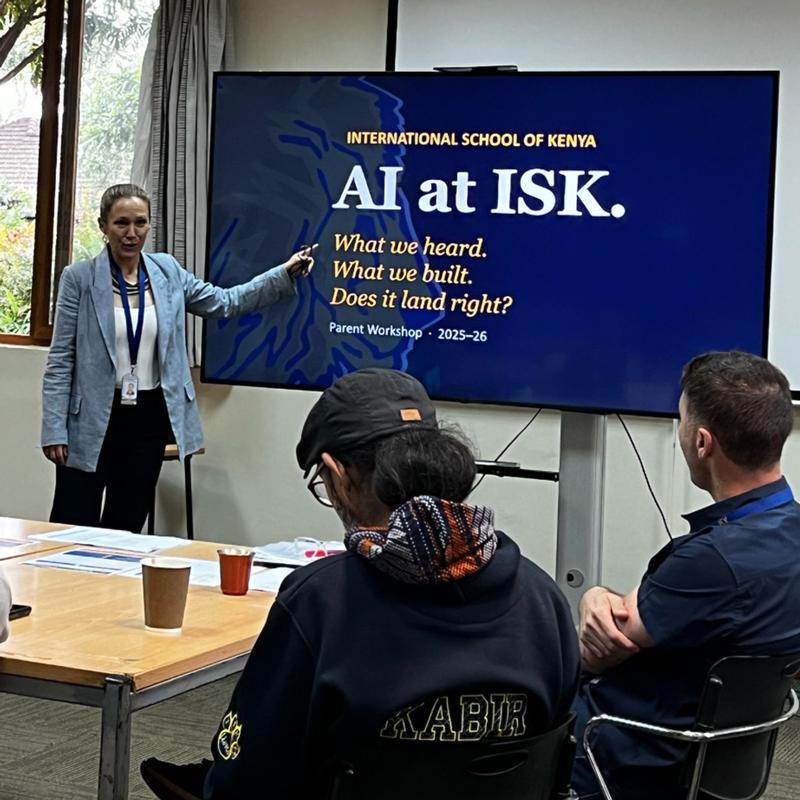
A team of high school faculty at the International School of Kenya (ISK) in Nairobi considered different perspectives and approaches to develop a new policy and teaching tools for the 2026–27 academic year. They are set to pilot that work beginning in August. Their efforts are the result of weekly meetings throughout March, April, and May during which the team examined available research, listened to faculty, students, and parents, and field tested possible teaching tools. Learning about ISK’s process might help other schools develop responses to generative AI.
The Challenge
In early 2026, ISK faculty and administrators recognized the rapid change GenAI was causing and the disparate messages students were receiving in classrooms depending on academic subject as well as teacher beliefs and comfort with technology.
“We saw students experimenting with AI tools, teachers exploring ways to enhance learning, and growing questions about academic integrity, authorship, assessment, and well-being,” recalls ISK high school Principal Ruth Jones. “Rather than responding reactively, we wanted to create a space where educators, students, and leaders could think carefully about the implications of AI for teaching and learning. The question was not whether AI would become part of education—it already had. The question was how we could help our community use these tools thoughtfully, ethically, and in ways that support learning.”
Based on these challenges, Hardi Fichardt, the 6–12 design and innovation coach, convened a series of focus groups with parents, students, and teachers. “I wanted to understand where the real pain points were before anyone wrote a single policy line,” Fichardt states.
“What came back was striking in its consistency. Students felt the biggest problem was the inconsistency between teachers. Parents had no visibility into what responsible use even looked like at our school. Teachers were exhausted trying to be AI detectives without any shared framework to stand on,” says Fichardt. “The committee didn't form because we had answers. It formed because the focus groups made the real problems impossible to ignore.”
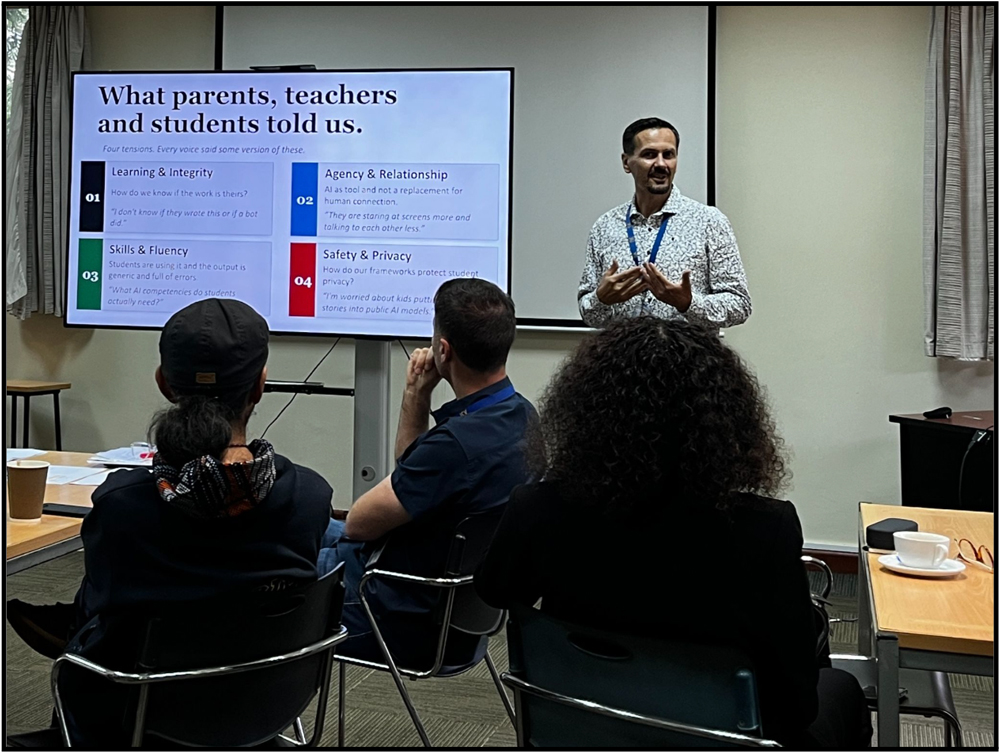
This process identified four specific tensions at ISK that emerged in response to rising use of GenAI. These themes were:
The Process
In April, a multidisciplinary group of high school teachers formed an AI team. The volunteers represented a range of academic subjects and perspectives. Team members were Rui Cunha, theatre teacher; David Duwyn, French and Spanish teacher; Alistair Goold, IB TOK coordinator; Jeff Idigo, IB DP Coordinator; Kenneth Okelo, science teacher; Samuel J. Richards, 9–12 head of social sciences; Fela Sanjuán, Spanish teacher and Grade 12 Level Leader; Todd Von Seggern, design teacher; and Tom Wallbridge, English teacher.
The committee’s work was facilitated by Fichardt who posed challenging questions, managed the schedule, and supported various two-person working groups with frequent check-ins, sample documents, academic studies, and facilitated discussion.
The entire team gathered every Thursday for eight-weeks. During each meeting, two-person project teams presented potential solutions for initial feedback before deciding what to advance for field testing with colleagues, students, and parents. It was an aggressive timeline with meetings often running later than planned as challenges prompted robust discussions with no easy answers.
“During my time on the committee, an important discovery I had regarding AI and pedagogy centered around the needs of our faculty and students. While faculty wanted ways to contain AI usage as well as strategies for enhancing their curriculum with AI, many students were testing AI's limits and were in need of guidance. This challenged me to determine the best way to preserve classroom learning while also teaching best practices for using AI,” explains Von Seggern.
The Philosophy
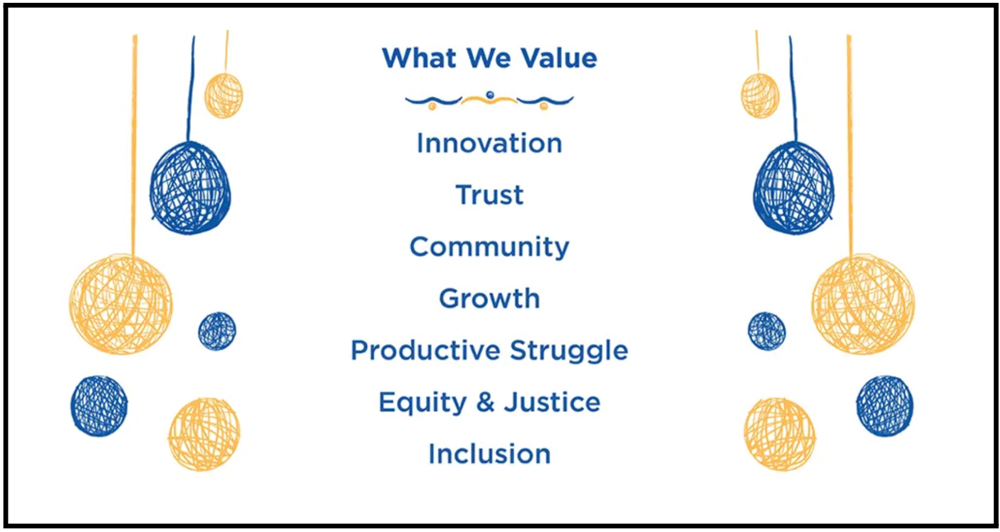
Defining a philosophy was the earliest stage of ISK’s process. The team leaned toward restorative practices in order to avoid teachers having to become AI surveillance agents. This approach aligns with ISK’s values of trust, community, growth, and productive struggle. The need for the new approach also reflects ways norms, trust, and human relationships in schools are being challenged by increased use of GenAI.
“My experience as a Grade 12 Level Leader over the past two years has significantly shaped my thinking,” says Fela Sanjuán. “Having been involved in several academic integrity cases, I have seen firsthand how uncomfortable and often unproductive it can be when conversations become accusatory. In those situations, both the teacher and the student can find themselves in a difficult position, with the student feeling pressured to prove their authorship after concerns have already been raised. Through our AI team discussions, we came to believe that a more proactive approach would be far more beneficial, one that helps students document and demonstrate their learning process from the outset rather than having to defend it later.”
Sanjuán’s view was supported by colleague Alistair Goold. In addition to being ISK’s International Baccalaureate Theory of Knowledge (TOK) coordinator, Goold is an expert in restorative practices who has led workshops for multiple schools in the Association of International Schools in Africa (AISA).
“Many schools have understandably focused on AI detection, enforcement, and proving whether misconduct has occurred,” Goold remarks. “While accountability remains important, there is a risk that over-reliance on unreliable detection tools can create mistrust, damage relationships, and place schools and students in adversarial positions.”
“A restorative approach starts from a different premise: our primary responsibility is to support young people in learning how to use these tools ethically, responsibly, and transparently,” says Goold. ISK’s policy aims to achieve this by aiming to be about 80% proactive and 20% responsive. This isn’t a magical mathematical formula, but rather a rough guideline shaped by restorative practices. Goold explains that “most of our effort is invested in building understanding, skills, trust, and clear expectations before problems occur, while responsive processes focus on restoring trust, repairing harm, and re-establishing learning when concerns arise.”
This led ISK’s AI team to emphasize proactive solutions while crafting a restorative policy aimed at learning with and coaching students when GenAI is used in place of key cognitive tasks being assessed (more on that later). More severe consequences remain for flagrant violations.
Pedagogical Principles and Four Tools
Four tools were designed to address the tensions identified during the initial student, parent, and teacher focus groups. Some tools are teacher facing to guide pedagogy while others are student facing to help guide responsible, ethical use while explaining the “why.” One key concept framing the work is protecting critical cognitive tasks.
“Grammarly became a point of debate for the team,” according to Richards. “We came to realize that Grammarly was an excellent example of how one tool could aid learning in some disciplines while hindering it in others. Grammarly’s AI suggestions could help a Grade 9 student refine a draft written argument in history or international relations. That same tool could undermine the core thinking and learning in an English, French, Kiswahili, or Spanish class. We have to be clear about which cognitive task is the core learning standard for a course. That’s the task we must protect for the student’s own thinking.”
Safeguarding key cognitive tasks is the “shared challenge underneath all of it,” according to Fichardt. “The moment a student outsources the thinking a task was designed to develop, the learning disappears, and that is true in every subject. But what differs across disciplines is what that protected thinking actually looks like, and that difference matters enormously in practice.”
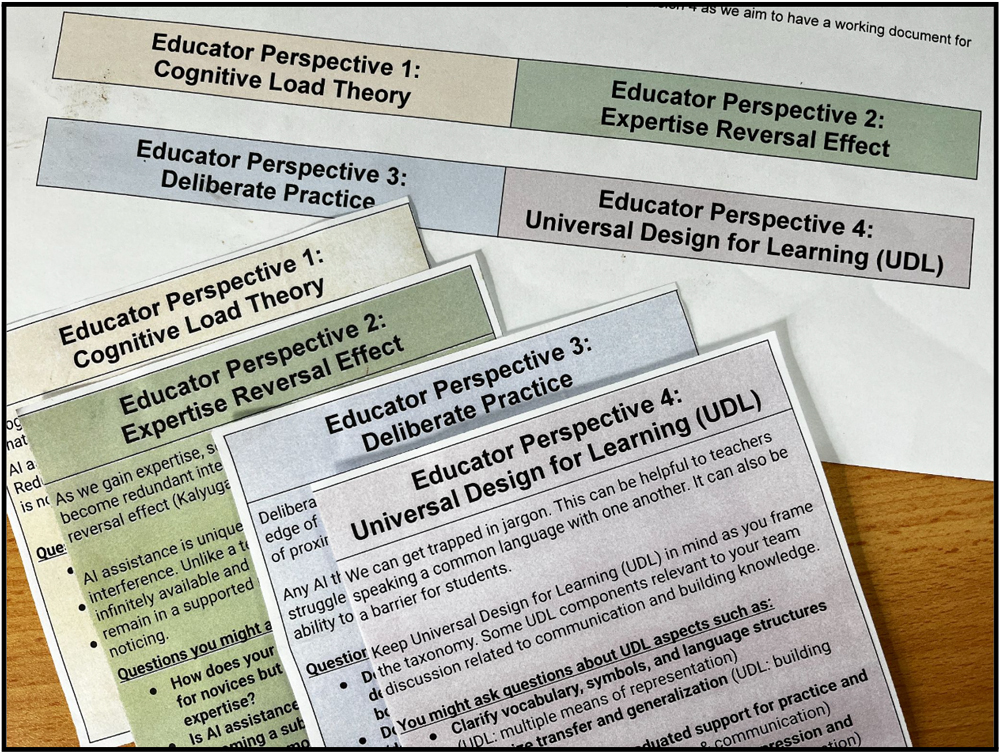
Learning requires effortful thinking. When GenAI completes the cognitive work a student was supposed to do, the answer may look correct but no learning has happened. Support and scaffolds must fade over time. GenAI does not withdraw naturally, a reality that can rob students of the productive struggle essential to learning.
If GenAI removes the challenge, it removes the opportunity to learn. These views are not original discoveries at ISK. They are rooted in cognitive and pedagogical research. In their 2014 study, Elizabeth L. Bjork and Robert A. Bjork identified that conditions of difficulty during learning are linked to long-term retention and transfer. Similarly, Slava Kalyuga found that scaffolding helps novice learners but if never removed, it stunts growth leaving students languishing as novices rather than becoming advanced learners. It is important to remember that GenAI never automatically removes itself as a learning scaffold. It is designed to do the opposite.
More recent research, such as a 2023 paper by Ethan R. Mollick and Lilach Mollich, argues that GenAI can be beneficial when it challenges students' ideas and serves as a thinking partner rather than as an answer producer. The OECD’s 2026 report on digital education included an assessment by Dragan Gaševic and Lixiang Yan that concluded, “Evidence on the effectiveness of GenAI to enhance instructional support is still emerging and offers mixed support.” They specifically warn educators to beware that a growing body of evidence points to GenAI creating a “mirage of false mastery” among learners because “high-quality, AI-enabled output conceals underlying weaknesses in human skill.” (OECD, 51). None of these studies indicate that schools should ban GenAI. They do, however, invite meaningful discussion about which cognitive tasks require human effort and struggle in order to cultivate opportunities for mastery learning.
French and Spanish teacher David Duwyn helped design authorship checklists to use as cover pages for classwork and assessments. Duwyn explains, “The checklist lays out a visible pathway that may open up a constructive conversation about the appropriate use of AI in terms of learning for the task at hand.” This is one proactive way to avoid the “mirage of false mastery” identified by Gaševic and Yan.
Another way ISK has tried to clarify when GenAI aids learning or interferes with it is to invite academic departments to co-create a learning taxonomy illustrating what tasks to protect for specific disciplines.
Four tools have been designed to guide deliberate use of GenAI in ISK’s high school.
AI policy that includes ISK’s philosophy of GenAI use, attribution requirements, and a three-stage restorative process for authenticity concerns.
AI Assessment Scale is a leveled framework that uses consistent language across subjects to tell teachers and students how much GenAI involvement is permitted on a task. ISK’s scale was adapted from one developed by Mike Perkins, Leon Furze, Jasper Roe, and Jason MacVaugh first published in 2023 and revised in 2024. (Perkins et al.)
Authorship Checklists are two student-facing forms that have students indicate when and how GenAI may have been used. Checklist 1 is for high-stakes work in the IB Diploma Program including Extended Essays, Internal Assessments, and TOK Components. Checklist 2 is for Grades 9 and 10 where the primary purpose is teaching students what a responsible process looks like. Emphasis is placed on students maintaining a “visible path of learning” to allay fears of plagiarism and to invite discussion of their process. The absence of a “visible path of learning” such as outlines and drafts is flagged as a likely breach of integrity.
Subject-Specific AI Use Taxonomy which defines what is permissible, cautionary, and prohibited in each academic discipline. This document has become a tool to help academic subjects consider which cognitive tasks must be protected to guarantee the necessary productive struggle that creates learning.
Science teacher Kenneth Okelo contributed to developing the taxonomy. He explains that, “AI has the potential to fundamentally change education. However, it is important to view AI as a tool for deliberate use, framed by structures that promote the cultivation of crucial cognitive skills, critical thinking, research, and problem solving.”
It is a view shared across ISK’s high school departments. Faculty are not banning GenAI. Instead, they are trying to find the best ways to leverage it for learning.
“Social Studies faces particular challenges related to the ‘jagged frontier’ of AI. AI platforms tend to be more helpful for contemporary topics like economics, but can be especially problematic for history,” according to Richards. “Because AI data sets rely heavily on US and European sources, they also encode these regions’ historical biases into their output.” A 2021 study found that GenAI amplified harmful white supremacist, misogynistic, and ageist views (Bender et al.). More recently, Kelsey Rice examined the influence of ChatGPT on undergraduate history essays in the United States. Her study found similar concerns. She cautioned that, “...ChatGPT has been trained on centuries of Eurocentric history writing that privileged elite white males as history’s most important actors.”
GenAI presents unique challenges and opportunities for each academic discipline.
“Design faces a challenge of ensuring students don't use AI to bypass critical cognitive processing and shortcut the learning cycle,” explains Von Seggern. “However, design possesses an advantage: our culture of hands-on, project based work is inherently resilient to AI. At the same time, the design space is uniquely positioned to leverage multimodal AI tools as creative partners—using them not just for automation, but to accelerate iterative feedback and expand the boundaries of student ideation.”
A similar transformation is taking place in the modern languages department. “One of my biggest learnings has been that AI has shifted the conversation from ‘How do we prevent students from using AI?’ to ‘How do we design learning experiences where student thinking remains visible and valued?’” states Spanish teacher Fela Sanjuán. “As educators, we can no longer rely solely on the final product as evidence of learning. Instead, we need to place greater emphasis on process, reflection, feedback, and the development of ideas over time.”
From her perspective as Principal, Ruth Jones is proud of the committee because “they resisted the temptation to view AI as either entirely positive or negative.” She points out that “The conversation around AI often becomes polarized. Some people see it as a threat to learning, while others see it as a transformative solution to educational challenges. Our committee worked hard to hold both realities at the same time. We acknowledged the opportunities AI presents for creativity, feedback, differentiation, and access, while also confronting legitimate concerns about integrity, critical thinking, and student agency.”
The four new tools are aimed to support students and teachers to navigate the tensions without becoming polarized.
Implementation
ISK’s high school is set to pilot its new policy and pedagogical practices beginning in August.
“The next phase is less about policy development and more about capacity building,” according to Jones. “We need to continue helping teachers design learning experiences and assessments that thoughtfully use AI while preserving opportunities for students to demonstrate authentic understanding. At the same time, we must remain adaptable. The tools will continue to evolve, and our response must evolve with them.”
In early June, the AI team shifted from developing tools to planning implementation. This will help transition from a reactive to proactive approach for the new academic year.
English teacher Tom Wallbridge points to this phase as being critical. “Success will depend on buy-in from across the community, from students, teachers and parents,” according to Wallbridge. “It will probably hinge on the clarity and effectiveness of communicating both how this philosophy and framework functions, as well as why this helps and matters. This is a solution to a problem, not another problem.”
Fichardt has recruited a new team to work on implementation. This keeps energy high and allows for more stakeholders to be involved in this intense initiative. Some members from the development team also plan to join the implementation team, a combination that helps to maintain both continuity and high energy.
A lot of learning has already happened. A lot more learning likely remains.
Advice to Other Schools
ISK’s experience to date offers lessons for other schools.
From the classroom perspective, Duwyn believes that “building trust and developing learning skills should be at the center of any pedagogy that integrates AI as a learning tool.” He advises that “the first thing teachers should do is to model appropriate use of AI in class and be transparent with their own use of AI.”
As the technology and innovation coach, Fichardt offers this wisdom for other schools beginning to ask questions about how to best approach GenAI. “The most valuable thing I learned is that asking where AI is allowed is a dead end. It produces lists and lists go out of date the moment a new tool arrives. The question that actually unlocks something is what expertise are we trying to build, and what would be lost if students never had to struggle toward it themselves. For other schools, my honest advice is simple. Consult before you build, and take what you hear seriously enough to let it change your direction. We did, and the framework we ended up with looks nothing like what we would have written if we had started from policy rather than from people.”
Jones advises fellow administrators to start with the learning rather than the technology. “It can be tempting to begin by asking, ‘What should our AI policy be?’ A more productive question is, ‘What do we value most about learning, and how does AI support or challenge those values?’ I would also encourage administrators to involve teachers, students, and parents in the conversation. The people closest to the learning experience often have the most important insights. Creating opportunities for dialogue builds trust and leads to more practical solutions. Finally, avoid framing AI as a problem to solve. It is a reality to navigate.”
ISK will begin the 2026–27 academic year in August with new tools to help navigate that reality.
References
Bender, Emily M. Timnit Gebru, Angelina McMillan-Major, and Shmararet Shmitchell.”On the dangers of stochastic parrots: Can language models be too big?” Proceedings of the 2021 ACM Conference on Fairness, Accountability, and Transparency (2021), https://dl.acm.org/doi/10.1145/3442188.3445922.
Bjork, Elizabeth L., and Robert A. Bjork. "Making Things Hard on Yourself, but in a Good Way: Creating Desirable Difficulties to Enhance Learning." Psychology and the Real World: Essays Illustrating Fundamental Contributions to Society, edited by Morton Ann Gernsbacher et al., 2nd ed., Worth Publishers, 2014, pp. 56-64.
Kalyuga, Slava. "Expertise Reversal Effect and Its Implications for Learner-Tailored Instruction." Educational Psychology Review, 19:4 (2007): 509-539.
Gaševic, Dragan and Lixiang Yan, “Generative AI for human skill development and assessment: implications for existing practices and new horizons” in OECD Digital Education Outlook 2026: Exploring Effective Uses of Generative AI in Education. Paris: OECD Publishing (2026), https://doi.org/10.1787/062a7394-en.
Mollick, Ethan R. and Lilach Mollick, “Assigning AI: Seven Approaches for Students, with Prompts,” The Wharton School Research Paper (September 23, 2023), Available at http://dx.doi.org/10.2139/ssrn.4475995.
Perkins, Mike, Leon Furze, Jasper Roe, and Jason MacVaugh. “The AI Assessment Scale” (2024), aiassessmentscale.com.
Rice, Kelsey. “ChatGPT and World History Essays: An Assignment and Its Insights into the Coloniality of Generative AI,” Teaching History: A Journal of Methods 49:1 (2025): 49-55. https://doi.org/10.33043/67bdga4z9.
Samuel J. Richards is the head of social sciences 9–12 at the International School of Kenya in Nairobi. He is an experienced middle and high school teacher and department leader who has developed curricula for schools in Brazil, China, Kenya, Switzerland, and the United States. He is a contributing author and curricular designer for IB history materials published by Pearson, Aga Khan Academies, and IB Exchange. He enjoys students’ “lightbulb moments” and has a passion for literacy learning, the humanities, and curricular improvement. He holds a master’s degree in history and a Master of Science in Education in curriculum and instruction.
LinkedIn: https://ke.linkedin.com/in/samuel-j-richards