

Earlier this year, in testimony before the U.S. Senate on children and technology, cognitive scientist Dr. Jared Cooney Horvath offered a reminder that many educators instinctively recognize: technology itself does not improve learning. What matters is the thinking students are asked to do.
Digital tools can support learning when they encourage retrieval, discussion, problem solving, and creation. However, when technology simply replaces existing tasks, it often adds little value and can even make learning more passive. Horvath’s point is not that technology has no place in classrooms, but that its presence alone does not transform learning. The impact of any tool depends on how it is embedded within the experiences students are asked to engage in.
As conversations about technology in schools continue to evolve, this distinction feels increasingly important. In many cases, discussions about screens focus on the presence of devices rather than the design of learning itself. Yet the more useful question for educators is not whether technology belongs in classrooms, but how it can be used in ways that deepen thinking, inquiry, and understanding.
When Technology Supports Inquiry
When digital tools are embedded within meaningful learning experiences, their role begins to shift. Rather than acting as replacements for traditional tasks, technology can create new opportunities for investigation, discussion, and creative expression.
In Grade 7 at the International School Yangon, students investigating an E. coli outbreak used an interactive simulation platform to interview virtual characters connected to the case. Each character held different pieces of information about the outbreak, and students had to determine which questions to ask in order to gather useful clues. Crucially, this was not a solitary screen experience. Students worked in teams, debating which characters to question next, comparing the clues each had gathered, and building theories together before testing them against new evidence. The simulation did not provide answers. Instead, it created a shared problem space where student-to-student conversation, not student-to-screen time, became the engine of learning.
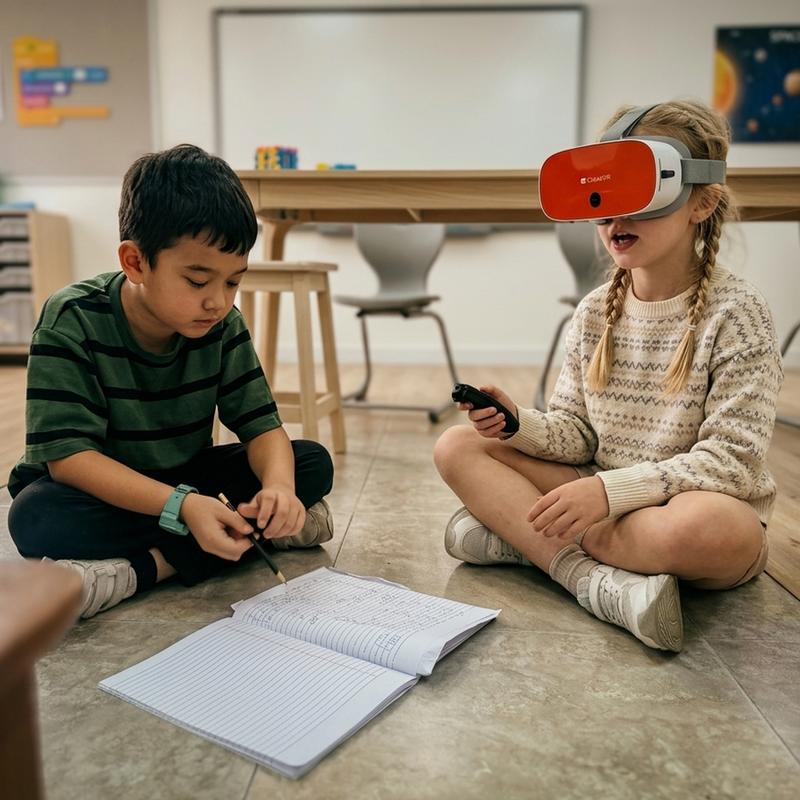
Technology can also expand the kinds of experiences students draw upon when developing language and ideas. In a Grade 3 literacy unit, students used virtual reality to visit different fairytale settings as part of a descriptive writing project. Instead of imagining a castle or enchanted forest from a single illustration, students were able to look around the environment, notice details, and collect sensory language that later shaped their writing. The virtual environment functioned less as a screen-based activity and more as a shared experience students could revisit when crafting their descriptions.
Older students are also exploring new ways technology can support thinking. In high school art classes, some students have begun using artificial intelligence (AI) tools as thinking partners while analyzing artworks. Rather than generating finished interpretations, the AI prompts questions about symbolism, artistic choices, and historical context that students then use to refine and articulate their own analysis. When examining Mondrian’s The Mill, for example, the AI might ask, “Look closely at the painting. What do you notice about how the paint sits on the surface? Do the brushstrokes look thick or thin? Can you see texture or buildup of paint anywhere? Does the paint look transparent or opaque? What are your observations when you look at the sky area specifically?” The AI does not offer answers; it opens a line of looking. Students use these prompts as a starting point for their own written analysis, and the quality of their interpretations depends on the quality of their observations.
This kind of design reflects what researchers are beginning to advocate for more broadly. Harvard Graduate School of Education researcher Ying Xu argues that most concerns about AI in education stem from a fear of replacement, of what students lose when AI steps in, rather than from asking whether AI can make existing learning time more enriching and engaging. As Xu puts it, “Rather than aiming to ‘introduce’ AI to children, our starting question is always, Can AI make the time children already spend on media more enriching and engaging?” The distinction matters in practice. When an AI tool asks a student what they notice about a brushstroke rather than telling them what it means, it is adding to the student’s thinking, not substituting for it.
Across these examples, the technology itself is not the focus of the learning experience. Instead, digital tools create conditions where students observe closely, ask questions, analyze information, and communicate their thinking, often with and through each other.
This approach also aligns closely with the principles of Universal Design for Learning. When technology is used intentionally, it can expand how students access ideas, represent their understanding, and engage with learning. A simulation may allow students to explore complex systems that are otherwise difficult to visualize. A virtual environment can support descriptive writing by giving students a shared experience to reference. AI tools can introduce alternative perspectives that deepen analysis. In each case, technology opens additional pathways for students to think, express ideas, and participate in the learning process.
Interpreting the Public Debate
Public conversations about technology in education often move faster than the policies or research behind them. Headlines and social media posts can simplify complex decisions into sweeping statements about whether technology should or should not be used in schools.
A recent example can be seen in discussions about Sweden's education policies. Online posts claiming that Sweden is "banning screens in schools" flooded many educators' feeds. Yet closer examination of the actual policy reveals a more targeted picture.
The Swedish government's approach has focused on rebalancing the early years toward foundational skills. The policy positions reading, writing, and arithmetic as the core of early grades, with the stated principle that digital tools should only be introduced when they encourage rather than hinder learning. In practical terms, this meant substantial reinvestment in physical materials and legislation ensuring students’ access to staffed school libraries. Sweden was not alone for long. Across the United States, a similar push to restrict phones in schools has gained momentum, even as schools are simultaneously urged to integrate AI tools. As Education Week noted in April 2026, these two conversations tend to happen in separate silos, with little apparent coordination between them, reflecting a broader tension in how schools approach technology decisions.
Separately, mobile phone use in schools has been addressed as a matter of attention and student wellbeing, a distinct issue that is frequently merged with the broader screen debate online, but is not the same conversation.
For educators, the takeaway is not that technology should be removed from classrooms, nor that it should be expanded without question. The more meaningful consideration is purpose. When digital tools are introduced thoughtfully, they can support thinking, creativity, and access to learning. When they are introduced without clear connection to learning goals, they risk becoming distractions or substitutes for strong foundations.
A Design Question for Schools
As educators reflect on the role of technology in classrooms, it may be helpful to return to the question Dr. Horvath raised in his testimony. The central issue is not the presence of digital tools themselves, but the kinds of thinking experiences students are invited to engage in.
Near the end of his testimony, Horvath offered a caution that resonates with many current conversations in education. If schools begin reshaping learning primarily to accommodate the tools we use, we risk redefining education around the technology itself. As he put it, “If we are redefining education to better suit the tool, that’s not progress. That’s surrender.”
For educators, this reminder brings the conversation back to where it belongs. The work is not simply deciding whether technology belongs in classrooms. It is designing learning environments where digital tools remain in service of curiosity, thinking, and human interaction, where students are talking with each other, not just engaging with a screen.
In the end, tools alone do not create understanding. What matters most are the learning experiences we design around them.
CAST. (2018). Universal Design for Learning Guidelines version 2.2. http://udlguidelines.cast.org
EdSurge. (2026). Why not ask why? Neuroscientist urges educators to reconsider technology’s reach. https://www.edsurge.com/news/2026-02-27-why-not-ask-why-neuroscientist-urges-educators-to-reconsider-technology-s-reach
Hess, R. (2026, April 14). Schools are urged to embrace AI—and ban phones. Can we resolve the tension? Education Week. https://www.edweek.org/technology/opinion-schools-are-urged-to-embrace-ai-and-ban-phones-can-we-resolve-the-tension/2026/04
Horvath, J. C. (2024). Testimony on children, learning, and digital technology. https://www.youtube.com/watch?v=Fd-_VDYit3U
Swedish Government. (2024). Government investing in more reading time and less screen time. https://www.government.se/articles/2024/02/government-investing-in-more-reading-time-and-less-screen-time/
Whitehead, S. (2025). The real story about Sweden’s screen debate. https://www.linkedin.com/pulse/real-story-stephen-whitehead-csml-mba-mgpm-pgcei-kdgac/
Xu, Y. (2025). AI can add, not just subtract, from learning. Harvard Graduate School of Education. https://www.gse.harvard.edu/ideas/news/25/04/ai-can-add-not-just-subtract-learning
Xu, Y. (2025). Why education research matters: AI and children. Harvard Graduate School of Education. https://www.gse.harvard.edu/ideas/news/25/12/why-education-research-matters-ai-and-children
Itzel Madero Hernandez is the technology integration facilitator at The International School Yangon. Itzel supports students, teachers, and parents in leveraging digital tools to enhance learning and fosters innovation through technology integration across the school community.