

Schools are asking teachers to do far more than teach. According to the Organisation for Economic Co-operation and Development's (OECD) Teaching and Learning International Survey (TALIS 2024), approximately half of teachers across OECD education systems report excessive administrative work as a source of work-related stress (OECD, 2024). The emotional weight of supporting diverse learners is real. Leadership changes. Artificial Intelligence advances. New cultures. Shifting expectations. It adds up, and it compounds. And when teachers struggle, it affects students.
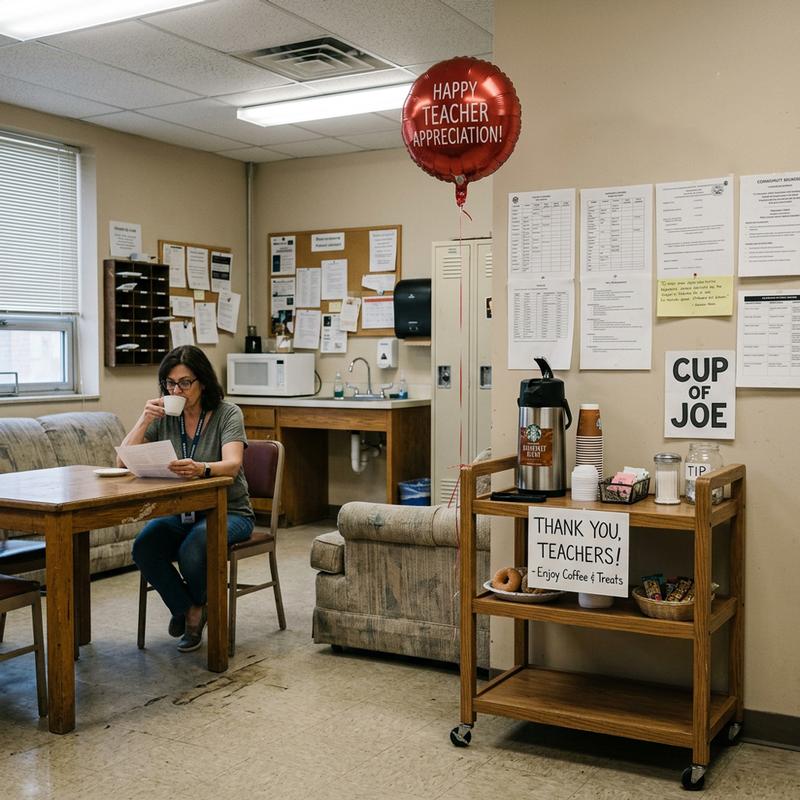
The Problem With How We’ve Been Doing ThisFor too long, our approach has been the coffee in the staffroom. The one-off yoga class. The surface-level gesture. It has to go deeper.
We need a research-based approach, one that mirrors how we treat student wellbeing, embedded in the school day. Not a professional development session in August, then silence while the pressure piles on.
What Wellbeing Actually Means
The OECD defines teacher wellbeing across four dimensions:¹
Cognitive — the ability to focus, process information, and concentrate
Subjective — emotional states, satisfaction, and sense of purpose
Physical and mental — the presence or absence of stress symptoms and health complaints
Social — the quality of working relationships within the school community
This definition matters because it confirms something schools often miss: teacher wellbeing is not an individual problem. It is shaped by systems, leadership, workload, relationships, and culture.
The CARE Framework
I developed the CARE framework as a systems response to these four dimensions.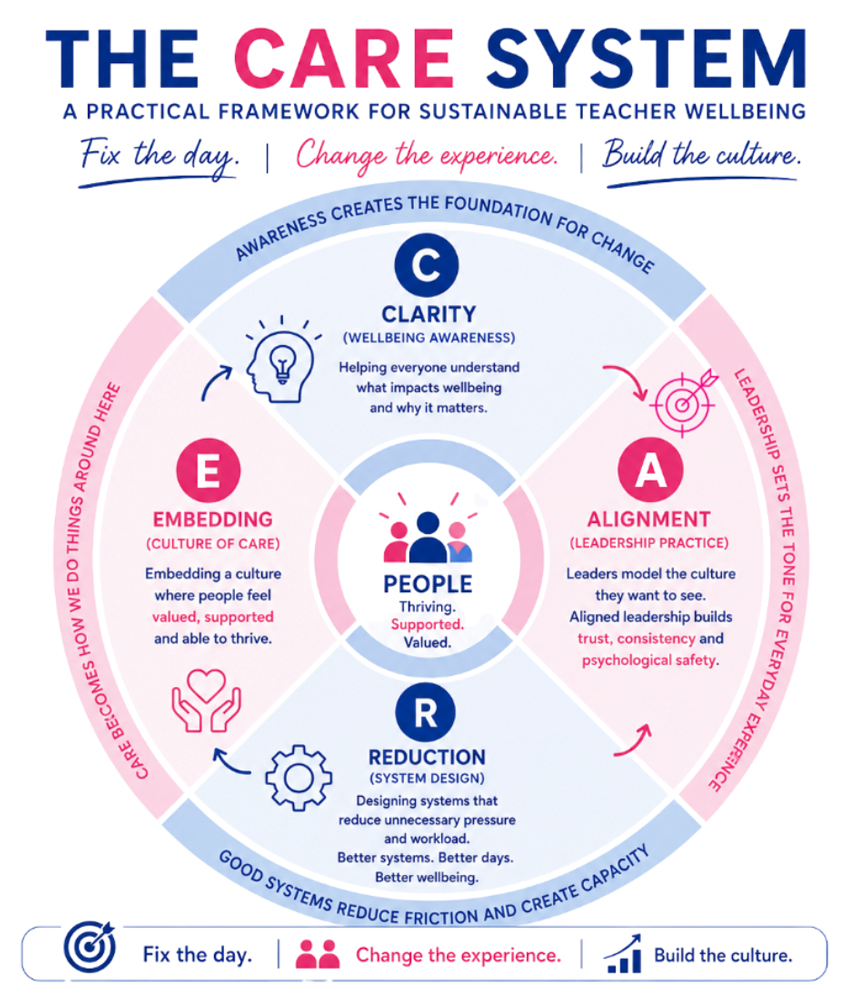
The CARE System: A Practical Framework for Sustainable Teacher Wellbeing (Photo source: Dr. Desiree Brown-Quilty)
The CARE model embodies the OECD’s dimensions.
C is for Clarity: What This Looks Like in Practice
Clarity is about helping everyone in the school understand what impacts wellbeing and why it matters. Without it, leaders make decisions in the dark, and teachers silently absorb pressure that could be addressed.
Try this:
Run a simple workload audit. Ask teachers to log their tasks for one week, separating teaching responsibilities from administrative ones. The results are often surprising, and they give leaders something concrete to act on.
At the start of a staff meeting, ask one question, “What is taking up the most mental energy for you right now?” Listen without problem-solving. Patterns will emerge that you didn't know were there.
Share the OECD dimensions of wellbeing with your staff. When teachers have a language for what they are experiencing, they can name it. Naming the issue is the first step toward change.
A is for Alignment: What This Looks Like in Practice
Alignment is about leadership practice. The culture of a school is shaped more by what leaders do daily than by any policy or program. Aligned leadership builds trust, consistency, and psychological safety.
Try this:
Audit your communication. How often do you send emails after hours? How much notice do you give before adding items to agendas? Small habits send loud messages about what the school really values.
Be explicit about expectations. Vague or unclear expectations are a significant and often overlooked source of teacher stress. Where there is ambiguity, name it and resolve it (Carroll et al., 2020; von der Embse et al., 2016).
Model boundaries publicly. If you want teachers to protect their time and energy, let them see you doing it too. Say out loud when you are not available. Encourage staff to do the same.
R is for Reduction: What This Looks Like in Practice
Reduction is about system design. It asks, what can we take away? Most schools are good at adding new initiatives, new expectations, new commitments. Reduction requires the discipline to subtract.
Try this:
Before adding anything new to the school calendar or teacher workload, ask, “What will we remove to make space for this?” Make it a standing question in leadership meetings.
Audit your meetings. List every standing meeting in your school and ask: What is the purpose of this? Could it be an email? Could it happen less frequently? Could two meetings be merged? Protect teacher time as if it were a finite resource, because it is.
Identify your highest-friction systems: Where are teachers losing time to unclear processes, duplicated admin, or tools that don’t work well? Fix one. Then another.
E is for Embedding: What This Looks Like in Practice
Embedding is about culture. It is what happens when wellbeing stops being a program and becomes the way things are done. This takes time, but it starts with small, consistent actions.
Try this:
Build wellbeing into existing structures rather than creating new ones. A two-minute check-in at the start of a department meeting costs nothing and signals that people matter. A brief question at the end of a performance conversation, “How are you feeling about your workload right now?” would do the same.
Create space for honest conversation. Psychological safety doesn't happen by accident. Leaders have to actively invite dissent. Start small. Ask your team what one thing would make their work feel more manageable. Then do something about it.
Where to Start
CARE is not a checklist. It is a way of looking at your school and asking are our systems, our leadership, and our culture set up for teachers to thrive? You do not need to implement everything at once. Pick one element. Try one strategy, then notice what shifts. Coffee in the staffroom is not the answer, but small, intentional changes, made consistently and embedded in the everyday life of the school are.
1 OECD (2020). TALIS 2018 Results (Volume II): Teachers and School Leaders as Valued Professionals. OECD Publishing, Paris. https://doi.org/10.1787/19cf08df-en
2 OECD (2024). Results from TALIS 2024: The Demands of Teaching. OECD Publishing, Paris. https://www.oecd.org/en/publications/results-from-talis-2024_90df6235-en/full-report/the-demands-of-teaching_0e941e2f.html
3 Carroll, A., et al. (2020). Teacher stress and burnout in Australia. Social Psychology of Education.
4 von der Embse, N., et al. (2016). Expectation stress among teachers. Referenced in Collie, R.J. (2022). Teacher and school stress profiles. Teaching and Teacher Education
Dr. Desiree Brown-Quilty is a humanities teacher at Luanda International School. Additionally, she is a speaker and educator wellbeing specialist with more than 20 years of experience in international schools across three continents. Her work focuses on helping schools build healthier, more sustainable environments for teachers through leadership, culture, communication, and wellbeing systems. Desiree is the creator of the CARE Framework, a holistic model for teacher wellbeing grounded in international school experience and wellbeing research.
LinkedIn: https://www.linkedin.com/in/desiree-bq/