
I taught in Switzerland, within an international school environment characterized by academic ambition, multiculturalism, and access to extensive educational resources. Later, I worked with adult women in vulnerable social conditions in Villa El Salvador alongside the Missionari di Villaregia. I also taught migrants arriving through the Balkan route in Udine, many of whom carried interrupted educations, trauma, and uncertainty about the future. Today, I teach in La Scuola d’Italia Guglielmo Marconi, within both the Italian system and the International Baccalaureate (IB) framework, in New York City in the United States.
At first glance, these educational realities seem impossible to compare. The resources, expectations, languages, and social conditions are radically different. Yet teaching across these contexts has led me to a conviction that continues to shape my work: students, regardless of their background, are ultimately asking many of the same questions. They seek recognition, meaning, belonging, and the possibility of imagining a future for themselves.
What changes is not the humanity of the learner, but the conditions surrounding that humanity.
In highly privileged contexts, education can sometimes become strongly connected to performance. Students are often under pressure to excel academically, build exceptional résumés, and prepare for increasingly competitive futures. Behind this apparent confidence, however, I have frequently encountered anxiety, fear of failure, and a difficulty in defining identity beyond achievement. Many students possess opportunities that others could only dream of, yet still struggle to understand who they are outside systems of expectation.
In marginalized contexts, the challenges are more visible and immediate. In Villa El Salvador, education was deeply connected to survival, autonomy, and dignity. The women I worked with were not approaching learning as an abstract intellectual exercise. For many, studying represented a possibility to reclaim voice, confidence, and agency within lives marked by economic hardship or social invisibility. Similarly, among migrants arriving in Udine after crossing the Balkan route, education often became one of the few spaces capable of restoring continuity to lives interrupted by displacement.
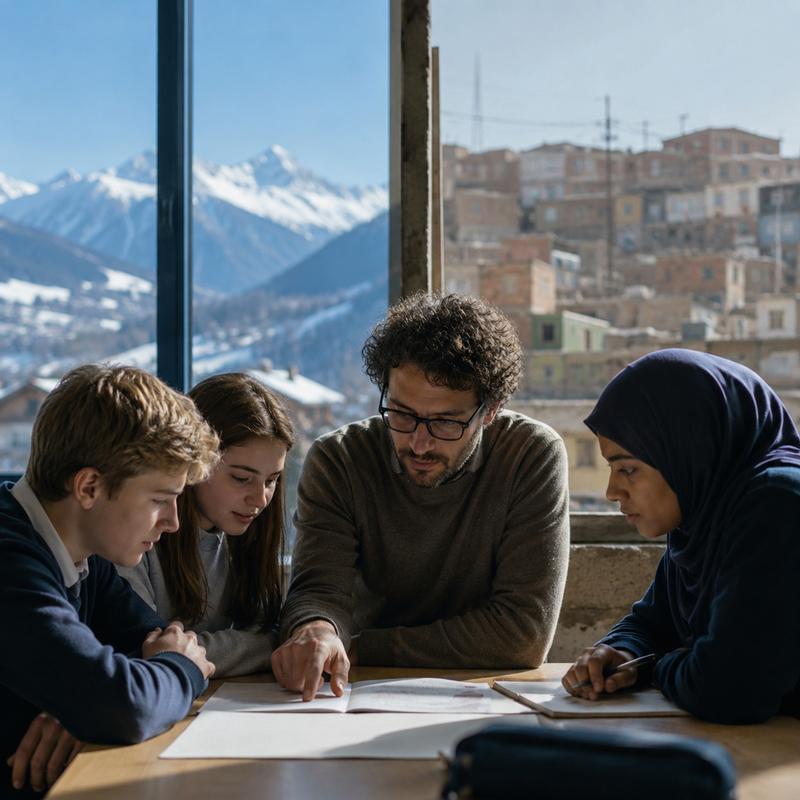
These experiences profoundly changed my understanding of teaching. I gradually stopped seeing education primarily as the transmission of knowledge and began to see it more as the creation of meaningful human relationships. Content matters deeply, but students rarely remember only what was taught. They remember whether they felt seen, respected, and intellectually invited into the learning process.
This realization also transformed my relationship with philosophy and the humanities in the classroom. I discovered that philosophical reflection, in particular, has an extraordinary capacity to connect students from very different worlds because it speaks to universal human concerns. Questions about freedom, justice, identity, responsibility, suffering, or hope emerge across all contexts, although often in different forms.
I have seen students recognize themselves in the writings of Immanuel Kant when discussing the fragility of peace and coexistence. I have seen others connect deeply with Simone Weil and her reflections on attention, vulnerability, and human dignity. In these moments, philosophy ceases to be merely academic. It becomes a language through which students attempt to interpret their own experience.
Teaching internationally has also forced me to confront my own assumptions about education. It is tempting to believe that good teaching depends primarily on resources, institutional prestige, or methodology. Certainly, these elements matter. Yet some of the most meaningful educational moments I have experienced emerged in contexts with very limited material means. Conversely, abundance does not automatically generate deeper learning.
What truly shapes education, in my experience, is the quality of attention present within the classroom: the ability to listen, to create trust, to make students feel intellectually and emotionally safe enough to think critically and authentically.
Working today within an IB and Italian educational environment in New York, I often carry these previous experiences with me. International schools occupy a unique position because they bring together students from multiple cultural, linguistic, and social backgrounds. This diversity can become an extraordinary educational resource if approached not simply as multicultural representation, but as an opportunity to cultivate empathy, complexity, and global responsibility.
In an increasingly polarized and unequal world, schools cannot limit themselves to preparing students only for universities or careers. They also have the responsibility to help students develop a deeper understanding of themselves and of others. Education should not merely produce competent individuals; it should help form reflective and compassionate human beings capable of living within complexity without retreating into indifference.
Teaching across these different realities has not given me definitive answers about education. If anything, it has made me more aware of its fragility and responsibility. But it has reinforced one belief that continues to guide me: every educational encounter contains the possibility of transformation, not only for students, but also for teachers themselves.
Beatrice Innocenti is Head of high school, IB Diploma Programme coordinator, Theory of Knowledge coordinator, and philosophy IB and history teacher at La Scuola d’Italia Guglielmo Marconi in New York. Throughout her career, she has taught in Peru, Switzerland, Italy, and the United States, gaining experience both in international school settings and in contexts related to social vulnerability and migration.