
Here in Bangkok, the most enduring lessons are rarely the ones you planned for. They are found in the warmth of a market vendor, in the way modern life here still leaves room for human connection, in the instinct of a 14-year-old who looks at leftover snacks and thinks of someone else first.
In an uplifting and cradling way, Thailand gave me enough time to slow down and see them. Recently, I came to believe that Thailand’s greatest competitive advantage may not lie solely in technological growth or economic scale. It may lie in something many advanced economies unintentionally engineered out of themselves: น้ำใจ. สามัคคี. เกรงใจ, social softness. The ability to modernize without entirely surrendering community. To remain ambitious without glorifying exhaustion. To preserve balance, hospitality, flexibility, wellbeing, and human interdependence within increasingly complex urban systems.
In Bangkok, innovation still exists beside food stalls. Families remain interconnected across generations. Strangers still help carry one another through daily life in ways many hyper-individualized societies increasingly struggle to replicate.
As artificial intelligence and automation continue reshaping global economies, nations may not ultimately be distinguished only by how advanced their machines become, but by how successfully they preserve the qualities machines cannot reproduce: empathy, trust, creativity, ethics, cultural identity, and social cohesion.
For the past twenty-four years, at a visceral level, I have often felt frustrated by what we are told success should look like — that Gross Domestic Product (GDP) growth alone is the ultimate academically validated measure of progress. Yet around the world, economists, urban planners, and sustainability scholars are increasingly questioning that assumption and exploring more complete ways to measure human flourishing.
Ideas once considered fringe or lofty — circular economies, regenerative systems, wellbeing economies, and post-growth models — are now influencing global policy conversations. Yet their most meaningful expression is not only found in policy forums or economic theory, but in how young people are learning to understand value, responsibility, and impact in their everyday decisions.
Around the world, many students are evaluated through examinations. In Thailand, many of life’s most important lessons unfold between people.
At the Australian International School Bangkok (AISB), these deeply rooted Thai values intertwine naturally with the Australian spirit of friendship, fairness, resilience, and community responsibility. When Thai warmth and attentiveness combine with Australian inclusion and reliability, something remarkable emerges within AISB Secondary’s international community of students and educators representing more than 57 countries.
Built upon values of respect, integrity, compassion, responsibility, and global citizenship, AISB’s Secondary campus intentionally blends rigorous international education with meaningful real-world experiences throughout Bangkok. For many students, the most meaningful memories extend beyond the classroom: Songkran celebrations filled with joy and unity, Loy Krathong traditions centered on gratitude and reflection, House events strengthening camaraderie, and student-led initiatives supporting nongovernment organizations (NGOs) and charitable causes across Thailand.
Within our Year 9 International General Certificate of Secondary Education (IGCSE) Enterprise program, that spirit ultimately found its way to UNICEF Thailand, though nobody knew it yet when the year began.
Students were challenged to research, create, and operate their own businesses. What began as coursework evolved into something more meaningful. Throughout the year, students explored a Bangkok market, connected with local suppliers, developed enterprises, managed finances, navigated setbacks, and experienced firsthand the entrepreneurial energy and service standards that continue to make Thailand internationally admired. And somewhere along the way, the project stopped being only about business.
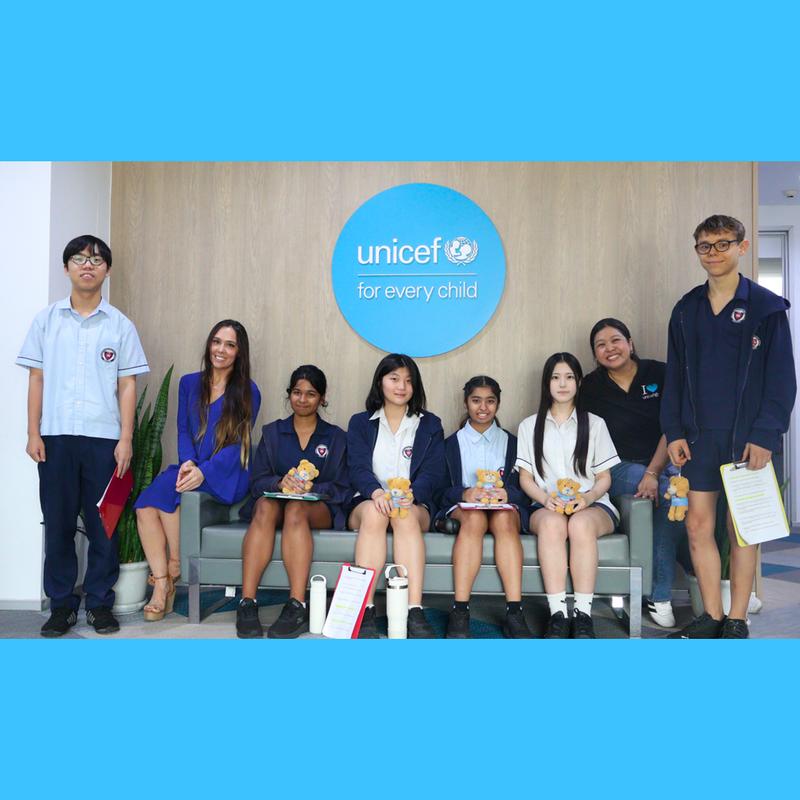
When students Sophia, Myra, and Rinny received recognition for Best in Enterprise, they carefully reflected on where their profits could create meaningful impact. Perhaps unsurprisingly, these students who spent months building a business around food became considerate to those for whom food is not guaranteed. After their discussion, the group chose to donate the profits to UNICEF Thailand, supporting children facing hardship and malnutrition, and hoping to create opportunities for children they may never meet, yet still feel connected to through the spirit of สามัคคี (Samakkhi) and Ubuntu: I am because we are.
Because here, students quickly learn that success is rarely achieved alone. It becomes strongest when shared.
Following AISB’s Enterprise Expo Day, students Alayna, Namo, and Oscar suggested donating remaining products from their snack business to the nannies, helpers, and support staff throughout the AISB community, the people who quietly contribute each day to the wellbeing and rhythm of school life. The gesture needed no announcement. It was simply น้ำใจ.
Moments like these revealed how naturally น้ำใจ and สามัคคี had become embedded within students’ thinking, and that meaningful leadership is measured not only through profit but through humility, awareness, and the willingness to uplift others.
Much of this growth has only been possible because of Thailand itself, the generosity of local communities and businesses, and the collaboration between diverse educators, families, and students from many cultures. I also credit the wisdom and leadership of AISB Secondary Director Michael Bryce for cultivating a culture where camaraderie, support, autonomy, and community engagement are led, where students are challenged not only to achieve academically, but to become globally minded, compassionate, responsible young people grounded in humility and service.
Across AISB Secondary, teachers help students engage with Bangkok in meaningful ways beyond classroom walls. In Global Perspectives, students connect with residents from Bangkok’s khlong communities while researching sustainability challenges. In drama and performing arts, students create authentic stories exploring the human experience through humor and reflection. Through music, students develop discipline, confidence, and collaborative grit. Across every homeroom, teachers nurture supportive relationships while guiding students with high expectations and genuine care.
AISB also recognizes the importance of preparing students for a future shaped by artificial intelligence, robotics, and automation, expanding opportunities in computer science, robotics, enterprise, and STEM to keep students adaptable and future ready.
Yet educators here recognize that as technology advances, deeply human qualities may become our greatest advantage. The human brain evolved for connection, creativity, problem solving, storytelling, and shared experience. Empathy, imagination, ethics, and humanity are not soft skills. As machines increasingly handle technical work, these human capacities may become our greatest advantage.
At a time when much of the world feels increasingly disconnected, Bangkok continues to offer something rare: a place where people from different cultures can collaborate, trust one another, grow together, and still lead with humanity. These are not positioned as soft skills, but as essential ones. They are the foundations that allow technical knowledge to be used wisely, and innovation to remain connected to human purpose. In this way, student learning becomes the central measure of progress. Not only what students know, but how they think, how they relate to others, and what they choose to do with what they have learned.
Looking ahead, AISB Secondary hopes to keep expanding student-led sustainability initiatives, entrepreneurial collaborations, and community partnerships throughout Bangkok — combining Thailand’s cultural wisdom with the global perspectives of an international community proud to call this city home.
Because ultimately, the most enduring lessons are rarely the ones planned for. They are the ones that emerge when students are given the space to connect learning with life — to see that success without generosity is just arithmetic, and that knowledge, without humanity, remains incomplete.
Tara Dunphy is an international educator, systems thinker and interdisciplinary learning advocate at the Australian International School Bangkok, where she teaches Year 7 and 8 Positive Relationships and Year 9 and 10 Cambridge International General Certificate of Secondary Education Enterprise. She also serves as a Model United Nations adviser. Her work focuses on helping students develop emotional intelligence, entrepreneurial thinking, global awareness and meaningful communication skills within diverse international learning environments. Drawing from experience in education, nonprofit leadership, operations and community development, Dunphy is particularly interested in how human behavior, culture, systems, technology and environments shape individual and collective well-being. She is passionate about student-centered learning, future-focused education and creating spaces where young people can think critically, collaborate authentically and develop confidence in their own perspectives.