"I think freedom, ideally, is being able to choose your responsibilities. It's not about not having any responsibilities, but being able to choose which things you want to be responsible for." - Toni Morrison, Nobel and Pulitzer Prize winning author
We talk a lot about student agency in schools. If we want deeper, more authentic engagement, we know we need to provide far more of it.
But what happens if we provide agency and freedom without purpose?
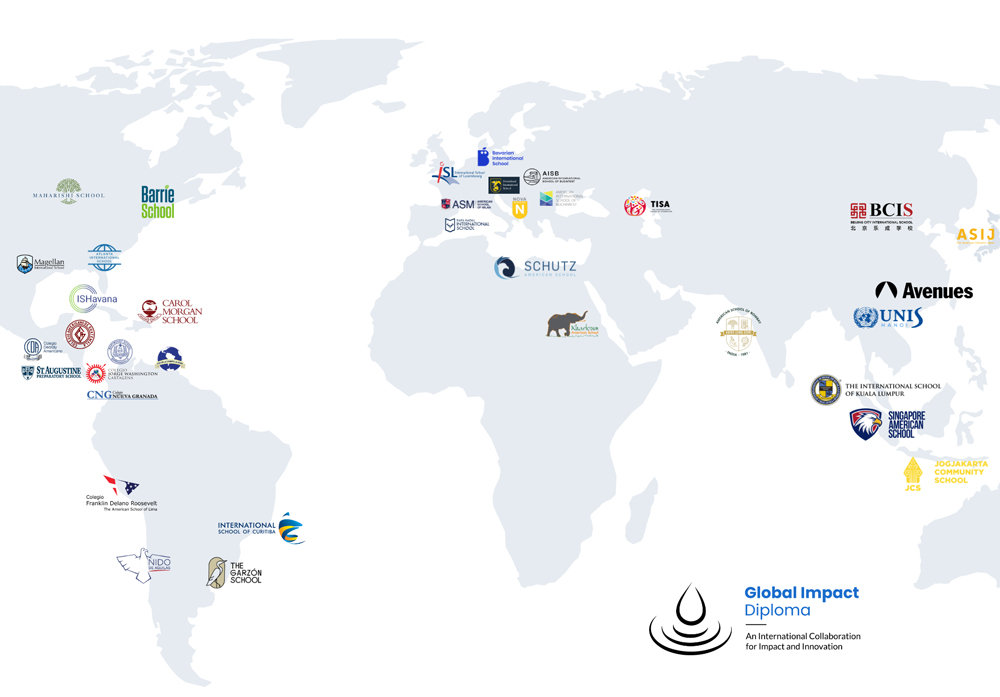
In designing the Global Impact Diploma (GID) over the last two years, these are the types of questions we have been wrestling with as a community. And we have learned countless lessons together this year as we launched it at more than 20 international schools.
One of the clearest and most powerful lessons is that agency is not the destination. Agency has become the starting point for something far more important: helping students explore who they are and how they want to contribute.
Abraham Maslow is famous for his hierarchy of needs. In the traditional pyramid, the highest level of human fulfillment is self-actualization. It turns out that Maslow was wrong, and he discovered this himself not long after surviving a heart attack later in his life. What he came to realize is that something else belongs at the top of the pyramid: self-transcendence (Kaufman, 2020).
We all want to grow and improve. But an even deeper need we all have is to serve something larger than ourselves. When we discover what that is, however big or small, we transform even more through that impact we have on others.
For years, our schools have rallied around being student-centered. In the GID, we recognize the need to give students more agency over their learning, and it’s one of our core design principles. But student-centered learning and self-actualization are not the core focus. In the GID, we work hard to keep impact at the center.
The core question for our students is not “What do I want to achieve?” Instead, the reframe is “What problems can we tackle?” And “How can we contribute?”
NUWA is a tangible example of this from the American School of Lima, Peru. They are a team of students in our GID Entrepreneurship for Impact course who have created a clothing business to raise awareness about and directly support the Shipibo artists in the Amazon.

This mindset extends far beyond our students as well. Across our GID Schools, we meet several times a semester in Communities of Practice to ask, “What can we build and test together?”
LESSON 2: Clarify the Waterline
How do you create shared alignment and global community without stifling autonomy and innovation?
This has been another beautiful tension in the GID. Early on, we developed language around what’s global (our shared purpose of impact, the six competencies, our five core courses) and what’s local (course rollout and timeline, the day-to-day lessons in the courses, how schools report on the competencies, etc.).
Midway through this first year, we stumbled upon an article in the MIT Sloan Management Review about the company that makes GORE-TEX. In How Gore Thrives with Zero Bosses, they talk about the idea of the waterline principle. The metaphor is simple: for things above the waterline, free people up to experiment and innovate and adapt! In the GID, this can mean empowering teachers to adapt aspects of the curriculum to their context. It can also mean entrusting schools to open up the courses to students in Grade 10 as well as Grades 11 and 12. For anything below the waterline, things that might sink the ship, we agree to go through deeper consultation together. Changes like adding new GID courses or updating the competencies take more time and review because of their impact on our schools.
Although there are times when this can get messy, this approach mirrors what Dan Coyle describes in his new book Flourish. An entire chapter is devoted to what he calls “The Rule of the Beautiful Mess.” They found that groups thrive when they have three things in common as they make their way through uncertainty together:
With our shared purpose, coupled with a high level of adaptability, we are able to serve a range of schools. GID Collaborating Schools start by launching one or two courses, and our GID Diploma Schools run all of the courses that are listed below.
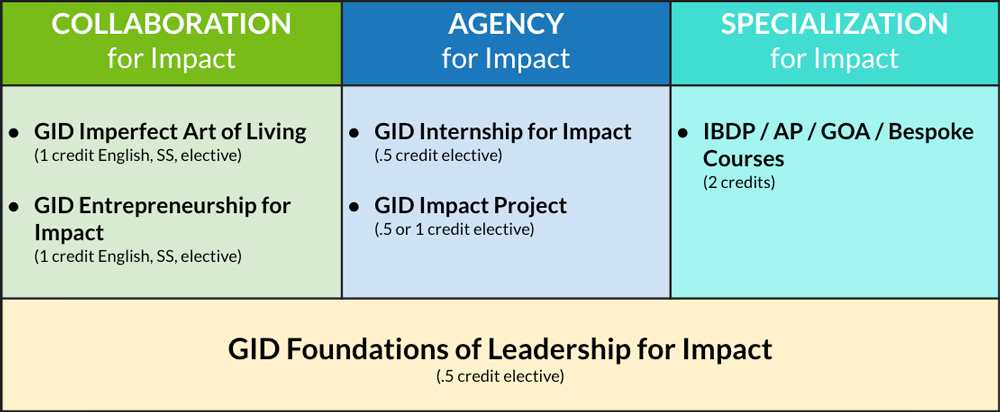
With this modular design, the GID has also combined well with the diverse programs and courses that our schools run (Advanced Placement, International Baccalaureate Diploma, Cambridge, Global Online Academy) and some of our schools are independent and design their own bespoke curriculum.
We are even working with the International Baccalaureate (IB) to pilot a collaborative diploma where students can start the IB Diploma and the Global Impact Diploma in Grade 10 in order to graduate with both. This year the American International School of Budapest has been testing this and next year two more schools will join (International School of Luxembourg and the American International School of Bucharest).
In a world that’s changing rapidly, keeping the waterline low and trusting our schools to innovate in their contexts is vital.
LESSON 3: Multiply Our Leaders
“Multipliers invoke each person’s unique intelligence and create an atmosphere of genius—innovation, productive effort, and collective intelligence.” - from Multipliers: How the Best Leaders Make Everyone Smarter by Liz Wiseman
When we gathered at AIS Budapest in May 2024 for the Pathways Summit, someone asked this question: how many of our schools actually have a leadership course?
Of the 90+ schools that were represented, only a few hands went up.
That was a pivotal moment for us, and over the next school year, a dedicated group of educators worked to change that. They designed and piloted a leadership course across five international schools that has now become our GID Foundations of Leadership for Impact course.
Our leadership course is now a core experience in the GID for students, and we are building a structure that multiplies and distributes leadership throughout our community. We frequently put out calls for contributors for projects that arise. Most of our GID trainings are co-taught by practicing teachers to ensure that, like the GID itself, professional development is created by our schools for our schools. Even our GID Summits are co-led by a range of educators from across our GID Schools.
And this distribution is not static.
For the 2026-2027 school year, student leaders will be embedded at every level of the GID organizational structure. Two students will be added to our GID Board, two more will intern with our GID Directors, and we will have a range of students contributing to our GID Project Leads team.
This design reflects a deeper lesson from this year: great leadership is often about learning how to follow. It means recognizing when others have stronger insight, when a different approach serves the group better, and when stepping back is the most responsible form of contribution. Ultimately, what we are hoping over time is that the idea of “leader” and “contributor” begin to merge. Everyone leads; everyone contributes.
What we are building through the GID is very much still evolving and we are constantly learning important lessons together. But there is also growing clarity that as we build this new diploma, we are also building a new global community: one where purpose is tied to real impact, clear systems connect us rather than constrain us, and leadership is practiced by all, not assigned to a few.
All of this is a reminder that meaningful changes in education do not happen in isolation. They come from creating conditions where students, educators, and schools can jam on something beautiful together.
References
Coyle, D. (2026). Flourish. Bantam.
Isaacs, K.W. (2205, July 31). How Gore thrives with zero bosses. MIT Sloan Management Review.
Kaufman, S. B. (2020). Transcend: The new science of self-actualization. TarcherPerigee.
Wiseman, L. (2010). Multipliers: How the best leaders make everyone smarter. HarperBusiness.Corey Topf is the Executive Director of the Global Impact Diploma and the Director of Global Pathways at the American International School of Budapest.
Joe Bonnici is the Director of Learning and Impact for the Global Impact Diploma and the Innovation Academy coordinator at the American School of Lima, Peru.
Global Impact Diploma website: https://www.globalimpactdiploma.org/
LinkedIn: https://www.linkedin.com/company/global-impact-diploma