

Schools do not lack data. They are drowning in it: strategic plans, accreditation reports, board papers, exam results, university destinations dashboards of all kinds, parent surveys, consultant frameworks, school improvement plans. In many schools, the problem is not access to information. The problem is that all this information too often produces little shared insight. It is more fog than focus. And when there is so much to see, it becomes harder to see what matters most.
A deceptively simple question still remains difficult to answer clearly and quickly: how healthy is the school?
That question is what drew me to the idea of a school APGAR score.
In 1952, Dr. Virginia Apgar gave doctors and nurses a simple way to assess a newborn child immediately after birth. It was not a full diagnosis. It did not pretend to predict the future. It simply focused attention on a few vital signs at the moment they mattered most. Its power lay in giving professionals a shared language for noticing what was strong, what was weak, and what required urgent attention.
I believe schools need something similar.
Not because schools are simple, quite the opposite. International schools, especially, are complex human systems: educational, financial, relational, cultural, and geopolitical all at once. Research on leadership in international schools has repeatedly pointed to complexity, frequent transitions, and fragile governance relationships, particularly between Heads and Boards. My own earlier work on headship longevity, and more recent work with Tristan Bunnell at the University of Bath, suggest both how difficult continuity and predictability can be to achieve and how much we still do not fully understand about why some schools remain stable while others do not.
This is precisely why a school APGAR score could be useful.
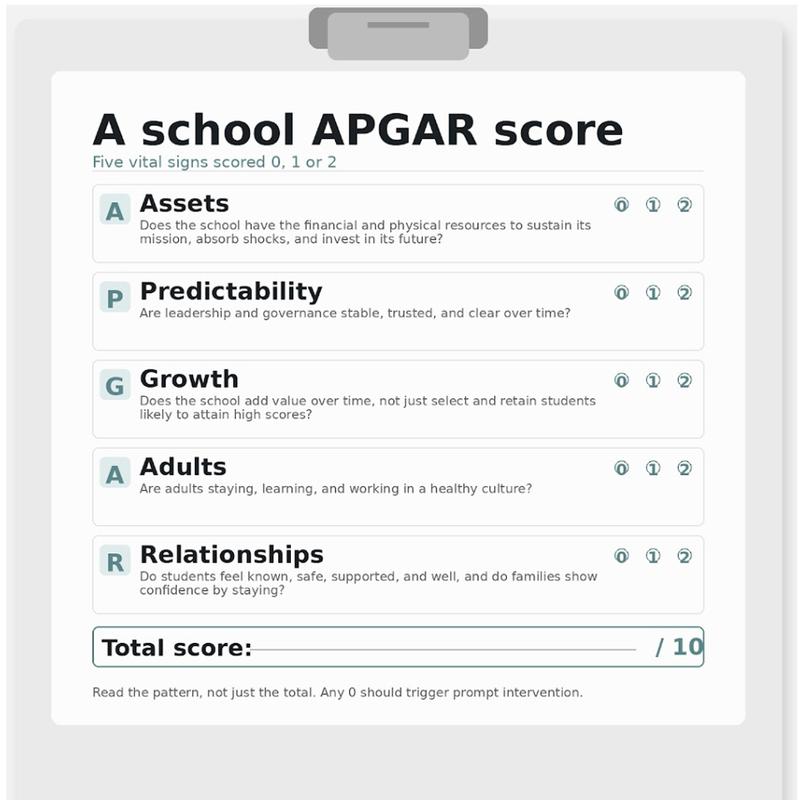
A school APGAR score would not be a ranking tool. It would not replace judgment, accreditation, strategy, or context. It would be a disciplined read of a school’s vital signs: a small number of indicators that Boards, Heads, and leadership teams could score simply, discuss honestly, and track over time. In the draft I am working on, those five signs are these: Assets, Predictability, Growth, Adults, and Relationships. Together, they ask whether the school has the assets to sustain its mission, whether leadership is stable and predictable, whether students are demonstrably growing, whether adults are working in a healthy culture, and whether students and families experience trust and belonging.
As with the original APGAR score, the point would lie less in the total than in the pattern: a single 0 in a vital area should trigger prompt attention.
The point is not to flatten the rich differences between schools. An International Baccalaureate school, a Montessori school, a proprietary school, and a not-for-profit school may differ profoundly in ethos and structure. But they all depend on some core conditions if they are to fulfill their mission well. Nor is the point to insult professional expertise by reducing leadership to a checklist. Good checklists do not do the thinking for professionals; they help them remember what is most important under pressure. Schools deserve that kind of discipline too.
So what might a school APGAR score actually do?
Used well, it could do three practical things. It could help a board and head see the same school through the same lens. It could surface emerging weakness before it hardens into crisis. And it could create a simple discipline for revisiting, over time, whether improvement efforts are actually strengthening the school’s core conditions.
No simple score will ever capture everything that matters in a school. It is not meant to. Its value would lie in creating a common language around the few conditions that matter most.
This, then, is an invitation, not a conclusion.
I do not see a school APGAR score as a finished product to be imposed on schools. I see it as a practical idea worth testing, challenging, and improving with others. What comes next should not be branding a new tool, but disciplined testing across a diversity of schools. I hope that a small number of schools are willing to pilot, critique, and refine the framework. If the idea proves useful, it should do so not as a proprietary tool, but as a shared professional resource for all of us working in international education.
David B. Hawley is a member of the UWC International Board and Chair of its Education Committee. A former Director General of the International School of Geneva and Chief Academic Officer of the International Baccalaureate, he also advises international school Heads and Boards through DBHawley Leading Together Consulting and continues his research on the longevity of international school Heads.