

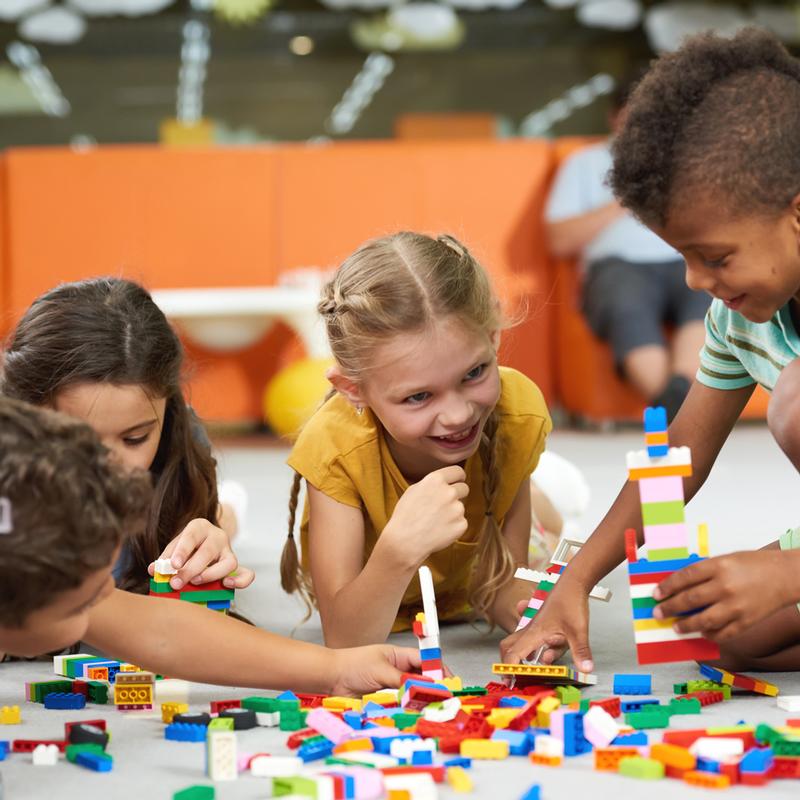
Years ago, while teaching Grade 2 at an international school in Europe, our Grade 2 teaching team designed a force and motion inquiry in which children built Rube Goldberg machines while families joined alongside them. As I moved through the hallway, I overheard two fathers talking to one another, half joking but half serious, wondering whether they might be allowed to keep building after the children were done. Their remark captured something larger. We often speak of play as something children need, yet adults are drawn to it too. Perhaps this is because play is not simply a childhood activity, but a human way of learning, creating, and making meaning.
That moment raised a larger question for me about how play is often understood in schools. In practice, conversations about play often center on children from birth to age five, even though early childhood extends through age eight. As children move from kindergarten into Grade 1 and beyond, opportunities for play may narrow just as its developmental value remains significant.
The issue is not whether children ages five to eight still need play. It is whether we recognize the evolving forms play takes in these years and intentionally make room for them in schools.
Children Do Not Outgrow Play. Their Play Transforms.
What may once have appeared primarily as dramatic or symbolic play can become more layered and connected to emerging interests. A child who once used a block as a pretend phone may later design a marble run, invent a board game, choreograph a dance, create comic books, experiment with recipes, or solve an engineering problem with others. Imaginative play does not necessarily disappear. It often expands into new forms (Whitebread, 2015).
These evolving forms of play can be seen in construction and design, drama and storytelling, cooking and food exploration, movement and sports, making and tinkering, music and creative composition, visual arts and design, and in the problem solving associated with STEM and STEAM learning. We may call these experiences inquiry, creative expression, or interdisciplinary learning, or even play-based practices, yet they often retain the same qualities that make play such a powerful context for learning: choice, imagination, experimentation, collaboration, joy, and multiple pathways for expression.
These forms of play offer children multiple ways to express understanding. A child may show thinking through building, drawing, movement, storytelling, or collaborative problem solving. Play can create room not only to practice skills, but to represent ideas in meaningful ways, including through language, symbolic representation, and emergent literacy practices linked to play (Kincaid et al., 2009).
Research on playful learning suggests these experiences are not separate from academic learning but can be contexts in which academic learning happens. Playful learning has been linked to collaboration, communication, critical thinking, and confidence (Hirsh-Pasek et al., 2020). Whitebread (2012) emphasizes play’s role in self-regulation and problem solving, while Fleer (2023) shows how imagination, empathy, and problem solving can work together in concept development.
As children’s play evolves, we do not always continue to name it as play. In many cases, schools may preserve these experiences but describe them in other ways. Once play is called engineering, inquiry, design, innovation, drama, movement and sports, or interdisciplinary inquiry, it is often viewed as legitimate. Yet recognizing these experiences as evolved forms of play matters, because imagination, creativity, physical engagement, and intellectual growth are not separate processes; they continue to develop together (Vygotsky, 1978).
What begins as play does not simply find expression in makerspaces, drama, technology, or inquiry. It may also become something more enduring: a passion, a vocation, or a way of knowing. The child building imaginary inventions may be rehearsing the habits of an engineer. The child creating comic books or illustrated stories may be discovering the beginnings of writing and visual storytelling. Play is not only preparation for future learning. It is often the earliest expression of future identity.
When Opportunities for Play Begin To Narrow
One place this can be seen is in the transition from kindergarten to Grade 1. What may disappear is not learning through play itself, but time for open-ended investigation, collaborative exploration, or the kind of “discovery time” many young children still need. While this transition brings important academic expectations, it can also bring reduced choice and fewer playful pathways for inquiry and expression.
The issue is not that Grade 1 should look like kindergarten. Rather, developmental progression does not require developmental discontinuity. This view aligns with research suggesting continuity in how children learn, even as the forms of play evolve (Hirsh-Pasek et al., 2020; Whitebread, 2012). Play at age six may involve greater collaboration, rulemaking, experimentation, narrative complexity, or sustained problem solving than it did at age four. The form changes, but the developmental value does not disappear.
Guided play research has pointed to evidence that children may learn deeply in thoughtfully designed playful contexts, challenging the assumption that direct instruction and play sit in opposition (Hirsh-Pasek et al., 2020). When play is reduced too quickly, we may unintentionally narrow conditions that support engagement, experimentation, and meaning making. Children may lose opportunities to engage deeply, take intellectual risks, and develop ownership over learning.
Recognizing and Protecting Evolved Forms of Play
For educators, the question may be less whether schools need to add these experiences, and more whether we intentionally recognize and protect them as part of children’s ongoing development through play. This may be through makerspaces, dramatic inquiry, playful literacy experiences, movement-rich learning, open-ended design challenges, or simply protecting “discovery time,” within the school day.
Perhaps this is why that moment with the two fathers has stayed with me. Play invites participation, drawing people into experimentation, problem solving, and shared joy, whether they are six years old or 60.
The years from five to eight matter in part because children have not moved beyond play but are often entering a period in which it becomes more social, more inventive, more strategic, and more connected to emerging interests. Yet these may be the ages when schools are most likely to narrow it.
The challenge is not simply to preserve play as something children do when academic work is finished. It is to recognize play as one way learning happens. When schools make room for construction and design, dramatic inquiry, movement and sports, cooking, and storytelling, they may be making space for some of play’s richest forms. Here, curiosity, problem solving, imagination, meaning making, and joy can develop together.
Perhaps the forgotten ages of play are only forgotten because we do not always notice how play evolves. Once we begin to see its changing forms, we may also begin to protect not only play itself, but the passions, pursuits, and possibilities that may begin there.
And perhaps those two fathers were reminding me of something else as well: we do not really outgrow play. It continues to shape how we learn, create, and make meaning.
References
Fleer, M. (2023). The role of imagination in science education in the early years under the conditions of a Conceptual PlayWorld. Learning, Culture and Social Interaction, 42, 100753.
Hirsh-Pasek, K., Zosh, J. M., Golinkoff, R. M., Gray, J. H., Robb, M. B., & Kaufman, J. (2020). A new path to education reform: Playful learning promotes 21st-century skills in schools and beyond. Brookings Institution.
Kincaid, E., Liu, Y., & Yin, J. (2009). The role of play and emergent literacy in the young child. Reading Improvement, 46(2), 86–93.
Vygotsky, L. S. (1978). Mind in society: The development of higher psychological processes. Harvard University Press.
Whitebread, D. (2012). The importance of play. University of Cambridge, Centre for Research on Play in Education, Development and Learning.
Whitebread, D. (2015, November 9). Why make-believe play is an important part of childhood development. The Conversation.
Bree Kraft is a lower elementary and early childhood educator with 22 years of teaching experience, including 18 years in international schools. She is currently teaching at Colegio Maya, Guatemala and will be moving to Tashkent International School, Uzbekistan next year. Originally from California, she believes children have a deep desire to learn and that play is a fundamental way learning takes shape.