
Four key elements informed our experience: inclusion, collaboration, agency, and professional learning. These elements ensured that accreditation was not something done to the school or for the school, but a process done by the school.
Inclusion: A Design Principle, Not an Aspiration
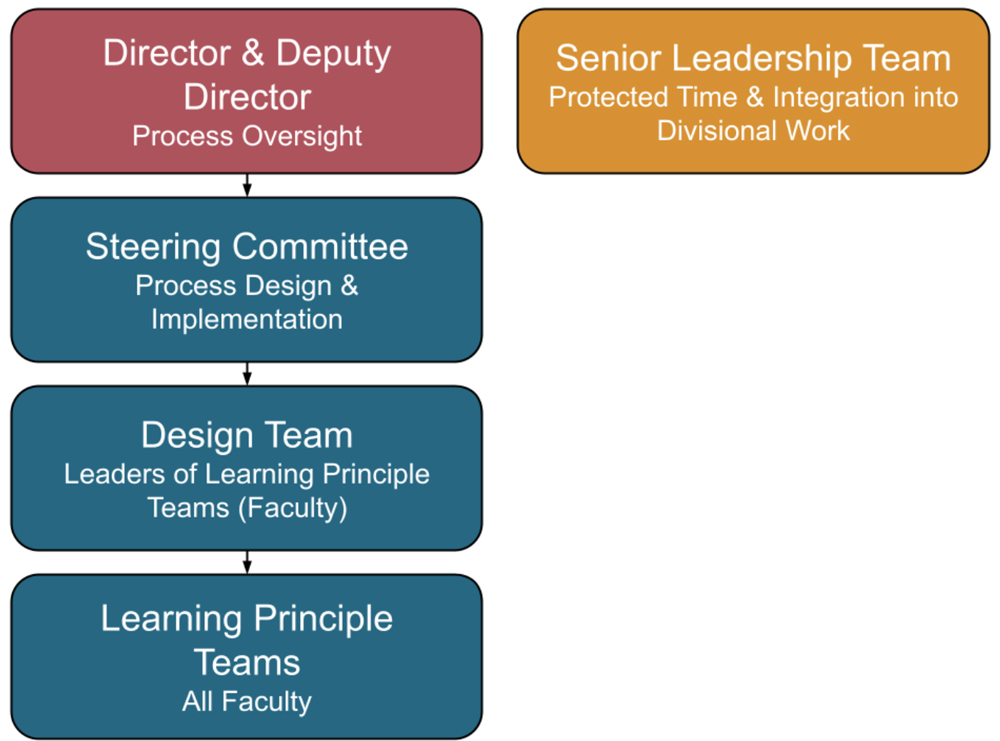
The first of these elements, inclusion, was intentionally planned throughout the entire NEASC process. Because the core of the work was built around our learning principle teams, efforts were made to ensure every faculty and staff member could choose the learning principle they most wanted to engage with. Participation was a collective expectation. Within these teams, colleagues engaged with data, developed learning stories, proposed ratings, and contributed directly to the sections of the self-study report connected to their learning principle. In short, the people closest to the learning were the ones shaping how that learning was described and evaluated.
To support this work, we established design teams composed of volunteer faculty leaders. Design team leaders worked in pairs or trios, and took responsibility for one learning principle group, working closely with the steering committee to plan, facilitate, and guide the work. They coordinated meetings, supported colleagues in making sense of the data, and ultimately submitted a draft of their group’s report to the steering committee. The intent was clear: teaching faculty should be at the heart of the process.
Behind the scenes, the steering committee provided oversight. This team was made up of the Deputy Director, Assistant Principals, two instructional coaches, and the educational data and technology coordinator. Together, they designed the structure and flow of the learning principle sessions, facilitated the design team meetings, and consolidated the reports and recommendations emerging from each group. Their role was to make high-quality thinking possible—curating resources, creating tools, and shaping the many inputs into a coherent draft of the final report.
At the highest level, the Director and Deputy Director ensured alignment with NEASC expectations and timelines, liaised with NEASC, and took responsibility for submitting the final report and organizing the visiting team experience. The senior leadership team (SLT) supported the process by protecting time, integrating the learning principles into divisional work, and ensuring that the outcomes of NEASC could be connected to the strategic framework. This alignment allowed the learning principle teams and design teams to work with clarity and purpose.
Inclusion, therefore, was both structural and cultural: roles and responsibilities were intentionally designed so every employee could see themselves in the work and understand why their contribution mattered.
Inclusion Through Evidence: Building a Shared Picture of Reality
A second element of inclusion was reflected in how we approached evidence. To gain an honest, representative picture of our current reality, we drew on a broad and varied data set rather than relying on a single survey. NEASC provided student, parent, faculty, and leadership surveys. We supplemented these with existing internal sources: employee voice surveys, student social-emotional learning data, and wider community surveys. In total, we worked with more than 3,000 data points.
However, collecting data was only the beginning. We were explicit about how data would be processed and used. We distinguished quantitative from qualitative sources, documented steps in our analysis, and shared this process with faculty and other groups engaged in the work. Everyone had access to the full data set, and we were intentional about how we brought it into different conversations, aiming to offer targeted slices at the right time to support focus while maintaining visibility of the bigger picture.
Visualization played an essential role. We invested time in designing visualizations that were accurate and easy to interpret. The goal was not to present numbers but to reveal patterns, tensions, and questions that could spark thoughtful discussion.
Alongside this, we used a common data dialogue protocol for every group—from learning principle teams to the steering committee, SLT, and the Board. The common sequence (predictions, observations, inferences, implications) grounded discussions and supported participants in using data to draw conclusions. This process supported meaning-making that was inclusive, transparent, and focused.
Several themes emerged through the data analysis that informed the new strategic framework, particularly around inclusion and challenge and the development of a coherent learning experience from early childhood through grade 12. Incorporating these insights into strategic priority-setting and operational planning further strengthened the ties between the NEASC reaccreditation and the strategic framework process.
Collaboration: Co-Construction Rather Than Compliance
If inclusion describes who was involved and how, collaboration describes the way the work evolved. Collaboration was not simply a coordinated activity; it was the continual refinement of the process in response to faculty experience.
After each round of sessions—whether at the learning principle or design team level—we listened to feedback about what worked and what needed adjustment. One early example illustrates this well. As teams began drafting learning stories, colleagues asked for more clarity: What exactly was a learning story? How detailed should it be? What counts as evidence? The steering committee responded by defining expectations more clearly, creating samples, articulating criteria, and adjusting timelines. The impact was immediate: improved products, greater alignment, and a stronger sense of shared ownership.
In this way, collaboration became an iterative process, one in which participants not only followed a plan but also shaped it.
Agency: Designing for Leadership at Every Level
A defining feature of our accreditation process was the intentional embedding of agency at every layer of the organization. Rather than positioning leadership as the primary driver, we structured the work so ownership and decision-making rested with the people closest to learning.
The SLT intentionally created the conditions for others to lead. Their contribution was not to direct the work but to make leadership by others possible—protecting time, clarifying purposes, removing barriers, and signaling trust in faculty and operational staff. By stepping back, they created the space for design team leaders, the steering committee, and learning principle teams to step forward with confidence and ownership.
Within this structure, a subset of the steering committee, led by the Deputy Director, held significant design agency. This “small steering committee” crafted the architecture of the process: the flow, sequence, structures, and moments for employee voice. They modeled a “split-screen” approach, making visible both facilitation and design decisions. The trust placed in this group was deeply motivating, but also carried weight, as committee members understood that their decisions shaped the experience of all participants.
Design team leaders exemplified leadership in action. They facilitated dialogue, guided meaning-making, helped colleagues select evidence, and adapted strategies to meet the needs of their groups. They curated learning stories, synthesized insights into draft reports, and served as vital connectors between faculty and the steering committee. Leaders navigated moments of uncertainty, yet consistently stepped forward with integrity and care.
Faculty and operational employees also experienced meaningful agency. They chose their learning principle, brought diverse perspectives, shaped the evidence base, and articulated connections between their findings and the strategic framework. Many expressed gratitude for the trust placed in them and the opportunity to contribute authentically.
Across all groups, agency was not simply distributed; it was experienced. Trust created a sense of shared purpose, elevated the quality of the work, and strengthened collective efficacy.
Professional Learning: A Multi-Layered Ecosystem
Professional learning emerged as a powerful element of the process. From the outset, learning was intentionally designed across multiple tracks, ensuring coherence while honoring the unique needs of different groups.
Learning Across Multiple Tracks
All employees engaged in content-level learning about school improvement. Meanwhile:
Reflective questions and feedback loops allowed for learning to be readily applied, strengthening trust and improving effectiveness.
Intentional Development for Design Team Leaders
The most deliberate learning design centered on design team leaders. Before facilitating, they experienced the session as participants. They then stepped back to analyze facilitation moves—what was used, why it worked, and how they might adapt it. This cycle (experience → analyze → adapt) built confidence and skill. Their reflections highlight the impact of this approach:
“The fact that we went through the meeting ourselves before we facilitated it, made everything easier. It made me clarify the things I was unsure about and then make sure the people didn't have those questions as we went through the process again.”
“The step-by-step examples helped guide us through the process, making it easier to break things down and implement effectively.”
“The authentic learning practice is always helpful, the detailed slideshow, agenda timings and cues for facilitation made the job so easy.”
Adaptive Schools as a Through Line
The Adaptive Schools framework became a central anchor for our work, and its timing could not have been better. Several steering committee members had completed the training just as NEASC planning began, allowing the strategies, norms, and stances they brought to immediately strengthen collaboration and elevate dialogue.
Because Adaptive Schools is being rolled out gradually at ZIS, the NEASC process offered many faculty an early, authentic experience with its tools before participating in formal training later in the year. This mirrored a core design pattern in our process—participants first experiencing a structure, then later analyzing and applying it as facilitators.
This sequence created a shared language for working together and reinforced Adaptive Schools as a practical “how” for collaborative inquiry at ZIS.
A Replicable Model for Future Work
Perhaps most importantly, the structures developed for NEASC are now informing future schoolwide initiatives, including current projects focused on time and space. The intentional design principles that shaped the accreditation process—inclusion, collaboration, agency, and professional learning—have become a blueprint for how we approach organizational growth.
The recent effort to redesign the school schedule serves as an example of this integrated approach. Modeled on the NEASC process structure, the faculty group’s work responded directly to findings from the learning principle teams regarding student workload balance, instructional time use, and collaboration patterns. By mirroring the accreditation process, the group ensured that agency and professional learning remained central; they gathered voices from across the community—teachers, students, and parents—to analyze data and iterate on multiple prototypes. This collaborative cycle allowed for thoughtful interpretation and refined ideas, moving the work forward with both integrity and clarity.
Living in a Moment of Change, and Possibility
The evidence and conclusions gathered through the accreditation process directly informed our strategic priorities and implementation roadmap. As a result of integrating these two processes, many aspects of ZIS are evolving: our identity and commitments, our values, the skills we expect educators to develop, the ways we collaborate, and the clarity with which we define who we are. This level of change can feel daunting. We are in the messy middle of a change cycle—a moment when many shifts are underway, and the future is still taking shape.
Yet it is also an energizing moment to be at ZIS. When we imagine the full realization of our strategic initiatives a few years from now, we see a school that lives its vision: a hub of exceptional teaching, learning, and leading, where every student experiences a coherent, empowering learning journey from early childhood through grade 12.
Katherine Deutsch is an instructional coach at ZIS who enjoys designing meaningful adult learning and building collaborative cultures. She has been an international educator for 21 years.
Kim Bentley is a ZIS instructional coach at Zurich International School and an agency trainer for Cognitive Coaching. A 26-year veteran educator, she specializes in fostering self-directedness.
Will Kirkwood is the schoolwide leader of innovation for learning at Zurich International School. He has spent over 20 years as an international educator driving pedagogical growth.