

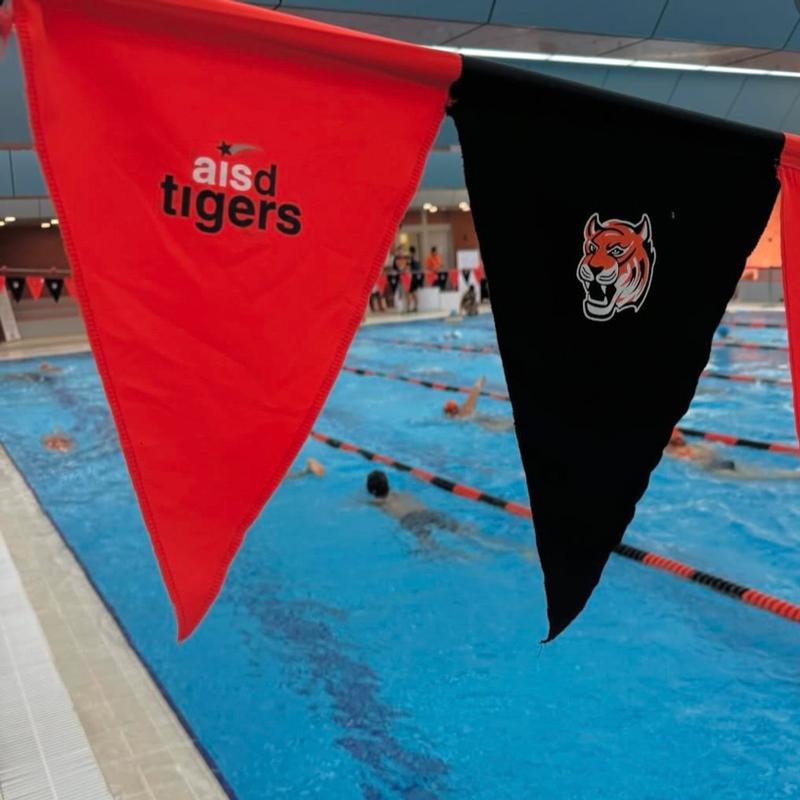
Teachers often “wear many hats,” taking on multiple roles throughout their careers, from classroom counselor and friendship mediator to academic advisor as they support students in countless ways. In international schools, some of these roles extend beyond the classroom into sports, where teachers coach student-athletes both on and off the field. While many high-impact teaching strategies are well-known for boosting academic performance, these same approaches can also be applied in athletics to enhance student-athlete development and foster a positive team and sport parent culture. In this two-part series, I explore how centering student voice, designing intentional practice, and setting clear objectives laid the foundation for change (Part 1), followed by how actionable feedback, shared learning, and strengthened communication with families helped transform both performance and team culture (Part 2).
My first season coaching swimming at the American International School Dhaka (AISD) started like many other seasons of coaching. I had to get to know the style of the head coach, who is a local Bangladeshi swim instructor and has worked at the school for over 35 years. I had to learn his style of teaching and communicating, learn about the kids, the swim rules and expectations of the South Asian Inter-Scholastic Association (SAISA) sports organization the school is a part of, and get kids ready for a high-level competition swim meet and do it all in eight weeks. Sounds like a challenge in and of itself. But throw in moving to a new country, a political revolution, and starting school online rather than the intended in-person as we expected, and the task became daunting indeed.
That first year remains unforgettable for many reasons, one being the experience of a “typical” swim team culture, complete with intensely passionate parents who fiercely advocate for their children. As the season progressed, it became apparent that focusing on personal bests, while valuable, did not fully reflect the expectations of our swimmers or their families. Following the season, swimmers and families shared that their children were hoping for more consistent, individualized feedback and coaching to help them grow. Although coaches provided verbal guidance in the moment on the pool deck, much of this feedback was not seen or heard by families, and many swimmers had difficulty remembering or applying it once practice ended, creating a disconnect between what was offered and what was actually experienced. Many swimmers were also placing significant emphasis on podium results, sometimes overshadowing the celebration of their own progress. Although our athletes showed tremendous heart and effort, there was a shared sense that the team had more potential to tap into. It was clear that some adjustments could strengthen both performance and the overall experience. The question then became: how might we best begin that improvement journey together?
As an educator with over two decades of classroom teaching experience, I decided to lean into my knowledge of pedagogy in the classroom and look at how I could bring that understanding and experience into the pool. We looked at our “why” and “how” and created a program handbook to help parents and swimmers understand the training schedule, team selection, and how practices were set up. Then we dug deeper and decided making some changes involving high-impact instructional teaching strategies would be our next steps forwards.
Starting With Student Voice
As an educator, one of the high-impact instructional strategies that I have used in my classroom and that is highlighted in Jim Knight’s book High Impact Instruction: A Framework for Great Teaching is the use of student surveys to learn not just about what students like, but how they approach learning and improving in the sport. A common practice in team sports at AISD is giving introduction surveys at the start of the season to help coaches get to know their athletes. At the start of the season, we sent out the survey to our swimmers inquiring about why they chose to participate in the swim team, what goals they had for the season, and how they best received coaching and feedback. Although this has long been a common practice across all team sports at our school, we realized that truly listening to what our swimmers were telling us, and adjusting based on their feedback, could better guide our own efforts to improve the overall swim program experience. We learned a lot about our students not just as swimmers, but as kids. One high school student wrote, “My favorite thing about this team is our positive attitude and mindset and our ability to make the best out of a bad situation. I'm looking forward to supporting this team in reaching new heights in all aspects this year.” From the survey, we found that while some student-athletes clearly understood how they wanted to receive feedback saying, “I like to be coached in a way that tells me clearly what to do, so that I know exactly how to improve”, others were still figuring out what that might look like in a sports setting. One middle school student wrote, “I would like to be coached with patience and an understanding environment. And I prefer not getting yelled at.” This insight into how our swimmers approached the sport helped us reflect and adapt our coaching methods. We also gained a better understanding of the goals they set for themselves. Some focused on specific times, while others centered on enjoying the team experience. One student shared, “A personal goal I have is getting 35 seconds in 50 meter freestyle.” A high school swimmer added, “My personal goal is to reach sub 30 seconds in 50 freestyle this year.” And a 13-year-old middle schooler wrote, “My personal goal is to become the best version of myself and to beat my PBs.”
Our athletes had clear intentions and aspirations for the season, and as coaches, we aimed to build on those goals, emphasizing personal bests and the ongoing journey of personal growth. We had goals to not only help our swimmers achieve theirs, but to help make positive changes in our team culture and dynamics, reset the vision for our program, and get everyone on board with the idea of personal bests and growth mindset in sports.
Designing Intentional Practice Sessions
We started small and looked at how our practices were structured and how we could put into place some additional high-impact instructional strategies keeping in mind what Peter Senge explains as “Small, well-focused actions can sometimes produce significant, enduring improvements, if they’re in the right place” (Senge 1990 p.114). The first area we focused on for high-impact changes was our practice schedule. Previously, our week consisted of two evening practices, two early morning sessions, and a shorter Saturday practice. Although our practice days and times were set to accommodate multiple sports’ schedules, we wanted to examine the structure of our sessions more closely. Our goal was to make small adjustments using high-impact instructional strategies to enhance the existing framework, with the hope of positively influencing both team culture and swimmer development. We decided to extend our practice on Saturdays and to dedicate that practice to time trials and swim meet simulations. This would help our swimmers get used to the “controlled chaos” that swim meets tend to be and expose them to a manageable amount of healthy stress to help prepare them for competition.
Rather than simply repeating last year’s structure, we decided to initiate high-impact planning into our season plan. We created guided objectives to introduce and expand on each stroke with an outline map for our eight-week season and made each practice session more intentional by aligning it with a specific stroke and skill focus. We then outlined clear objectives at each practice that would be built on throughout the week. These clear learning targets helped our swimmers understand our goals for each practice session (Chappius 2009). The objective was spoken about before each practice to help remind our swimmers what our focus was on for the day’s practice session and how the drills were designed to specifically improve on that stroke. Swimmers would then demonstrate their learning and growth in a time trial utilizing that stroke during the Saturday session. At the start of each session, we shared the objective and explained how it would connect to our Saturday time trials. Swimmers knew exactly what we were doing and how they would be able to track their improvements. Each two-day block was devoted to a particular skill or stroke, with targeted drills designed to strengthen that focus. The recorded times from our weekly time trials then served as our main measure of progress. This purposeful structure became the foundation of our training program for the season that shaped not only our team progress but our team culture and a wider sense of belonging that our students were feeling as the season went on.
By the midpoint of the season, we had successfully introduced high-impact teaching strategies into our swim program. The combination of understanding student voice, designing intentional practice sessions, and setting clear objectives created a framework that allowed swimmers to track their own growth. Coaches began to notice early signs of improvement in both performance and engagement, and students started connecting with the purpose behind each session. These foundational changes set the stage for Part 2: integrating actionable feedback, shared learning, and parent communication, critical steps that would fully transform the team culture and swim program.
References
Dr. Christi Chase is head of student support services and an elementary learning specialist at the American International School Dhaka in Dhaka, Bangladesh, where she also serves as a swim coach and swim team manager. She previously taught and led programs at the American School of São Paulo in São Paulo, Brazil, and the Shanghai Community International School in Shanghai, China, coordinating student support services and chairing elementary science initiatives. Her work focuses on building inclusive student support systems, implementing tiered academic and behavioral interventions, and coaching educators to strengthen instructional practice. She is passionate about supporting diverse learners and fostering student growth both in and out of the classroom.