
What happens when curiosity becomes the starting point for learning, and creation becomes the pathway to understanding?
When I was preparing to become an educator, I was deeply influenced by the Brazilian writer and philosopher Rubem Alves, who once wrote that ”curiosity is an itch in the ideas.” Years later, when I became a teacher and the head of the upper school design and technology department, that idea guided the refinement of the elective curriculum under my responsibility. Elective courses offer many benefits: they connect students with practice, with a research environment, and with transdisciplinary projects. Curiosity becomes the entry point. Questioning follows naturally and opens space for meaningful learning.
At the beginning of this century, the Maker Movement gained visibility through the democratization of digital tools. As learning by doing became more evident, educators revisited the ideas of Seymour Papert, who argued decades earlier that "knowledge is constructed, not transmitted.” He suggested that understanding deepens when learners create, whether writing a poem to grasp poetic structure or building with lego gears to understand mechanics.
With this perspective, I designed an elective course called Flight and Design. Its purpose is to foster curiosity and engagement while strengthening conceptual understanding of ideas traditionally explored in science and mathematics.
Learning Flight by Making It Fly
Science and mathematics often appear abstract when encountered only through formulas and definitions. Concepts such as forces, equilibrium, or system interaction can feel distant from lived experience. The science of flight, frequently introduced through equations, illustrates this challenge.
What if we reverse the order?
Instead of beginning with theory and moving toward application, students begin with experimentation. Trial and error becomes the engine of learning. The long human fascination with flight, from myth to modern aviation, becomes the starting point for disciplined inquiry.
In this course, students do not memorize forces before launching rockets. They launch first. They do not define stability in advance. They experience instability and seek explanations for it. Concepts emerge as tools to interpret observable phenomena.
The course is part of a broader Design and Technology pathway that positions students as active agents in their learning. The guiding principle is simple: doing becomes the pathway to understanding. Data collection structures curiosity. Science and mathematics enter the process when students need explanatory frameworks.
Process
Each unit follows a structured design cycle: brainstorm, define, make, test, reflect and transfer.
This structure prevents prototyping from becoming superficial activity. Making becomes disciplined investigation. This sequence ensures that hands-on activity remains analytical. Students generate ideas, establish constraints, construct prototypes, collect performance data, analyze results and apply insights to new contexts.
Unit 1: Aerospace Fundamentals and Flight Stability
This unit introduces causation, balance and structural form through experimentation.
Students begin with straw rockets inspired by NASA K–12 materials. By modifying nose length and observing trajectory changes, they encounter oblique launch as a physical reality before seeing it expressed mathematically. They measure distance and angle, record data, and search for patterns. Cause and effect becomes visible.
Next, they use OpenRocket to simulate compressed air rockets. Digital modeling allows exploration of center of gravity, center of pressure and stability. Simulation refines understanding but builds on prior physical prototyping.
The digital model then becomes a real rocket. Using paper and cardboard fins, students construct models and launch them from launchers they created. Some tests occur without fins, making instability immediate and instructive.
Guided investigation leads students to locate the center of gravity and estimate the center of pressure. The four forces of flight, lift, weight, drag, and thrust are introduced as explanatory evidence for what they have already observed. Launch data is organized into tables and graphs. Measurement transforms experimentation into organized inquiry. Balance and equilibrium become operational necessities rather than abstract vocabulary.
The unit culminates with PET bottle rockets powered by pressurized water. Students must transfer prior understanding to prototypes with greater range and higher structural demands. Design decisions about mass distribution and form now carry amplified consequences.
Unit 2: From Mechanical Stability to Systems Thinking
This unit expands both technical challenges and conceptual understanding. While the first unit centers on static stability, the second introduces propulsion, interdependence, and system behavior.
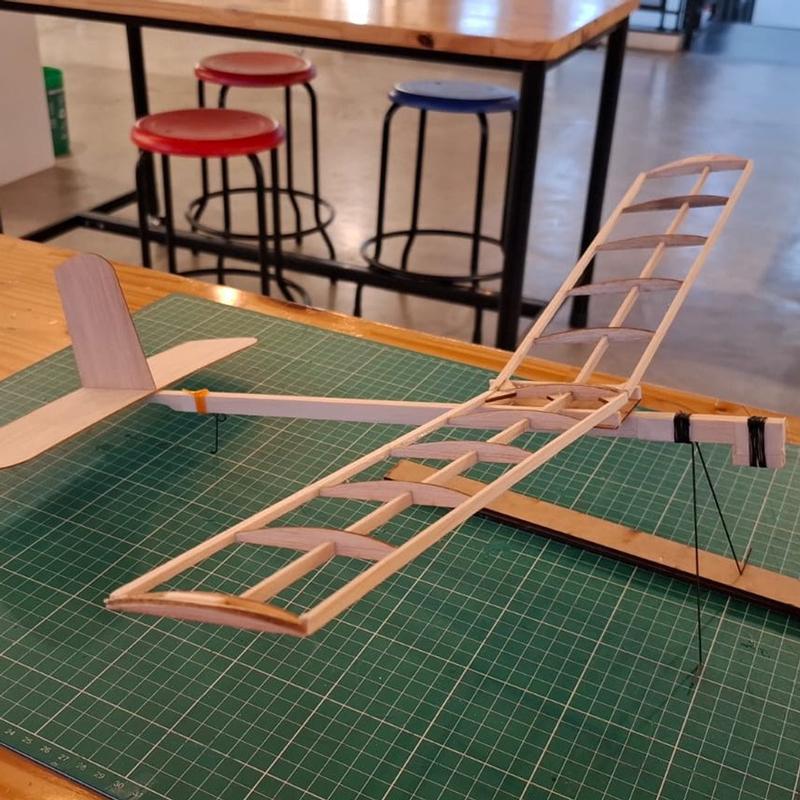
Students prototype paper gliders before progressing to rubber band powered aircraft. Initial paper models reinforce aerodynamic principles. Later, a low cost motor system introduces propulsion and control. Laser cut components, wing ribs, and structural covering require careful material choices. Wing geometry, mass distribution, and structural integrity become correlated decisions. Earlier concepts return in more dynamic form. Stability is no longer fixed; it responds to motion and propulsion.
Flight is reframed as a system of interacting variables rather than a single mechanical event. The result depends on revisiting previous concepts learned.
Unit 3: The Importance of Real World Applications - Unmanned Aerial Vehicles
The last unit expands the science of flight concepts to a community-based approach through drones. The accessible DJI Neo drones are used as a tool to help students learn about the four forces of flight applied to Unmanned Aerial Vehicles (UAVs). This resource is becoming increasingly popular, and the implementation of drones in school classes helps students learn not only about science, but also about responsible use, ethics, and local laws. It also creates opportunities for educators to discuss real-world applications such as public and private security, delivery services, and the promotion of public spaces.
What This Experience Reveals
Several insights emerge from this approach.
1. Physical experience clarifies abstraction. A spiraling rocket communicates imbalance more effectively than a diagram.
2. Simulation gains meaning when grounded in construction. Digital modeling becomes purposeful after encountering physical limitations.
3. Data legitimizes curiosity. Tables and graphs function as interpretative tools rather than isolated assignments.
4. Transfer consolidates understanding. Moving from straw rockets to bottle rockets, from gliders to motorized aircraft and drones, requires generalization of principles.
When students build, test, and reflect, theoretical concepts become necessary tools for observable behavior. Causation, balance and systems thinking shift from definitions to analytical tools. In this model, doing is not separate from learning. It is the way through which understanding develops. Flight becomes more than a topic. It becomes a context in which learners connect science, reasoning and design.
As they design, simulate, and launch rockets, construct aeromodels or pilot drones, learners make decisions about structure, stability, and material use, analyzing performance data to refine their solutions. Through this process, they experience how engineering concepts translate into functional systems.
Charles Pimentel is a design and technology educator at Graded – The American School of São Paulo and a PhD candidate at the Federal University of Rio de Janeiro (UFRJ). He is also a research fellow at the Transformative Learning Technologies Lab (TLTL), where he investigates the use of sensors and microcontrollers in schools through IoT applications to support data literacy. His work explores how technology can be a tool for social impact and student empowerment in K–12 education.