
Like clockwork, every session I facilitate with educators is kicked off with our school’s mission and vision slide. I create space and make a personal and direct connection to why our mission matters to us as a community, the students we serve, and our greater purpose as a school community. It is one of the most important things I can do as a leader, as I firmly believe in being rooted in who we are, which a strong mission should encapsulate.
However, I haven’t always valued mission statements as I do now. It wasn’t until a few years back working with a mentor in the region, where I was forced to articulate what ways my work connects to the schools’ mission. While I understood the importance of such statements, the mission felt passive and in the background. My mentor challenged me and gave me a mission: find ways that you are connecting to the school’s mission and articulate that in the work that you do.
This led me to a path of intentionally finding ways our mission statement is alive in our work. I had to be intentional in connecting my work, not just to our strategic direction, but to who we are as a community. My mission had to be more than a slide in a presentation. It needed to be a connection to the community. This required taking time to reconnect with our institutions’ mission, which represents the collective voice of our stakeholders.
As a result, taking a moment to read the mission together, connecting to an aspect of the mission, and offering up space for participants to do the same thing, is now a core part of my practice. However, more recently, I have pushed myself to think about what our mission and vision says about our particular school? What ways is our mission unique to our community, and what ways does it need to be further tailored to our context?
Working at an international school in China, I sought to further understand what about our school’s vision makes us, us, compared to other schools around China. I compiled a list of ten mission statements from international schools around China, including the one I work at, to better understand themes and commonalities in our values. This led to the creation of the word cloud below, highlighting words that are more prominent in our collective mission statements:
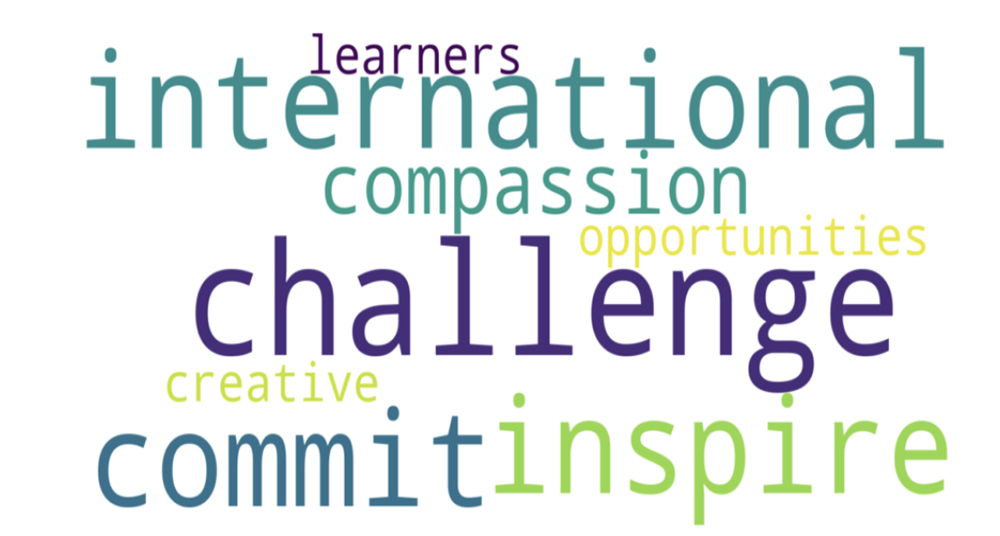
Top eight most common words seen in mission statements of international schools in China. More commonly represented words are larger. (Photo source: Christian Polizzi)
Surprisingly, two ideas that I often connect with, challenge, and commit, were featured prominently in the schools’ visions. What ways do international educators live out these visions and what do they say about us? I have challenged myself to more clearly articulate how these words better convey who we are.
I decided I wanted to zoom out further. As a community of international educators, we are shaped by the greater community we serve. Much like we grow and mold young minds, we are shaped by our experiences in different school communities. While the school I work at is a part of the East Asia Regional Council of Schools (EARCOS) network, I have started my international teaching career at a school in the Central and Eastern European School Association (CEESA) network. I pulled 10 missions from schools in EARCOS and CEESA to reflect on what values these learning communities have instilled in me as an educator. Here's what I found:
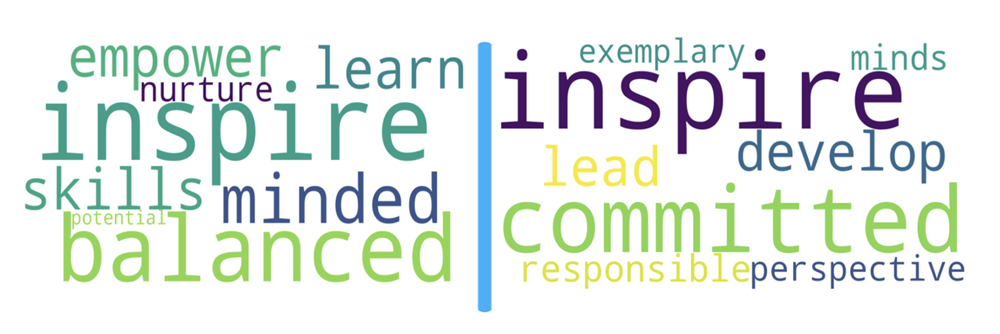
When we look closely at the mission and vision statements of international schools around the world, we begin to see that as educators we have high aspirations for our communities. The language of compassion, responsibility, leadership, balance, growth, and global citizenship shapes not only what we teach, but how we teach and why we show up each day. These words influence the expectations we hold for students, the learning experiences we design, and the ways we build community in our classrooms.
When the mission is part of the ethos of the community, the mission language will seep into our professional identity. We become nurturers of potential, cultivators of curiosity, and guides for young people learning to live meaningfully in an interconnected world. If these statements truly define our schools, then they must also define our practice. Let’s commit to making the values we promote visible in our daily choices, in the questions we ask, the relationships we build, and the opportunities we create for students to grow not only as learners, but as humans who can contribute with empathy, courage, and purpose.
Christian Polizzi is currently the head of school wide literacy initiatives at the International School of Beijing. Christian has experience as a director of curriculum, instructional coach, and teaching English language arts, social studies, and special education in both public schools and private international schools. Christian is continuously seeking ways to provide support and equitable access to education for all students across the globe.