

As a thought-experiment recently, I put myself in the shoes of a high school modern world history teacher who has just wrapped up a unit on WWI and plans to do a lesson or two on the League of Nations as part of an inter-war unit. Out of curiosity, I went to ChatGPT (version 5.2) and inputted the following prompt:
I'm teaching modern world history to 10th grade students. We've just finished up learning about WWI and the Treaty of Versailles and we're now turning our attention to the inter-war period. I want to do a lesson on the League of Nations, focusing on both its successes and its failures. Can you put together a 75-minute lesson for this topic?
The result from this prompt was impressive. Within a few seconds, ChatGPT provided me with a detailed lesson script, including lesson objectives, an essential question, a list of needed materials, mini-lecture notes, an activity for students to explore cases of success and failure, some discussion prompts, an exit ticket question, ideas for extending the lesson, and strategies for student differentiation.
Given the heavy workload of teachers in many schools, I understand the temptation to do what I just did. I’ve been there on a Sunday evening, sitting down in front of my computer, feeling the panic set it as I realize that I must be ready to teach multiple lessons on different topics (even different subject areas) on Monday morning. And to be honest, the lesson that ChatGPT put together for me on the League of Nations wasn’t bad. In terms of covering the content of the topic and leading students through some activities, that lesson was perfectly adequate. But is that the task of teaching?
That’s a big question. What exactly is the task of teaching? Is it about having knowledge about some subject matter? Knowing some pedagogical methods to employ? Implementing curriculum? Facilitating activities? Of course, all of these are part of the job, but I don’t think we can reduce teaching to any one of these, nor even to the sum of all of them. In fact, if we do, I think we cheapen the professional nature of teaching, and we become warranted in our anxieties about being replaced by technology. Technology tools, especially with advances in generative AI, can perform those tasks quite well. I think these questions are rooted in another question: What exactly is the professional knowledge required for teaching?
Pedagogical Content Knowledge: The Unique Professional Knowledge of Teachers
This was the question that interested Lee Shulman. In an address in 1985, Shulman took aim at the George Bernard Shaw adage, “He who can, does; he who cannot, teaches.” It was in this same address that Shulman first articulated his idea of Pedagogical Content Knowledge (PCK), which he later defined as “that special amalgam of content and pedagogy that is uniquely the province of teachers, their own special form of professional understanding” (Shulman, 1987, p. 8). For Shulman, PCK enables teachers to transform subject matter to render it comprehensible to the students. For effective teaching, it is not sufficient for teachers to have knowledge of the subject matter, nor is it enough to plug and play different pedagogical strategies. Teachers are those with the knowledge and skill to design and lead lessons that will guide their particular students to an understanding of specific subject matter. According to Shulman, the process of transformation requires that teachers engage in pedagogical reasoning. His corrective to Shaw’s adage was, “Those who can, do. Those who understand, teach” (Shulman, 1986, p. 12). Teaching is more than the transmission of information, goes farther than following a lesson script, and extends beyond prompts in an AI tool; teaching is cognitive and creative work— it’s professional work.
Shulman emphasized that an important source of PCK development is teachers’ “wisdom of practice.” Yes, teachers need to have content knowledge, and they need to have pedagogical knowledge; these are both necessary conditions, but neither are sufficient for PCK. PCK is formed when teachers apply these knowledge domains, together with their knowledge of the students in the classroom, in the act of teaching. In other words, PCK forms through teachers’ on-going cycles of “pedagogical reasoning and action” (Shulman, 1987). As teachers reflectively plan and implement lessons with intentional representations of the subject-matter and instructional strategies that consider the specific students in the room, teachers develop their PCK, which then helps them teach the subject matter and the students more effectively.
The Refined Consensus Model of PCK
Researchers in science teaching have kept alive Shulman’s theory of PCK. The culmination of much of this research has resulted in the Refined Consensus Model (RCM) of PCK (Carlson et al., 2019). While developed specifically in the context of science teaching, I believe the RCM of PCK provides a helpful depiction of teacher professional knowledge for other subject-area teachers as well. As shown in Figure 1, the RCM of PCK is represented by several concentric circles. Moving from the outside-in, the outermost circle represents the various knowledge domains that are necessary but insufficient for teaching. These are the knowledge domains commonly developed during teacher pre-service training, and they are often the focus of teacher in-service professional development. The next circle represents the collective knowledge of teachers of the same subject-matter.
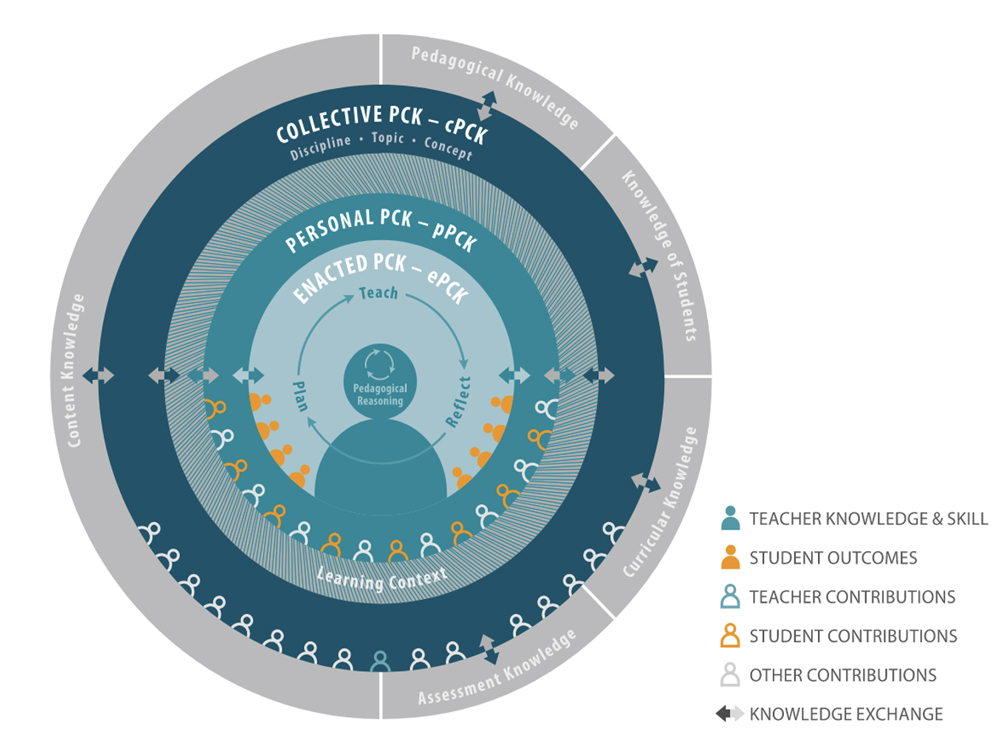
As we move into a specific learning context, the inner circles on the RCM represents each teacher’s PCK, personal PCK (pPCK) and enacted PCK (ePCK). It’s important to note that the RCM includes two-way arrows between each of the concentric circles; these indicate how PCK develops both from an outward-in and from an inward-out direction. On the one hand, teachers’ PCK develops as they draw on their knowledge from the various outer circle domains, as well as the knowledge shared with them from subject-area colleagues. On the other hand, teachers’ PCK also develops from the other direction, from the inside of the circle outward, as teachers pull from their wisdom of practice.
Research on teacher PCK suggests that it tends to operate differently within teachers at the level of pPCK versus ePCK. At the enacted level, teachers tend to use their PCK more intuitively. PCK researchers have borrowed language from Schön (1983) to describe ePCK as a form of knowledge-in-action. Much like an experienced emergency room doctor can make quick, intuitive decisions in the heat of a medical emergency, the expert teacher can read the room, recognize student misunderstandings, pivot mid-lesson, and come up with a new example on the spot, seemingly with barely a thought. Again, like the experienced doctor, this tacit knowledge of the expert teacher arises from a rich reservoir of concrete and consolidated knowledge honed from study and experience. This explicit form of PCK is what the RCM identifies as pPCK; it’s described by researchers as knowledge-on-action. The PCK research suggests that the greater a teacher’s explicit pPCK, the more fluid and effective the teacher’s ePCK.
Implications for Teacher Professional Learning
PCK as a theory for teacher professional knowledge also has implications for teacher professional learning (PL). Clarke and Hollingsworth (2002) argue that teacher PL is mediated through two factors, the first of which is “enactment.” While teachers must have content knowledge, pedagogical knowledge, and curriculum knowledge, the formation of their PCK requires the crucible of actual teaching practice. Teachers’ knowledge in these different domains, gained from pre-service training or in-service professional development, must be enacted in their classroom teaching practice in order to form PCK.
According to Clarke and Hollingsworth, the second mediating factor for teacher PL is “reflection.” Here, PCK researchers again borrow from the language of Schön (1983) for refinement. While in the mode of teaching a particular topic, teachers tend to engage in reflection-in-action. On this level, they’re reflecting on what’s working and what’s not within a lesson or sequence of lessons in terms of guiding students to understanding. In this reflection-in-action mode, teachers are focused on being teachers, concerned with the learning of their students. Research suggests that teachers often struggle to step outside of this reflection-in-action mode. This is understandable; after all, the job is to teach, and the time demands of the job often forestall much time or cognitive space to do anything else. However, the research suggests that pPCK development requires teachers to step back from the reflection-in-action mode, so as to study their own teaching experience as the object of their learning. It requires that teachers become learners — learners of the teaching craft, studying their own teaching in the mode of reflection-on-action.
This shift to reflection-on-action is not always a natural one. The research literature suggests that it is best facilitated with outside guidance and deliberate protocols. One tool in the literature, developed by Loughran et al. (2004) is called Content Representation (CoRe), a protocol that requires teachers to determine the big ideas of a topic they plan to teach and then consider eight questions that prompt pedagogical reasoning. Researchers have also found that prompted reflection, including from an outside researcher, coach or colleague, and sometimes using video-recordings of the teachers’ own lessons, can support teachers to assume a reflection-on-action stance to consolidate their learning from a recent episode of teaching.
Teachers as Cognitive Actors and Knowledge Creators
Returning to the RCM of PCK as a model of teacher professional knowledge, it’s worth noting the cognitive constructivist assumptions about knowledge, teaching, and learning that undergird the model. The theory of PCK assumes that teachers must attend to student conceptual knowledge structures and employ instructional strategies and subject-matter representations that will guide students to their own constructed understandings. The theory suggests that teachers are also involved in their own knowledge construction. Every day, teachers are creating new knowledge about how to effectively teach specific subject matter to particular students. Teachers generate that knowledge for their own reuse and, by sharing it with colleagues, they can contribute to the broader collective professional knowledge of teachers. Teachers are not mere technicians. They are not just implementers of curriculum, facilitators of methods, transmitters of information, or followers of scripts. Teachers are also not mere AI prompt engineers. Rather, teachers are cognitive actors and knowledge creators — they are professionals.
Resisting That Which Undermines Teaching as a Profession
None of this is to say that teachers should not use generative AI tools, but it is to implore that teachers mustn’t surrender the teacher professional task of pedagogical reasoning. Generative AI can serve as a powerful pedagogical reasoning thought-partner, but teachers must remain in control of that thinking and the knowledge construction that emerges from it. It is teachers who have the insight regarding their own students, their interests, culture, prior-knowledge, and pre-conceptions. It is teachers who can check for their students’ understanding during a lesson, diagnose the gaps, and determine the next appropriate instructional moves. It is teachers who can transform subject-matter into effective representations that will guide their specific students to understanding. If we give up on this cognitive and creative work of teaching, both a source and the outcome of our professional knowledge, our profession will suffer; it may even be lost. More importantly, however, I think we owe it to our students to keep pursuing the professional task of teaching, while pushing back on the forces that undermine it. I believe that thoughtful and reflective teaching, teaching defined by on-going cycles of pedagogical reasoning and action – teaching mimicked poorly by generative AI – contributes to improved student learning.
References
Carlson, J., Daehler, K. R., Alonzo, A. C., Barendsen, E., Berry, A., Borowski, A., Carpendale, J., Kam Ho Chan, K., Cooper, R., Friedrichsen, P., Gess-Newsome, J., Henze-Rietveld, I., Hume, A., Kirschner, S., Liepertz, S., Loughran, J., Mavhunga, E., Neumann, K., Nilsson, P., … Wilson, C. D. (2019). The Refined Consensus Model of Pedagogical Content Knowledge in science education. In A. Hume, R. Cooper, & A. Borowski (Eds.), Repositioning Pedagogical Content Knowledge in teachers’ knowledge for teaching science (pp. 77–94). Springer Nature Singapore. https://doi.org/10.1007/978-981-13-5898-2_2
Clarke, D., & Hollingsworth, H. (2002). Elaborating a model of teacher professional growth. Teaching and Teacher Education, 18(8), 947–967.
Loughran, J., Mulhall, P., & Berry, A. (2004). In search of Pedagogical Content Knowledge in science: Developing ways of articulating and documenting professional practice. Journal of Research in Science Teaching, 41(4), 370–391. https://doi.org/10.1002/tea.20007
Schön, D. A. (1983). The reflective practitioner. Routledge. https://doi.org/10.4324/9781315237473
Shulman, L. S. (1986). Those who understand: Knowledge growth in teaching. Educational Researcher, 15(2), 4–14.
Shulman, L. S. (1987). Knowledge and teaching: Foundations for a new reform. Harvard Educational Review, 57(1), 1–22.
Nathan Haines has been a secondary English and social studies teachers for 18 years, 13 of which have been in international schools in East Africa. Nathan was most recently teaching at the International School of Kigali, but will be teaching at the International Community School of Addis Ababa for the 2026-27 school-year. Nathan is an Doctor of Education (Ed.D.) candidate in Curriculum and Instruction and has stepped away from teaching for the 2025-26 school-year to complete his Ed.D. capstone research. His research focuses on a model of teacher professional learning via reflective practice with a collegial thought-partner.