The following article is adapted from a student presentation given at the AI in Education Conference, Haileybury Astana School.
Even though I was pretty shocked the first time I noticed that, UNICEF reported that 21% of parents in Kazakhstan buy their child a phone when they turn 4. And as artificial intelligence (AI) gets more integrated into these devices, these kids won’t just grow up with screens; they’ll grow up with AI. And this got me thinking, what will our world look like in 10 years, when so much of what we’re used to doing now is automated by smart machines? And do we risk losing the important aspects of our lives?
Today, I’ll explore two key challenges that students face with AI in learning and personal lives:
And then, we’ll reflect on how these habits impact students’ lives, and what schools can do to support us.
But before that, I want to ask you a question. Who has used AI to brainstorm or write, or maybe to draft emails, or organize your thoughts? We all do it. It’s efficient. It saves time. And in the age of AI, that seems like the smartest thing to do. But on a random Tuesday, as I was crafting a 54th email with ChatGPT, I asked myself a question, what happens if we get used to these tools? And are young people more vulnerable to that than older groups?
Let me tell you a story. In November, I had to write this big coursework for history. The topic was German hyperinflation. First thing I did? I opened ChatGPT. I asked it to outline my essay structure, and boom, within seconds I had a perfect, logical plan. So, I got my structure ready, I had a huge pile of history books near me, and I was ready to write. But as I put my fingers on the keyboard, I realized that I had no idea what I was going to write about. So I went back to ChatGPT, and I asked it to give me some more instructions. And so it did. But soon I found myself unable to do the work without AI’s help, until I finally decided to start over and do my own planning. So, it turns out that heavy reliance on AI tools that make you more “productive” in fact makes you less smart and more dependent.
A study published in January 2025 surveyed 666 people of different demographics. It revealed that young people are more likely to become dependent on AI tools. And this happens because we can develop a habit from an early age to skip tasks like research or reading carefully. And this further leads to “cognitive offloading.” Cognitive offloading, in general, can be beneficial. It is like when you physically can’t memorize the long surnames of all of your 55 students, so you store them on your computer. However, the problem with cognitive offloading is that AI’s impressive abilities allow us to offload or skip tasks that we physically can perform, like brainstorming. Yet, we still don’t do them because we claim to “save time” and “be productive.”
And if we get used to relying on technology for mental tasks—like navigation, brainstorming, or decision-making—even if they are time-consuming or seem “small,” we may face long-term cognitive decline. And this raises the risk of early dementia, as the researcher of Alzheimer’s disease Dr. Anne McKee outlined.
Now, some of you might say, “But crafting prompts for AI also takes critical thinking!” And you are absolutely correct, but prompt crafting is a skill and it requires an understanding of AI and its limitations. And here’s the reality I’ve seen, most students aren’t trained to prompt thoughtfully. We don’t learn to question AI or to turn it into a tool to challenge our thinking. Rather, it is seen as a shortcut in learning and a cheating tool. And that’s where the problem begins.
If students grow up surrounded by AI tools but aren’t taught how to use them intentionally, they’ll struggle to stop themselves from using AI every time it makes learning faster or easier. And over time, this constant reliance doesn’t just make learning shallow, it can actually weaken key mental skills. But to keep the true meaning of learning and stay independent in the age of AI, we need to have AI awareness, critical thinking, and great mental strength.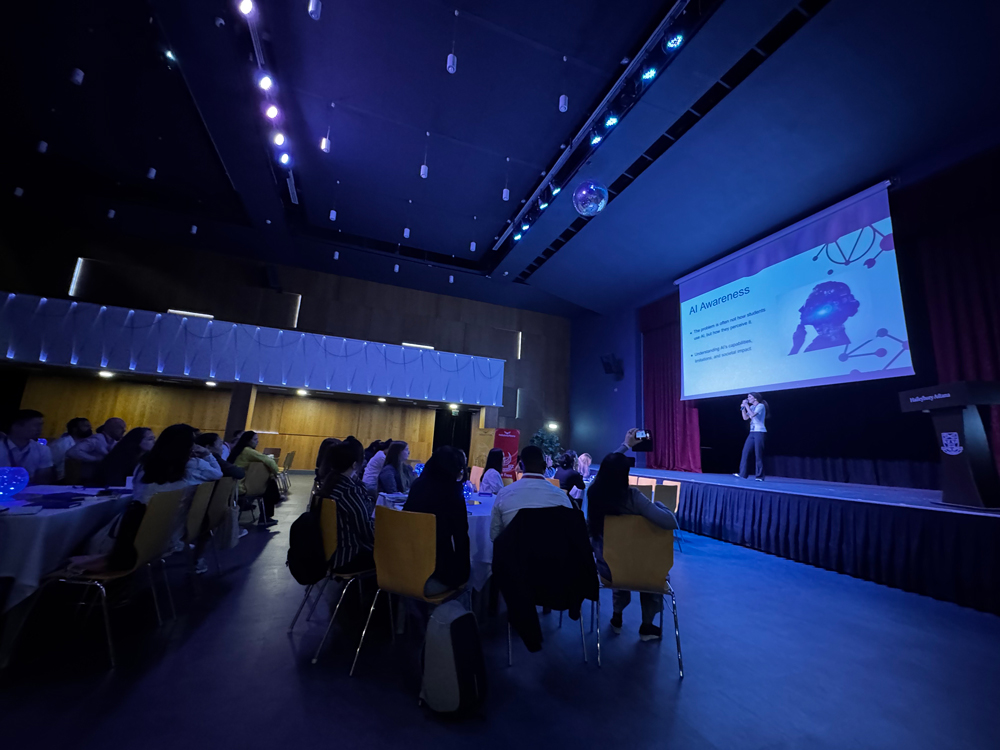 AI in Education conference.
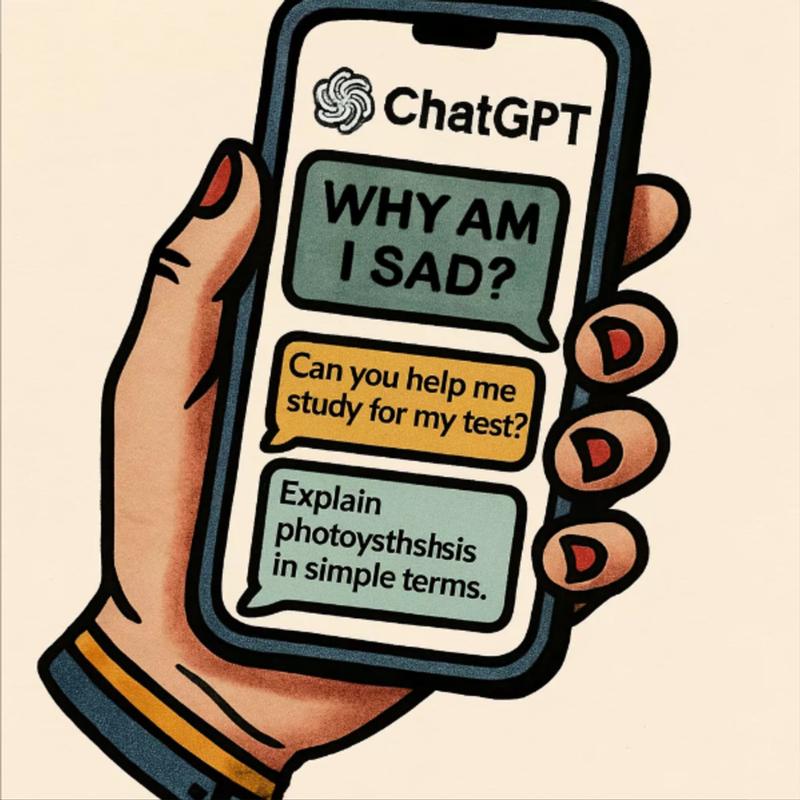
Remember when I said, at the very beginning, that I would talk about two key problems? Well, before we dive into the latter, imagine a school classroom on a Monday morning in winter. It’s cloudy. It’s cold. You’re weighed down by academic pressure, self-doubt, and loneliness. You don’t feel like talking to anyone; your problems seem too small to share. But inside, you feel terrible. So, you open ChatGPT and type out your feelings. It responds in seconds. It listens. It doesn’t judge. A few days later, you’re spending lunch breaks having daily therapy talks with AI. But somehow, you feel better. You feel like a human again.
Today, more and more students turn to AI not just for productivity or learning, but for emotional support. 15% of students globally now use AI chatbots to talk about their feelings, fears, and personal problems. But even if it might sound creepy for some, AI can actually be beneficial for mental health. It provides personalized support and is always available. This allows you to be honest with yourself, reflect on your feelings, and even help you solve some of your problems. Yet, let’s think together, what happens if students rely on AI for emotional support way too much? And what do we lose in return?
Now, let’s return to the Monday morning in winter we pictured earlier. Without realizing, you start talking to the chatbot every single day. When you feel overwhelmed, upset, or in conflict, you think to yourself, “I need to talk to ChatGPT.” You stop opening up to friends, parents, or any other person. While you feel understood and heard by AI, you simultaneously get lonelier.
A couple of months ago, that person was me. And what I learned from this experience is that it is easy to rely on AI way too much for emotional support, especially if you’re emotionally vulnerable or new to this kind of help. And I wasn’t the only one who faced it. Students globally who use AI for emotional support are 25% more likely to become emotionally attached to it, and less likely to reach out to real people. In fact, we’re already facing a global epidemic of student loneliness, worsened by overuse of digital tools. AI risks becoming a substitute for human connection, when what we really need is more of it. And that has its consequences.
When we prefer AI to real people, we lose social skills. For example, meet Replika. Replika is an AI therapist-chatbot. Last year, a study of almost 500 Replika users revealed that using AI as your friend damages your ability to engage in real relationships. And I can understand that; talking to an AI is not the same as a real person. It doesn’t require you to compromise, empathize, or truly listen. Real connection takes effort, and if we stop practicing it, we forget how to do it. AI affects students today not only academically but emotionally. School isn’t just a place to learn facts; it’s where we grow into ourselves, build relationships, and find our place in society. Yet, AI has the potential to replace that for students.
So, what does this all mean? The majority of students worldwide have easy access to AI tools. These tools can support learning and wellbeing, but the danger comes when they’re overused and poorly managed. And that danger gets even worse if students form these habits early. Over time, it can lead to cognitive decline, and emotional detachment from society.
So, maybe, as we move deeper into the age of artificial intelligence, the question isn’t just how we integrate AI tools or limit them. Maybe, it’s also about the mindset. It’s about how we prepare young minds that are not just digitally skilled but emotionally resilient. The minds that see AI not as a shortcut in learning or the only friend but as a tool—a flawed, biased, potentially smart, but imperfect machine. No more than that. And the minds that have the courage to ask: Why am I using AI? To simply polish my work? Or to grow the skills, challenge myself, and understand myself more? If students can answer that truthfully, they’ll stay loyal to learning and real interaction, even when AI offers an easier path.
And this brings me to the final question: what can we do?
Teach AI Awareness
Many students today believe that, no matter what AI does, it is better than them. And it is one of the reasons why I, my friends, and the majority of students constantly turn to AI to polish their writing, ideas, or essays instead of trying ourselves. One of the ways to break this idealistic image of AI is to teach AI awareness. It normally includes understanding AI’s mechanisms, benefits, and limitations. This knowledge gives students power because they are able to critically evaluate AI.
Actually, this is something I’ve tried doing. Let me show you an example. At my school, I created a project called media, information, and technology literacy (MIT Literacy). In November, I conducted research among Year 7 students in my school. I did a survey, interviewed some of the students, and asked two teachers to do the “AI tasks” with their students. The results revealed that many younger students didn’t fully understand how AI works, how it shapes their thinking, and how it influences our society.
So to solve this problem, I’ve designed seven lessons of MIT Literacy to help students become more aware and more critical of AI technology, helping them use these tools safely, responsibly, and effectively. My goal wasn’t just to “teach AI,” but to build the skills that AI can’t replace, like critical thinking. For a whole month, we explored mechanisms and limitations of AI, like bias and hallucinations, and reflected on AI’s impact on our society. We learned how to stay media-literate in the age of AI bias, how to stay safe in the age of AI scams, and how to identify real information in the age of AI deepfakes.
But I will be honest with you, my group of students was quite small; there were only 10 of us. But through interactive lessons, I saw a real change. Students felt more confident with AI and were able to question it critically. I’m still actively leading this project, and I am looking to learn from other schools too.
The Purpose of Learning
Remind students the purpose of their learning. When we, students, sometimes see no purpose in what we learn in class, we are more likely to reach out to AI to do the work for us. While I understand that it is physically challenging to monitor the motivation and work ethic of every single student, I still believe that if teachers emphasize the real-world applications of the skills we learn in class, more students will be motivated to study not only for the sake of the grades but for the actual skills.
Social Connection and Creativity
Lastly, embrace social connection and creativity. If students today learn to value flawed yet true creativity instead of average perfection, they will be less likely to use AI and will feel more confident to discover their own academic pathways. Speaking of social connection, while this may not directly prevent students from using AI for emotional support, it can still give students a sense that their feelings matter beyond AI algorithms. Sometimes, this might even mean taking five minutes off your lesson to ask your students, “How are you feeling today? Why do you feel this way?” Or, if they are hesitant, ask them to reflect in silence or on the paper. But this will already give them independence to reflect on their emotions and connect with their peers.
Talking about AI in class, valuing creativity over perfection, and amplifying students’ voices might not have been something we had in schools 10 years ago, but it is something we need to have now to compete with AI. AI has the potential to change our lives, starting with education and ending with our personal lives. And it is extremely fast at learning. Its intelligence is equivalent to an individual who reads over three trillion words in a month without sleeping or eating. Honestly, it is quite scary to think about our world 10 years from now and whether we will still be able to call it ours.
But I sincerely believe that if our education system raises critical, independent, and connected individuals who stay resilient and true to their values, not a single machine will be able to beat us.
Naima Umiryayeva is a Year 12 student at Haileybury Astana in Kazakhstan.