

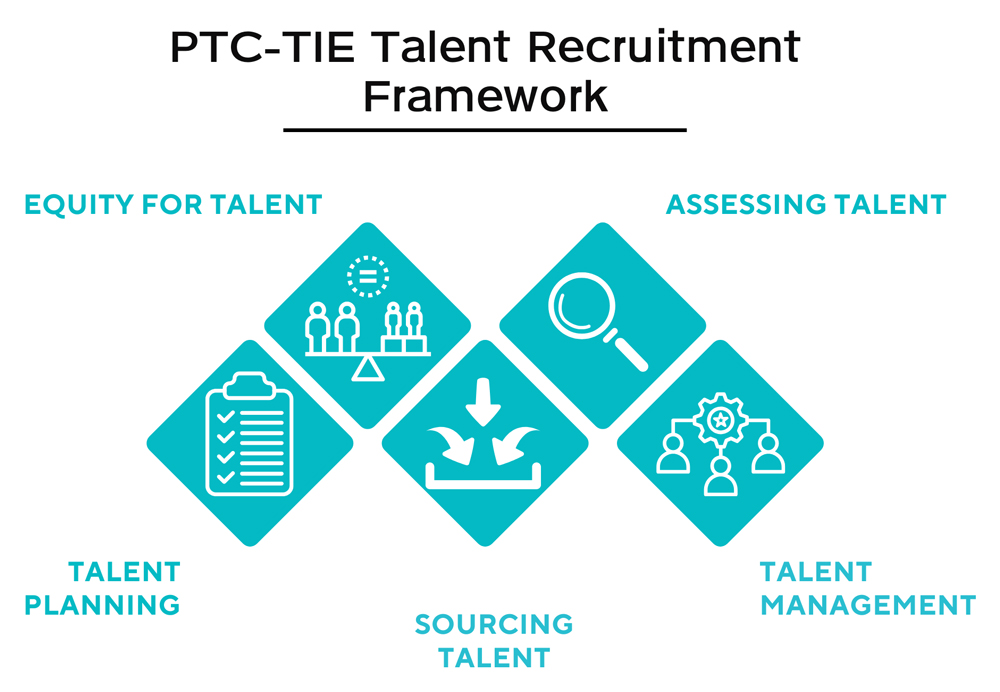
The Talent Recruitment Framework, created by the Principals’ Training Center (PTC) and TIE, encourages a systemic view of recruitment, connecting hiring and professional growth directly to student outcomes through four key domains: acquisition, acceleration, advancement, and assessment. When schools approach recruitment through this lens, hiring becomes less about filling positions and more about shaping the culture and future of learning.
Drawing on our recent Leading Recruitment in International School course, offered through the PTC, here are five evidence-based strategies that help schools identify, support, and retain the best educators, those who not only inspire students but also elevate the profession.
1. Hire for Demonstrated Impact, Not Interview Polish
Anyone can prepare for an interview, but not everyone can show authentic evidence of impact. The Measures of Effective Teaching (MET) Project found that combining multiple indicators: classroom observations, student feedback, and evidence of student learning predicts future effectiveness more accurately than any single measure (Kane et al., 2013). This aligns with global findings that the most effective teachers are those who can demonstrate learning gains across diverse and multilingual contexts (Grissom, Egalite, & Lindsay, 2021).
In international schools, where students often arrive with varied curricula, language backgrounds, and learning profiles, hiring must focus on authentic teaching impact rather than interview polish or familiarity with one system. Evidence of practice, such as annotated student work, lesson reflections, or short video segments offers a more equitable and accurate picture of how teachers support learning across cultural and linguistic boundaries.
In hiring, look for candidates who:
Replace “Tell me about your teaching” with “Show me your teaching.” Invite lesson videos, samples of student work with teacher feedback, or brief written reflections that illustrate growth. Use structured rubrics to evaluate these artefacts consistently. A portfolio-based, evidence-driven approach ensures fairness, values diversity of experience, and focuses hiring on what matters most; teachers’ demonstrated ability to help all learners thrive.
2. Look for Teachers Who Hold High Expectations for All Learners
The Opportunity Myth (TNTP, 2018) highlighted a reality familiar to many international educators: too many students spend large portions of the school year engaged in work below their true level of ability. This gap is especially evident for multilingual learners and students from historically underrepresented or transient backgrounds.
In international contexts, where classrooms often include a wide range of cultural, linguistic, and academic experiences, maintaining high expectations is inseparable from providing responsive support. Research shows that when students, whether learning in a second or third language, adjusting to new curricula, or bridging academic transitions are offered access to challenging, grade-level learning with appropriate scaffolding, they meet and often exceed expectations (Grissom, Egalite, & Lindsay, 2021; Lucas, Dixon, & Owen, 2025).
In hiring conversations, look for candidates who:
Ask candidates to share a unit plan or example of how they move diverse learners toward mastery. Probe how they respond when a student struggles: do they scaffold learning through language and concept support, or do they lower the bar? Teachers who maintain high expectations while adapting instruction are those who help international school students of every background and language to reach their full potential.
3. Build a Faculty That Reflects Your Students
Diverse teaching teams don’t just bring representation, they bring strength. Research across education systems shows that teacher diversity enhances student engagement, belonging, and learning outcomes for all students, while enriching professional collaboration and innovation in teaching (Grissom, Egalite, & Lindsay, 2021; Lucas, Dixon, & Owen, 2025).
In international schools, where classrooms include students from many linguistic and cultural backgrounds, diverse faculties signal to students that every identity and perspective is valued. Teachers with varied cultural and linguistic experiences are often more adept at designing inclusive curricula, addressing bias, and supporting multilingual learners and students new to international education.
In hiring, look for candidates who:
To build such teams, broaden recruitment networks, use structured rubrics to reduce bias, and form diverse hiring panels. These intentional systems turn diversity from aspiration into practice, ensuring that inclusion is not only reflected in who is hired, but also in how schools grow, learn, and lead together.
4. Hire for Coachability and Growth
Even the most experienced teachers should be learners first. Research shows that sustained instructional coaching and feedback cycles lead to measurable improvements in teacher effectiveness and student achievement (Kini & Podolsky, 2016; Grissom, Egalite, & Lindsay, 2021). In international schools, where educators work across curricula, cultures, and languages the ability to adapt, reflect, and grow is often a stronger predictor of long-term success than prior experience alone.
In hiring, look for candidates who:
During interviews, listen for teachers who describe challenges as learning opportunities and can name concrete ways they have improved. Once hired, sustain that mindset by embedding short feedback loops, peer coaching, and structured reflection into the professional culture. In globally diverse schools, coachability isn’t a nice-to-have, it’s how educators continually refine their craft to meet the evolving needs of every learner.
In the end, evidence-based hiring isn’t just about better interviews, it’s about coherence, fairness, and collective responsibility for learning. As Peter Senge reminds us, “Vision without systems thinking ends up painting lovely pictures of the future with no deep understanding of the forces that must be mastered to move from here to there.”
Evidence-based hiring is systems thinking in action. It’s how we connect our vision for learning to the people who will make it real, our teachers.
References
Chetty, R., Friedman, J. N., & Rockoff, J. E. (2014). Measuring the impacts of teachers II: Teacher value-added and student outcomes in adulthood. American Economic Review, 104(9), 2633–2679. https://doi.org/10.1257/aer.104.9.2633
Gershenson, S., Hart, C. M. D., Hyman, J., Lindsay, C. A., & Papageorge, N. W. (2022). The long-run impacts of same-race teachers. American Economic Journal: Economic Policy, 14(4), 300–342. https://doi.org/10.1257/pol.20190573
Grissom, J. A., Egalite, A. J., & Lindsay, C. A. (2021). How principals affect students and schools: A systematic synthesis of two decades of research. The Wallace Foundation. http://www.wallacefoundation.org/principalsynthesis
Hattie, J. (2011). Visible learning for teachers: Maximizing impact on learning. Routledge.
Kane, T. J., McCaffrey, D. F., Miller, T., & Staiger, D. O. (2013). Have we identified effective teachers? Validating measures of effective teaching using random assignment. MET Project Research Paper. Bill & Melinda Gates Foundation.
Kini, T., & Podolsky, A. (2016). Does teaching experience increase teacher effectiveness? A review of the research. Learning Policy Institute. https://learningpolicyinstitute.org/our-work/publications-resources/does-teaching-experience-increase-teacher-effectiveness-review-research
Lucas, K., Dixon, K., & Owen, A. (2025). The influence of teacher diversity on student achievement and classroom inclusivity. Journal of Social Science and Education Policy. IU International University of Applied Sciences. https://www.researchgate.net/publication/394820123
TNTP. (2018). The opportunity myth: What students can show us about how school is letting them down—and how to fix it. TNTP. https://tntp.org/publications/view/student-experiences/the-opportunity-myth
Gallup. (2018). State of America’s schools: The path to winning again in education. Gallup, Inc.Stacy Stephens is the Director of TIE.