
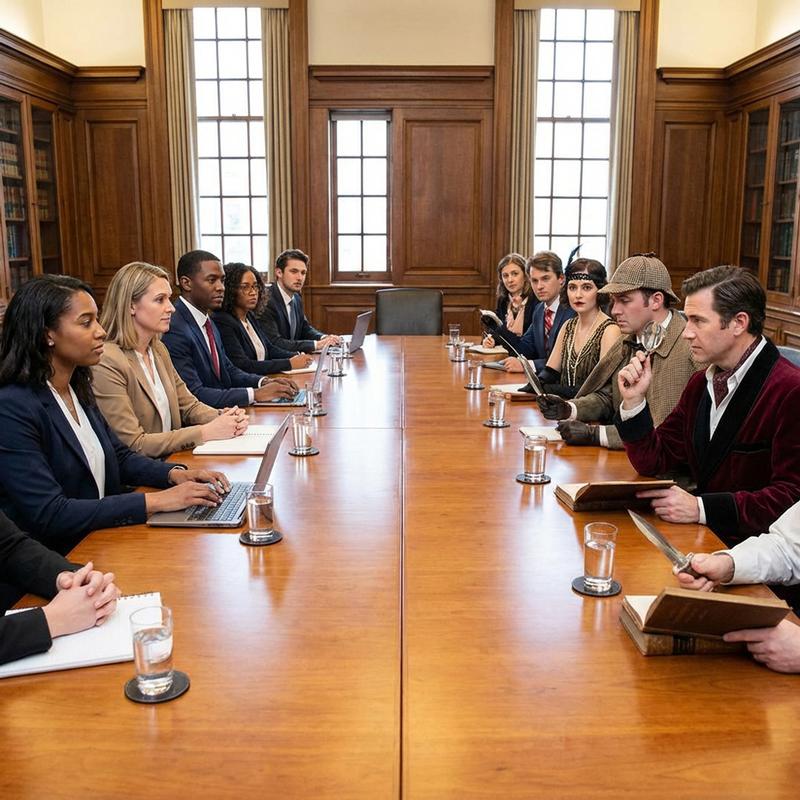
Both will have carefully curated guest lists. Everyone will receive a role. Dietary restrictions will be noted. Participants will receive documentation in advance, some of it confidential, linked directly to the purpose of the evening. Expectations for behavior and interaction will be clear. On the night itself, we will each play our part, following a shared script that allows the evening to unfold smoothly. With that preparation, I hope we will leave with a sense of enjoyment, connection, and an evening well spent. Perhaps there will even be puns. Justice, I trust, will be served.
The first party is a murder mystery.
The second is a Board meeting.
Over time, I have learned that effective Board meetings require just as much structure, forethought, and intentionality as a well-run murder mystery dinner.
Continuity in a World of Turnover
At this particular Board meeting, we will gather four newly elected Board members, four continuing members, and—through appointment—a small number of additional trustees to complete the Board. Together, this hybrid group will select a new Chair, Vice Chair, Treasurer, and Committee Chairs. We will review roles and responsibilities, agree on norms of collaboration, and—if the evening goes according to plan—leave with a shared understanding of how our individual roles contribute to advancing the school’s Mission, Strategic Plan, and Campus Master Plan.
By the end of the evening, this newly constituted group will need to have developed sufficient clarity and collective trust to make decisions with long-term consequences for our school community. The next month, they will begin deliberations on the following year’s budget. They will also collectively serve as my supervisor and employer, and in six short months, they will be asked to conduct an appraisal of my work.
Unlike the murder mystery, I hope no heads will roll.
Structure as a Gift
This month, my Board of Directors will elect my fourth Board Chair in the five years I have served as Head of Windhoek International School (WIS). In international schools—where Boards are volunteer-based, parent-elected, and shaped by family mobility—this level of turnover is not unusual. What I am learning, however, is that the greatest gift I can give each incoming Chair is not only goodwill, institutional memory, or constant availability, but structure.
That insight comes from Priya Parker’s book The Art of Gathering, in which she reminds us that “Gatherings crackle and flourish when real thought goes into them, when (often invisible) structure is baked into them, and when a host has the curiosity, willingness, and generosity of spirit to try.” People do not feel they belong because a gathering is informal. They feel they belong because the purpose of the gathering is clear, its roles are defined, and its expectations are explicit.
In governance, this lesson is profound. Clearly detailed Board manuals, well-articulated roles, and shared appraisal frameworks do not constrain Board Chairs and trustees; they liberate them. They offer each new Board member not just a seat at the table, but a role at the party—one that provides guard rails for leaders to bring their true selves to the table, with enough structure to ensure that the school’s culture and strategic direction will endure.
The Power of Protocols
At Windhoek International School, we draw on strategies from Thinking Collaborative’s Adaptive Schools resources to provide structure not only for roles and responsibilities, but also for how we think together. These protocols give shape to conversation, especially when decisions are complex or values-driven. Assigning Board members to be “fractal partners” has had the added bonus of one Board member affectionately referring to me as “Snowflake!”
For example, when faced with a strategic-level question of whether to prioritize a new Design Lab or a new Sports Field—both identified in our strategic plan, but we only have enough money for one or the other—we intentionally structure the discussion. Using strategies and moves from Adaptive Schools and School Reform Initiative, Board members are assigned as thinking partners and then asked to adopt deBono’s Six Thinking Hats. This ensures that multiple perspectives are explored systematically, reducing the risk of groupthink and efficiently creating space for every voice at the table. Once again, structure allows the Board to engage the question with both rigour and inclusivity.
From Control to Stewardship
When we structure meetings with such protocols, we ensure that everyone has a role at the party. Conceiving the role of School Head and Board Chair as co-hosts of a gathering reshapes how we think about leadership and governance more broadly. International schools are not linear organizations. Student outcomes unfold over years. Strategic initiatives span accreditation cycles. External forces—enrollment volatility, regulatory change, geopolitical uncertainty—sit well beyond the control of any single leader.
In such contexts, governance models that assume tight control or simple cause-and-effect relationships will inevitably strain. When expectations are built on a false sense of predictability, I have learned that Boards can find themselves repeatedly reworking frameworks or struggling around wordcrafting policy, rather than attending to the deeper work of direction, strategy, and coherence. Tension arises not because expectations for excellence are too high, but because the design of the decision-making tool does not reflect the nature of the work.
Headship and international school governance, in practice, is less about delivering short-term outputs and more about holding direction—ethically, strategically, and relationally—over time. Good governance endures not because of policies or people alone, but because relationships are protected by clarity, norms, and shared responsibility. At WIS, these have been gathered into a publicly published Board Manual. These governance structures give people the rules and roles for the party.
Conclusion: Two Successful Parties
Both parties I will attend this month will, I hope, be successful, not because they are identical but because they are well-hosted. In each case, the host has done the quiet, often invisible preplanned work of providing structure: defining purpose, assigning roles, setting expectations, and creating conditions in which people can participate fully and confidently.
Whether we are gathering around a dining table or a Board table, structure is what allows people to belong. It gives continuity in the face of turnover. When the structure is sound, then even as people come and go, everyone knows not just that they are invited, but how they belong and what part they are there to play. Relationships of trust are formed, and everyone can play their role with confidence.
Ethan Van Drunen has two decades of experience in day and residential international schools in Namibia, India, Myanmar/Burma, and Serbia. As the Head of Windhoek International School since 2021, his emphasis has been on strengthening inquiry-based learning, staff and student wellness, inclusion, strategic planning, outdoor education, operational excellence, teaching literacy, and mission-focused governance.